
Count house pours
Sealed backups plus an open fill from 0 to 1. Same order every close.
House pours, speed rail, open bottles
House vodka, gin, rum, whiskey, and tequila hide more dollars than the dusty call brands. Count the rail like it is the business, because it is.
14 days free · No credit card · Plans from $59/month
Last updated
Count each house pour as sealed bottles plus an open fill from 0 to 1, then compare that to recipe-aware POS sales. ExactPour is built for that rail. Start a 14-day trial or compare plans on /pricing. The broader liquor pillar is /liquor-inventory-management.
Sealed backups plus an open fill from 0 to 1. Same order every close.
Interchangeable house bottles share one slot so a new case sticker does not break the week.
Well vodka soda and the rest. Then compare poured versus sold in dollars.
The problem
Well vodka can outsell every call brand and still get rounded to a shrug at close.
Two well vodka UPCs that pour as one slot need a marriage, not two rows that never match sales.
A quarter ounce extra on the house pour is the largest leak in most casual rooms.
The solution
Fill levels, barcode identity, well-drink mapping, and variance in dollars on the SKUs that actually move.
Scan once, count everything.
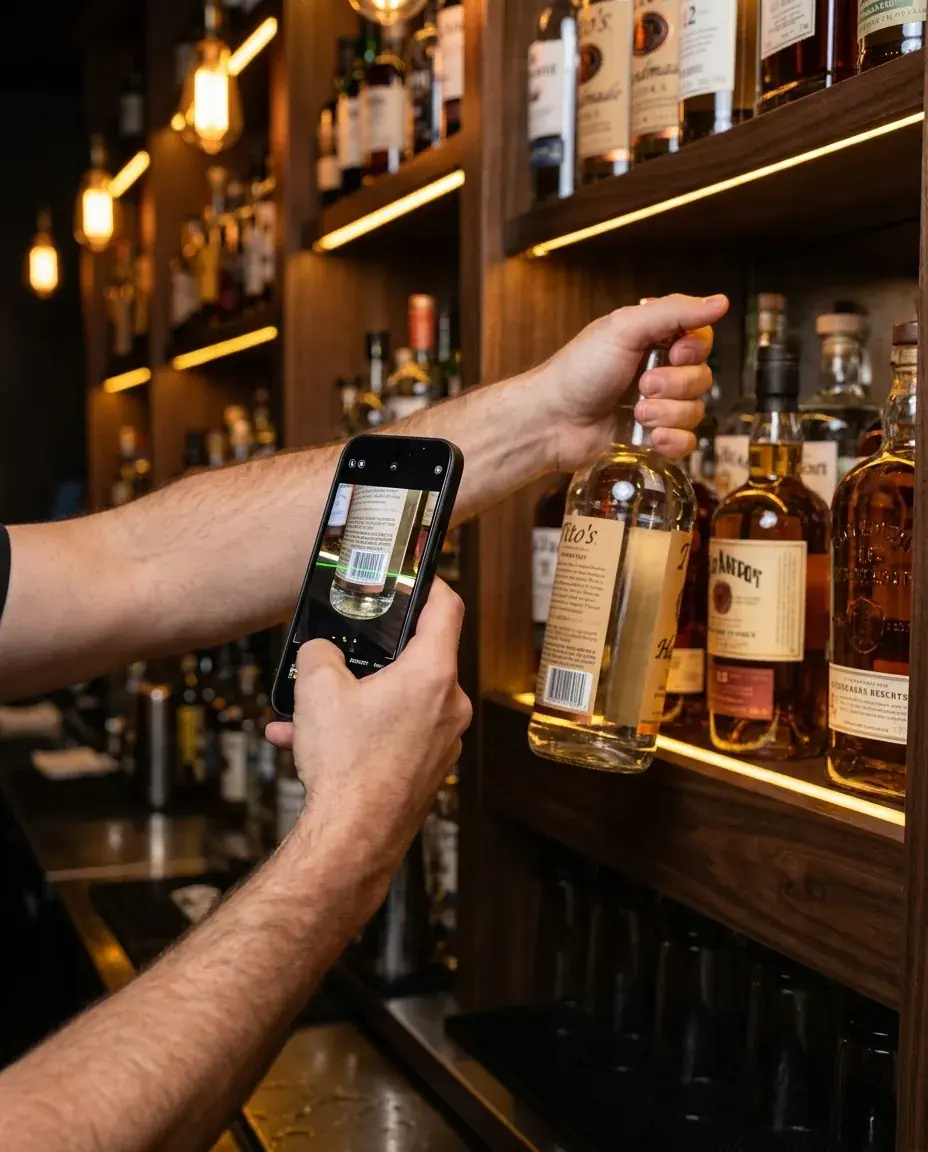
Scan any UPC with a phone or handheld, tap a fill level, and ExactPour aggregates scans per product and auto-computes volume in real time. Undo and inline edits keep counts honest.
Partial bottles, not just whole counts.
Every scan records a fill level from 0 to 1 and computes volume as size times fill, so you track real stock instead of rounding to the nearest bottle.
Group interchangeable SKUs.
Group products like "Well Vodka" or "Seltzer Variety" so any member barcode counts as one slot. Per-location, database-enforced, and self-cleaning.
Toast, Square, Clover, and GoTab are live.
Connect Toast, Square, Clover, or GoTab to a location. Menus and sales import on a schedule or when you ask. POS credentials are stored encrypted.
Surface the gaps. Explain them.
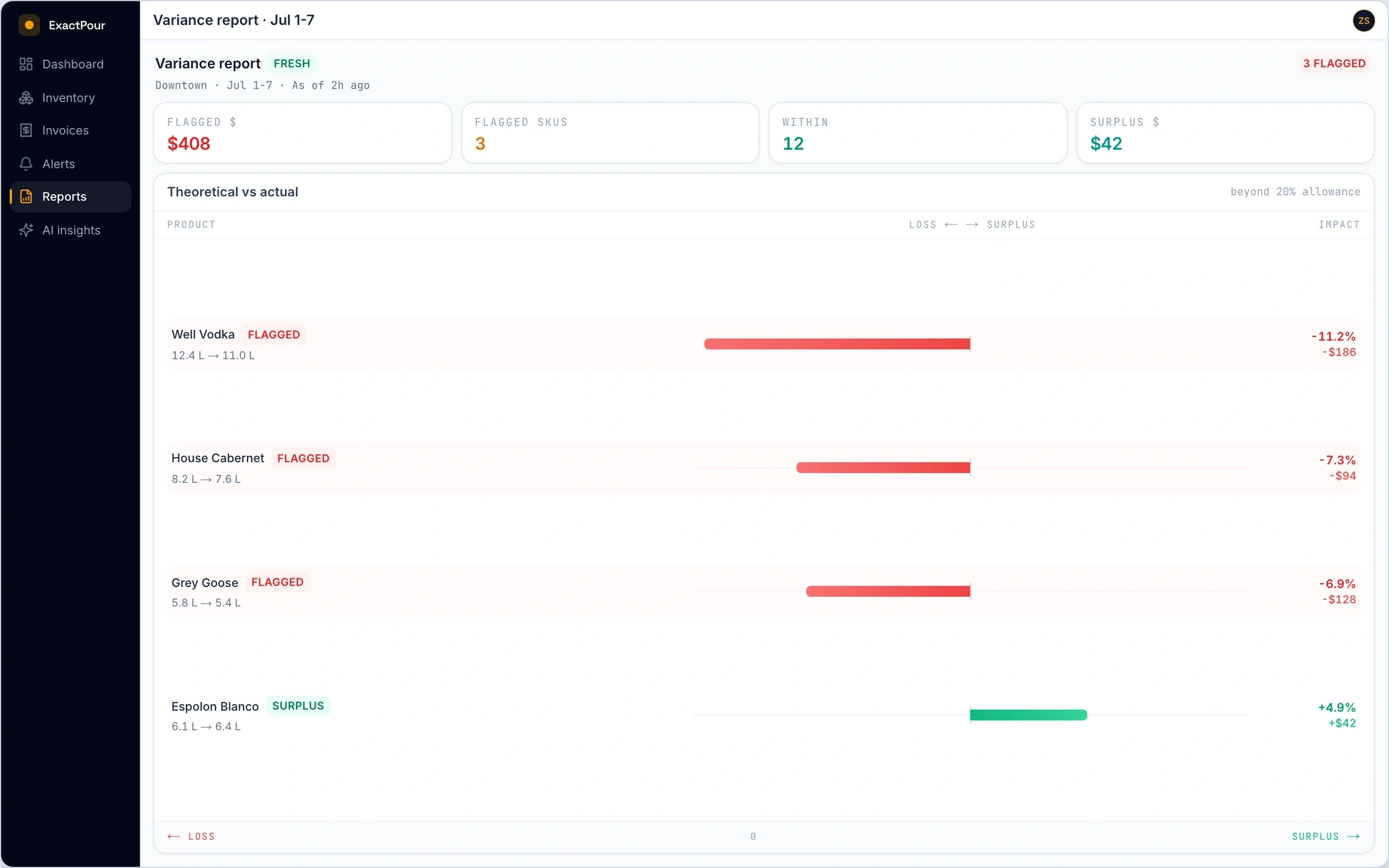
Items that drift beyond tolerance are flagged (>10% warning, >5% info). Close each out with a reason (breakage, theft, over-pour, measurement error) and notes.
Know the cost of every drink.
Cost per serving is computed from live bottle pricing and recipe ounces, so you see pour cost and margin per menu item and can price with confidence.
Integrates with the POS you already run
Sales sync nightly · No rip and replace




Well variance
The SKUs that moved, priced, with a place to reason-code.
Compare
| Capability | ExactPour | Rounded well guesses |
|---|---|---|
| Open house pours | Fill 0 to 1 | Full / empty |
| Swapped well UPCs | Married slot | Broken rows |
| House drink mapping | ||
| Overpour dollars | Per SKU | A feeling |
Open house pours count as real volume, not rounded bottles
Interchangeable well SKUs can share one slot
House drinks map to the rail that actually poured them
Overpours show up as dollars on the product that leaked
The back bar can wait until the rail is honest
liquor inventory management covers the full liquor room. This page is only the rail: house pours that leave in ounces every night. Buyers search well liquor inventory because the generic liquor page still sounds like a storeroom. A well is not a storeroom. It is an open set of bottles that multiple people touch, in the dark, at speed.
Casual bars, pubs, and sports bars live here. Award cocktail bars with measured specs and wine-only rooms do not. If your house pour is the drink, this is the job. pubs and sports bars describe those rooms. Keep the liquor pillar for the broader program.
Walk the speed rail in the same order every time. Scan or identify each house SKU. Record sealed backups on the rail or in the well ice as whole units. Record the opener as a fill from 0 to 1. Do not round to empty, half, or full unless that is the only training the team will keep, and if you do that, write it down. liquor inventory template is the paper version of those columns. bar inventory counting basics is the method.
Unit cost on well vodka looks small and is not. A dollar move on a house pour hits every well drink. Invoice capture keeps that cost honest. bar invoice management is that job. Pour cost on the well is pour cost control. Shrinkage on the well is how to reduce liquor shrinkage.
Distributors swap well vodka UPCs. A sheet that treats each bottle as a unique forever SKU will never match sales. ExactPour marriages group interchangeable well products so any member barcode counts as one slot. That is how a house pour stays countable when the case sticker changes.
Then map the POS items that deplete that slot. A well vodka soda, a vodka cranberry, a splash in a pint. Toast rooms should read toast liquor inventory before they interpret a short well as theft. Unmapped house drinks are the most common fake shortage in ExactPour onboarding.
Call brands get watched because they are expensive per bottle. Well brands leak because they are cheap per bottle and expensive per night. A heavy house pour across a Saturday will outperform most back-bar theft. Coach the rail first. Jiggers and controlled pourers are tools after you have a week of numbers, not a punishment on day one.
Document comps that come off the well. Pubs especially. Hospitality that never hits a ticket is the other well leak. The playbook stays how to reduce liquor shrinkage. The product page for the same leak is bar shrinkage prevention. This page stays on counting and mapping the rail itself.
Once the well is honest for two weeks, add the back bar and the liquor room. Doing the whole building first is how closers quit the program. Sports bars can add game-day call brands in week two. Pubs can add the Irish whiskey that actually sells. Dusty bottles can wait. Dead stock is a later report, not a first-week task.
Groups should get one well honest in one room before they roll out. multi location bar inventory is the next page, not the first. The category view remains bar inventory software.
Scan the well. Connect the POS. Map house drinks. Close two nights. Review well SKUs only. If those dollars make sense, you have a system. If they do not, fix mapping before you buy cameras. New accounts get one 14-day Pro trial. Nothing is charged unless you add a payment method. Starter at $59/month adds POS. See pricing.
Still on a sheet? bar inventory spreadsheet alternative. Still deciding the room? bars, pubs, sports bars. This page is the rail.
We will not pretend a well count is laboratory precise. Visual fill is an estimate. Shared bias is the goal. Spot-check the house pour that dominates unexplained dollars more strictly if you need to. We will not invent an industry well-shrinkage rate for your rail. Measure your gap.
We will also not turn this into another liquor-inventory synonym. If the search was really for the pillar, liquor inventory management is waiting. If the search was the rail, you are on the right URL.
A well is a geography. The same vodka can sit in the rail, in the ice well as a backup, and on the liquor room shelf. If three people count those as three mysteries, you will invent product. Write the rule: rail opener is a fill, rail backups are sealed units on that SKU, liquor room is sealed units on the same SKU. ExactPour aggregates scans by product. Scanning the backup as a new mystery bottle is how wells get fictional.
Walk left to right every time. Skipping a hole in the rail because it looks empty is how a dry well vodka becomes a surprise mid-Saturday. Empty is a fill of 0, and it is information. It means you either sold it, moved it, or never restocked. Monday can work with that. Monday cannot work with a hole you pretended was not there. liquor inventory template uses the same sealed-plus-fill columns if you are still on paper.
A well drink recipe that says one and a half ounces while the team pours a heavy two will look like shrinkage forever. Before you coach theft, pour a water test with the house bottle and the house glass. Write the spec you actually want. Then map that spec. Then count. Then coach. A jigger is a training tool after that sequence, not a substitute for it.
If you change the house spec, change the recipe the same day. Toast and Square will keep selling the item. ExactPour will keep depleting the old ounces until you edit the map. That lag is how well liquor inventory gets a bad reputation. The rail did not lie. The recipe did. toast liquor inventory covers the Toast half. pour cost control covers the price of the new spec.
Friday tickets show 160 well vodka drinks at one and a half ounces, or 7.1 liters if the recipe is true. The rail started at 10 liters equivalent and ended at 2.2. Receiving was one liter from the liquor room, logged. Actual usage is 8.8 liters. The gap is 1.7 liters. That is a heavy pour, a bad map, or undocumented comps. Tuesday tickets show 40 drinks, 1.8 liters explained, and a 0.2 liter gap. The Friday gap is the meeting. The Tuesday gap is noise. Weekly blended percentages hide that shape.
A sports bar or pub that only looks at month-end liquor cost will skip Friday in the review. They will order more well vodka and tell themselves volume is up. Well liquor inventory is the discipline of seeing Friday. ExactPour will not publish a recovered dollar figure for this example. It will keep Friday and Tuesday in the same product so the meeting has a SKU, a dollar, and a night. how to reduce liquor shrinkage is the coaching script. pricing is the trial.
Scan five to eight house pours. Map the ten tickets that deplete them. Close four nights. Review only those SKUs. If the closer finishes and Monday has a short list, expand to the back bar. If they do not finish, you added too many bottles. The well is allowed to be a small product list. That is the point.
Start free if you only want the count. Start the 14-day paid trial when you want Toast, Square, Clover, or GoTab to explain the rail. See pricing. The liquor pillar remains liquor inventory management. This page remains the rail. If you need a paper start tonight, use liquor inventory template and move the same columns into a scanned session after the first close.
A liquor room par of two cases is not a well par. The rail needs enough openers and backups to survive Saturday without a mid-service run that breaks the cutoff story. Set a well par in bottles-on-the-rail, not in cases-in-the-cage. After two counted weeks you will know whether house gin needs one backup or three. ExactPour can suggest orders from pars once those numbers exist. Do not invent them on day one from a distributor's pitch.
Sports bars raise well pars before a playoff week and should lower them after. Pubs raise house whiskey before a holiday weekend. Write the change. Count through it. If you raise the par and never count, you only raised the amount of product that can walk. A well par that never comes back down is how cash sits on the rail all season. set par levels is the method. This page is why the well gets its own par, not a copy of the storeroom. After the first counted Saturday, write the rail par on the same card as the count route so the closer restocks the well, not the cage.
FAQ
Estimate fill from 0 to 1 and multiply by bottle size. Half full is 0.5. Train the team on the same visual so the bias is shared.
Group interchangeable well SKUs as one slot so any member barcode counts as the house pour. Then keep mapping drinks to that slot.
No. liquor inventory management is the full liquor program. This page is the speed rail and house pours.
POS reconciliation is on Starter at $59/month and up. New accounts get one 14-day Pro trial. Nothing is charged unless you add a payment method. Counting can start on Free. See pricing.
Measure first. A jigger is a tool after you know which house pour is heavy, not a substitute for a count.
Next step
Start a 14-day Pro trial. No credit card. Or see /pricing first.
Start tonight
Run ExactPour on your own bar for two weeks. See the leaks, the over-pours, and the dollars you can still save.
14 days free · No credit card · From $59/mo