
Scan
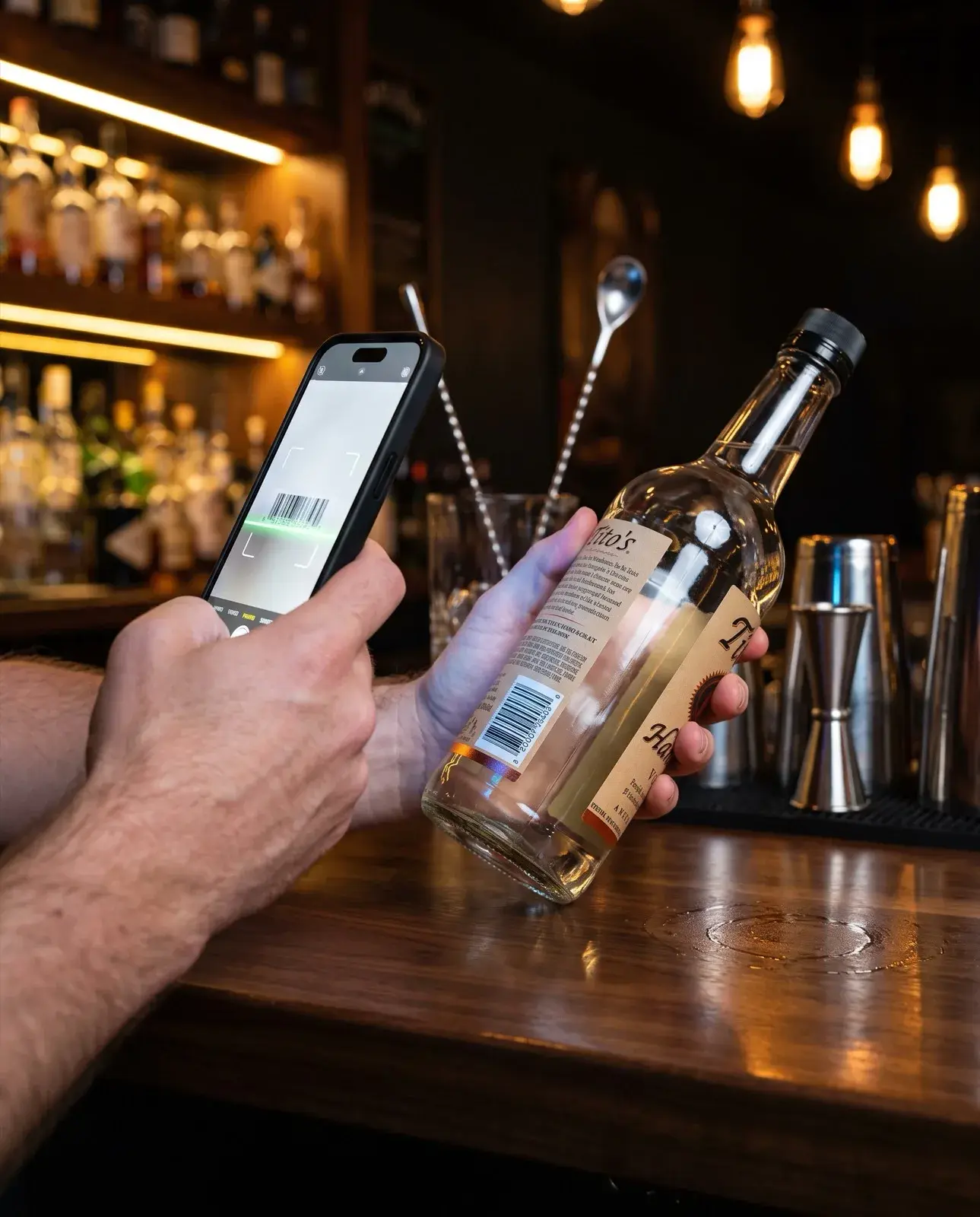
Phone camera or handheld. Tap fill on open bottles. A sample opening count closed at 14 scans, 7.63L, $239.13.
Bar inventory software
ExactPour is bar inventory software for liquor rooms: barcode counts with fill levels, Toast / Square / Clover / GoTab reconciliation, and variance in dollars. Free is $0. Paid plans are $59, $99, and $129.
14 days free · No credit card · Plans from $59/month
Last updated
Bar inventory software tracks every bottle on the well, compares that count to what the POS sold, and prices the gap in dollars. ExactPour is built for casual bars, pubs, and sports bars: scan barcodes, tap fill levels, and reconcile Toast, Square, Clover, or GoTab. Free is $0. Paid plans are $59, $99, and $129 a month.
Phone camera or handheld. Tap fill on open bottles. A sample opening count closed at 14 scans, 7.63L, $239.13.
Authorize Toast, Square, Clover, or GoTab. Sales become projected usage once recipes exist.
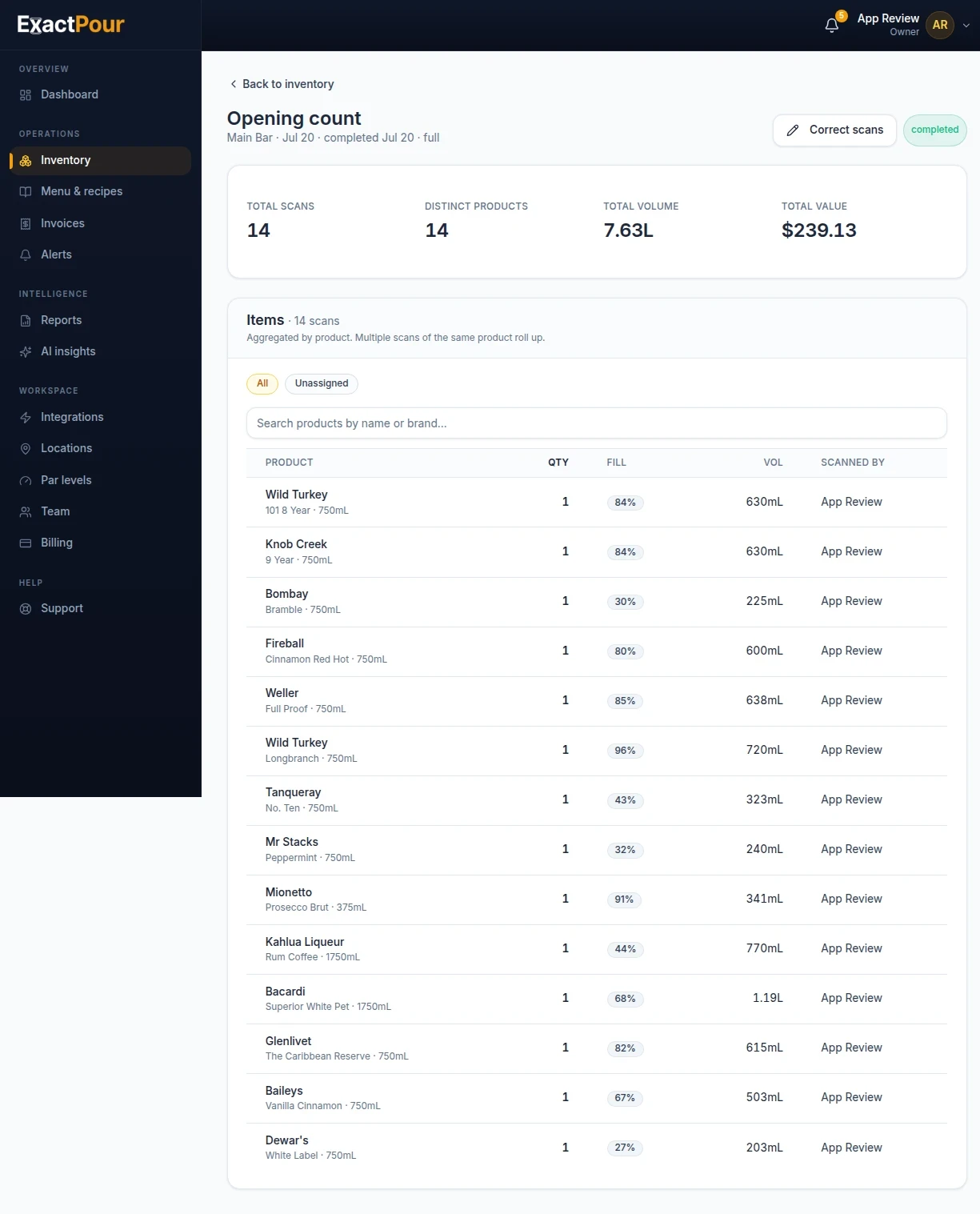
Variance is projected versus actual. The demo workspace shows $0.00 flagged after that count, because nothing is mapped to leak yet.
The problem
Clipboard-and-spreadsheet counts eat hours after close and are stale the moment they're done. Owners skip them, and blind spots grow.
Over-pouring, comps, and theft do not show up on a clipboard. Without a count-to-sales reconciliation you cannot prove which SKUs moved and which did not.
Without pour cost per drink, menu pricing is a guess and low-margin cocktails hide in plain sight.
The solution
Barcode counting, POS reconciliation, and an AI intelligence layer, built for the pace of a working bar.
Scan once, count everything.
Scan any UPC with a phone or handheld, tap a fill level, and ExactPour aggregates scans per product and auto-computes volume in real time. Undo and inline edits keep counts honest.
Partial bottles, not just whole counts.
Every scan records a fill level from 0 to 1 and computes volume as size times fill, so you track real stock instead of rounding to the nearest bottle.
Toast, Square, Clover, and GoTab are live.
Connect Toast, Square, Clover, or GoTab to a location. Menus and sales import on a schedule or when you ask. POS credentials are stored encrypted.
Surface the gaps. Explain them.
Items that drift beyond tolerance are flagged (>10% warning, >5% info). Close each out with a reason (breakage, theft, over-pour, measurement error) and notes.
Know the cost of every drink.
Cost per serving is computed from live bottle pricing and recipe ounces, so you see pour cost and margin per menu item and can price with confidence.
Wake up to what needs fixing.
Auto-generates 3 to 5 prioritized, actionable insights from the last 30 days of variance, sales, and counts, each carrying a severity so you know what to act on first.
Integrates with the POS you already run
Sales sync nightly · No rip and replace




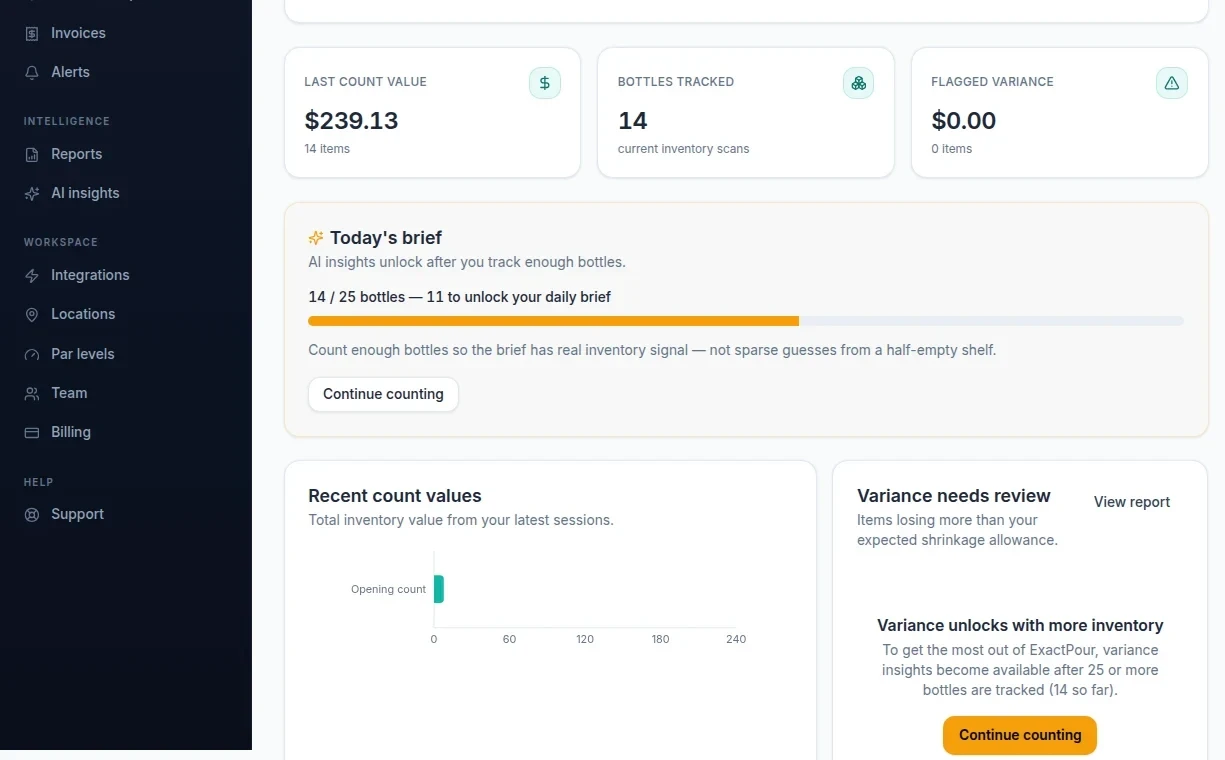
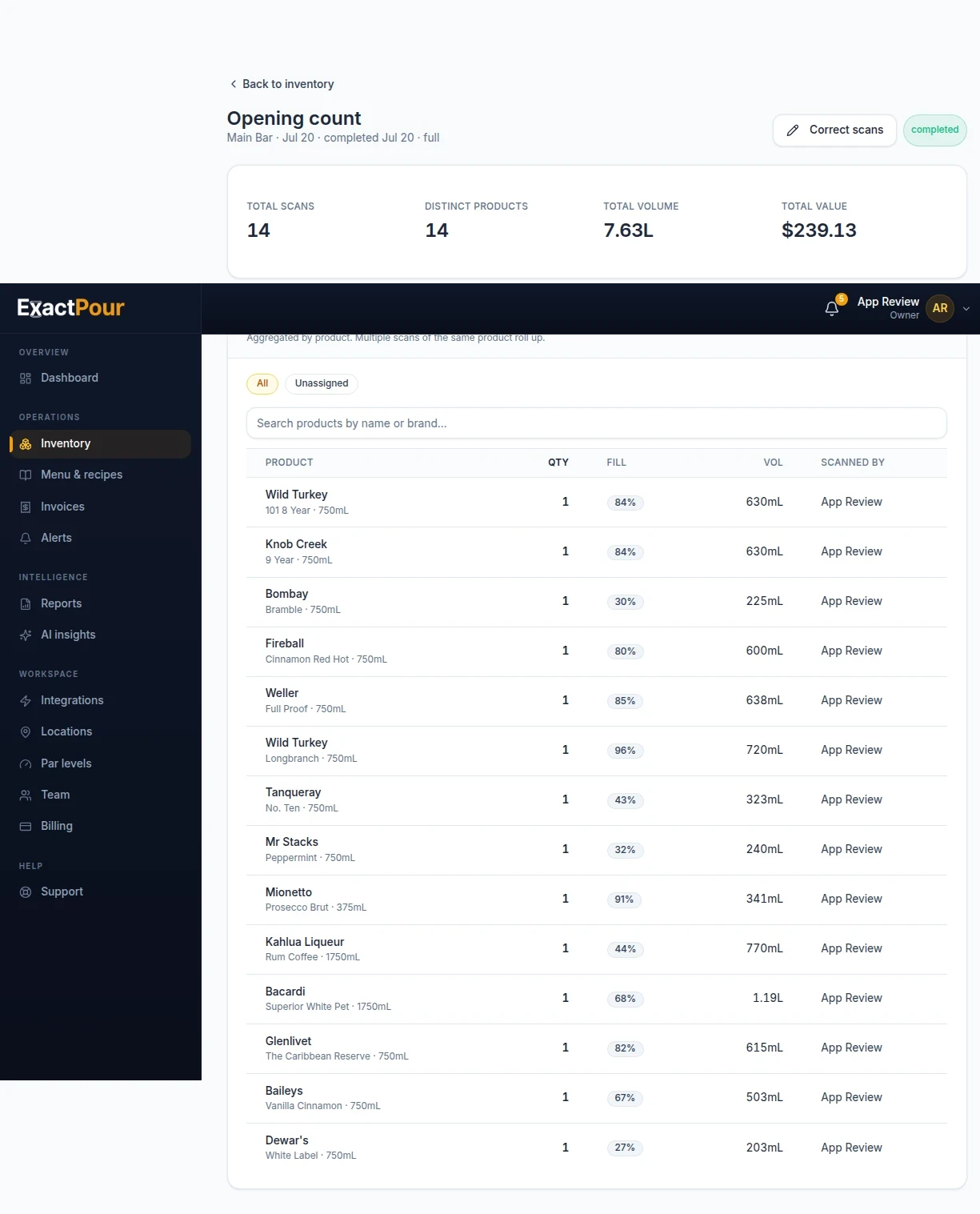
Opening count, Main Bar, Jul 20
Completed full count in the demo workspace: 14 scans, 14 products, 7.63L, $239.13.
Compare
| Capability | ExactPour | Spreadsheets & clipboards |
|---|---|---|
| Full liquor count | Minutes, by barcode | Hours, hand-tallied |
| Partial-bottle accuracy | Rounded guesses | |
| POS sales reconciliation | Automatic | |
| Variance flagged automatically | ||
| True pour cost per drink | Manual formulas | |
| AI briefs, forecasts & anomaly alerts | ||
| Multi-location roll-up | Separate files | |
| Immutable audit trail |
Barcode scanning removes hand tallying and re-keying. Time one full count in your room.
Reconcile every pour against POS sales to expose shrinkage
See true pour cost and margin on every drink
Get AI-written daily briefs on where margin is leaking
Run one bar or a dozen from a single login
Bar inventory software tracks every bottle on your back bar, compares what you physically counted against what your point of sale says you sold, and surfaces the gap as a dollar figure you can act on. The strongest systems replace the clipboard-and-spreadsheet ritual with barcode scanning, partial-fill capture, and automatic reconciliation, so a count that used to consume an entire post-close shift becomes a repeatable weekly habit and the numbers are finally trustworthy enough to drive ordering and pour cost.
ExactPour is built specifically for bars and restaurants. You scan a bottle's UPC with any phone or handheld, tap the fill level, and the platform aggregates scans per product, computes volume in real time, and syncs the result against your Toast, Square, Clover, or GoTab sales to expose shrinkage, over-pouring, and unexplained usage before those gaps compound into a bad month. On top of that counting engine sits an AI layer that writes daily briefs, forecasts demand, and answers plain-language questions about your inventory so managers spend less time reconstructing history in spreadsheets.
That combination, physical truth from the shelf plus sales truth from the POS, is what separates inventory software from a digitized clipboard. ExactPour does not stop at storing counts; it turns every closed session into projected usage, variance flags, pour-cost views, and suggested reorders. Operators can measure the same SKUs the same way every week, which is the foundation of every other beverage metric that follows. For a deeper commercial comparison of platforms, see best bar inventory software, and for methodology notes on how operators talk about inventory performance, see bar inventory benchmarks 2026.
Unexplained usage can come from over-pouring, undocumented comps, theft, breakage, transfers between stations, or honest measurement error. Reconciliation narrows the products and periods to investigate without claiming a cause the data cannot prove. ExactPour surfaces the gap first, then lets your team attach reason codes so the story becomes coachable rather than accusatory.
A spreadsheet cannot catch any of that in time. By the time a monthly count reveals a problem, the trail is cold and the money is gone. Bar inventory software closes that feedback loop by reconciling counts against POS sales on a cadence your team can keep, so you find a bad night while the staff are still on the schedule and the details are still fresh. ExactPour flags items that drift beyond tolerance automatically, so managers are not hunting through rows for outliers after a long weekend.
Over a few cycles, patterns emerge that no gut feel can match: a well spirit that always runs short on a specific shift, a high-value SKU that needs to move behind the bar, or a station whose transfers never get logged. That is how ExactPour turns unexplained liquor usage into a managed queue of exceptions instead of a vague sense that something is off. Interactive calculators and planning helpers on calculators can help you model what tighter variance control would mean for your own beverage sales before you change anything on the floor.
The biggest reason bars skip inventory is that it takes too long. Walking the shelves with a clipboard, writing a number per bottle, and keying it into a spreadsheet the next day eats an entire post-close shift, and it still produces stale numbers that depend on who held the clipboard. Barcode-driven counting collapses that workflow: scan the UPC, tap a fill level such as Full, 3/4, 1/2, or 1/4, and ExactPour does the math in real time, volume, value, and on-hand quantity update as you walk.
Because the workflow is standardized, counts stop depending on the person. A new bartender can take a full liquor inventory on their first shift and the numbers line up with last week's, because everyone is measuring the same way. Undo and inline edits keep the data honest without slowing anyone down, and sessions auto-resume if a rush interrupts the count. ExactPour removes hand tallying and spreadsheet re-entry so teams can count more often; more frequent counts are the single biggest driver of accuracy operators can control.
Hardware stays simple on purpose. ExactPour supports smartphone cameras, standard USB handheld scanners, and browser counting, there is no proprietary scale or custom device required to get started. That matters for bars that need a system their closing team will actually finish, not a process that only works when the inventory specialist is on the schedule. When counting is fast enough to keep weekly, variance reviews become a Monday habit instead of a quarterly fire drill.
A count on its own only tells you what you have. The insight that protects your margin comes from comparing that count to what should be there. ExactPour pulls sales from your point of sale, maps each drink to the liquor it consumes through recipes, and calculates projected inventory: starting stock minus everything the POS says you poured. Comparing projected to your physical count surfaces the gap where over-pouring, comps, theft, and measurement error hide.
Every item that drifts beyond tolerance is flagged automatically, so you are not hunting through a spreadsheet for outliers. You reconcile each exception with a reason code, breakage, spillage, over-pour, theft, or an honest measurement error, and those notes build a history you can use to coach staff and settle disputes with evidence instead of suspicion. ExactPour keeps that history tied to products, periods, and locations so the same conversation does not restart from zero every month.
Recipe mapping is what makes POS reconciliation meaningful. A ticket that says "margarita" is useless for inventory until ExactPour knows how many ounces of tequila, triple sec, and other ingredients that drink consumes. Once mapped, every future sale depletes projected stock correctly, including common modifiers when your program uses them. That is how ExactPour turns the POS you already run, Toast, Square, Clover, or GoTab, into the sales half of a closed inventory loop.
Pour cost, the percentage of revenue spent on the liquor in each drink, is the headline metric of a healthy bar, and it is only as reliable as the inventory behind it. Guess at your counts and your pour cost is fiction. ExactPour ties recipes to sales and to real usage, so you see pour cost by category, by product, and by location, and you can watch it move as you change specs, prices, or vendors.
That clarity turns menu decisions into math. When a cocktail's pour cost creeps up because a base spirit got more expensive, you see it immediately and can adjust the price, the recipe, or the well brand before the drift quietly erodes margin across thousands of drinks. Operators can measure pour cost with a simple formula: liquor cost in the drink divided by the drink's selling price. ExactPour computes that from live recipes and current bottle costs rather than a stale quarterly reconstruction.
Variance sits beside pour cost as the other number that keeps a beverage program honest. ExactPour defines variance as the gap between projected usage from POS sales and actual usage from your physical count. Shrinkage is the portion of that gap you cannot explain with a reason code. Together, those metrics let managers decide whether a problem is pricing, portioning, process, or product walking out the door, without inventing industry benchmarks that do not apply to your room.
Modern bar inventory software does not stop at counting. ExactPour layers an AI engine on top of your reconciled data that writes prioritized, plain-English insights, so you open your phone to a brief that tells you what to act on instead of digging through dashboards. It forecasts demand by running regression on recent POS depletion, so you get a run-out date and a confidence rating per product before you run dry. And it flags statistical anomalies the moment they appear, scanning variance against each product's own baseline.
On Pro and above, scheduled AI monitoring watches counts, sales, and invoices. It runs anomaly sweeps, surfaces insights, and delivers digests so a multi-location operator can manage a portfolio of bars from one login instead of a stack of spreadsheets. That intelligence is what separates a tool that digitizes the clipboard from a platform that works your margin overnight, still grounded in the counts and POS syncs your team actually completed.
The conversational assistant answers questions from your real numbers: which products lost the most money last month, which location's variance widened this week, which SKUs are approaching run-out. ExactPour does not invent answers outside your data. It accelerates the work managers already do when the underlying count and reconciliation are clean enough to trust.
Not all bar inventory software is built for the realities of a working bar. When you evaluate options, start with counting speed and accuracy, because a tool that is painful to use simply will not get used. Look for true barcode scanning with partial-fill capture, and a phone-camera or browser workflow your bartenders can learn in minutes. If the room has no signal, scans save on the device and upload when you are back online. Then look past the count to the analysis: does the platform reconcile against your POS, calculate real pour cost, and flag variance automatically, or does it just digitize the clipboard?
Finally, weigh the intelligence and the scale. The right platform should get more valuable the longer you use it, turning every count into a richer history that sharpens ordering, pricing, and loss prevention over time. Look for multi-location support with per-location permissions, supplier invoice handling so your costs stay current, and an AI layer that answers plain-language questions instead of forcing you to build reports. ExactPour was built to do all of that for bars, nightclubs, restaurants, and hospitality groups of any size, starting free for a single location.
Use best bar inventory software when you want a structured side-by-side of capabilities, and use bar inventory benchmarks 2026 when you want research framing for how operators talk about inventory performance. Wine-forward rooms should also read wine inventory management so vintage identity is not flattened into a liquor row. Pair those with a hands-on trial that includes a real count and a real POS sync; marketing pages cannot substitute for watching your own team close a session on your own back bar.
A useful buyer's checklist starts with the count itself. Can your closing team scan barcodes and capture partial fills without proprietary hardware? Does the session save and resume cleanly if service interrupts? Can a second bartender pick up where the first left off? ExactPour is designed so those answers are yes: phone camera or handheld scanner, fill levels on every open bottle, and sessions that survive real bar chaos. If a vendor cannot demonstrate a live count on your shelf, keep shopping.
Next, evaluate reconciliation. ExactPour imports menus and sales from Toast, Square, Clover, and GoTab, then maps items to recipes so projected usage is item-level rather than a coarse sales total. Ask every vendor how recipe mapping works, how modifiers are handled, and whether sync is scheduled and on-demand. Manual CSV uploads are not the same as a live connector. Also ask how variance is flagged, ExactPour marks products that drift beyond tolerance and requires reason codes so exceptions become a coaching trail.
Finish with operations fit: multi-location roll-up, role permissions, invoice cost updates, pour-cost reporting, forecasting, and whether AI briefs are grounded in reconciled data. Price matters, but so does whether the weekly cadence will survive your slowest closer. ExactPour starts free for a single location and includes POS reconciliation on Starter and up, so you can prove the workflow before you expand. Cross-check claims against best bar inventory software and pressure-test your own math with the helpers on calculators.
ExactPour is designed so implementation is measured in hours and days, not months. Day one is setup: create your account, add a location, and start building the product list by scanning what is already on the shelf. You do not need a perfect catalog before you count; ExactPour lets the first walk of the room create the products you actually carry. Assign roles so managers can review variance while bartenders can run counts without seeing settings they do not need.
Day one or two is the POS connection. Authorize Toast, Square, Clover, or GoTab for the location, import menus and categories, and map your highest-volume drinks to recipes first. ExactPour does not require every obscure menu item to be perfect before you reconcile; start with the wells and signature cocktails that drive most depletion, then expand the map as you go. Run Sync now before your first formal count so projected usage has fresh sales behind it.
Your first reconciled count is the milestone that matters. Close a full session, let ExactPour compute projected versus actual, and work the flagged exceptions with reason codes. Many operators complete that loop in the first week when they prioritize the top sellers and keep the first count focused. From there, set a weekly cadence, tune par levels, and let forecasting and AI briefs accumulate on real history. The goal of implementation is not a perfect database on day one, it is a trustworthy first reconciliation you can improve every cycle.
ROI for bar inventory software should be calculated from your own sales, costs, and variance, not from someone else's claimed averages. ExactPour helps operators measure the inputs: on-hand value from counted bottles, projected usage from POS sales and recipes, and the dollar value of unexplained gaps after reason codes. Once those numbers are real, the math is straightforward and you can decide whether tighter control is worth the subscription on evidence from your room.
Use formulas, not folklore. Pour cost equals liquor cost divided by beverage sales for the period you choose. Variance dollars equal (actual usage minus projected usage) valued at your bottle costs for the SKUs involved. If you reduce unexplained variance, the recovered dollars are the reduction in that gap, not a percentage borrowed from an industry slide. ExactPour surfaces the components so you can plug them into the formulas yourself instead of trusting a black-box "savings" claim.
Illustrative example with made-up round numbers: suppose a bar records $10,000 in beverage sales in a week and liquor cost of goods of $2,000, for a 20% pour cost. If reconciliation shows $400 of unexplained variance on top of that cost, operators can measure whether coaching, recipe corrections, or tighter comps shrink that $400 over the next cycles. ExactPour does not promise that every venue will recover a fixed amount; it gives you the count, the POS sync, and the variance dollars so your own example replaces the fantasy spreadsheet.
Spreadsheets are familiar and flexible, and they fail for the same reasons every busy bar already knows: slow data entry, inconsistent estimates, no automatic POS link, and no durable audit trail of who counted what. ExactPour replaces the spreadsheet as the system of record while still letting you export when finance needs a file. The win is not prettier cells, it is a count workflow people finish and a reconciliation that does not depend on someone remembering to paste sales totals.
Scale-based systems weigh bottles and convert weight to volume. That can be precise in controlled conditions, but it often adds hardware cost, calibration, and a counting ritual that is awkward on a crowded back bar. ExactPour takes a barcode-plus-fill-level approach: scan the product identity, capture an estimated fill, and move on. Operators who need gram-level precision for a spirits lab can still use scales as a spot check; most working bars need speed, consistency, and POS reconciliation more than laboratory-grade scale checks on every SKU every week.
Barcode counting wins when the job is operational control. ExactPour standardizes identity through UPCs, standardizes partials through fill levels, and standardizes truth through POS reconciliation. Compared with spreadsheets, you remove re-keying. Compared with scale-only workflows, you remove hardware dependency for everyday counts. Many programs mix methods, ExactPour for the weekly full count and a scale for occasional audits on high-value bottles, and that hybrid still beats a monthly spreadsheet nobody trusts.
Multi-location bar inventory software has to solve more than "more rows in a spreadsheet." Each venue needs its own counts, pars, POS connection, and permissions, while ownership needs roll-up views that are actually comparable. ExactPour supports per-location inventory with a shared login model so area managers can review variance and pour cost across rooms without emailing files around. Standardization matters: if every venue counts differently, consolidated reporting is theater.
POS complexity multiplies with locations. One room may run Toast while another runs Square or Clover; ExactPour treats each location's connector independently so sales still map to that room's recipes and counts. Transfers between venues need process discipline too, product that moves without a record looks like shrinkage at the destination and surplus at the source. ExactPour's variance and reason-code history help multi-unit operators see whether a problem is local to one bar or systemic across the group.
When you evaluate multi-location readiness, ask about role-based access, consolidated pour-cost and variance reporting, location-level catalog differences, and whether AI digests can summarize a portfolio instead of a single room. ExactPour is built for that portfolio view on higher plans, but the foundation is still the same: each location must complete real counts and real reconciliations. Scale the process only after one venue has a weekly cadence that sticks.
ExactPour treats Toast, Square, Clover, and GoTab as first-class POS connectors rather than afterthoughts. In each case the pattern is the same: authorize the integration for a location, import menus and sales, map items to recipes, and reconcile projected usage against physical counts on a schedule or on demand. ExactPour reads the catalog and sales data it needs for inventory intelligence; it does not place distributor orders or rewrite your POS menu as part of everyday sync.
Toast is a common choice for full-service rooms that want deep menu structure; Square is common for bars and restaurants that want a flexible catalog; Clover appears across many independent venues; GoTab is frequent in taprooms and high-volume open-tab environments. ExactPour's job is not to replace those systems. It closes the shelf-to-sales loop each one leaves open on its own. The four connectors live on one page: POS integrations.
If you are still choosing a POS, pick the system that fits service and payments first, then confirm ExactPour supports it, which it does for Toast, Square, Clover, and GoTab today. If you already run one of those four, the fastest path to trustworthy inventory is connecting ExactPour, mapping your top recipes, and completing your first reconciled count. For capability comparisons beyond POS brand, see best bar inventory software and the operator-focused research notes at bar inventory benchmarks 2026.
FAQ
The best fit is the product your closer will finish weekly and that can reconcile the POS you already ring. ExactPour is built for that job on Toast, Square, Clover, or GoTab. Judge it on a live count in your room, not a feature brochure. See best bar inventory software.
ExactPour does. Authorize Toast, map well drinks, count open bottles, and compare poured versus sold. Toast stays the till. Details are on toast liquor inventory.
ExactPour starts free for counting on one location. Paid plans are $59, $99, and $129 a month on pricing. The signup trial is 14 days on Pro. Nothing is charged unless you add a payment method. Other vendors may quote custom prices.
No. ExactPour uses a smartphone camera, a standard USB handheld scanner, or the browser. There is no proprietary scale required to start.
It computes projected usage from POS sales and recipes, then subtracts the physical count. The leftover dollars are the shrinkage conversation after you code comps, spills, and transfers. ExactPour flags products beyond tolerance.
No. It is written for traditional casual bars, pubs, and sports bars with a liquor well.
Next step
Start your 14-day Pro trial. No credit card required.
Start tonight
Run ExactPour on your own bar for two weeks. See the leaks, the over-pours, and the dollars you can still save.
14 days free · No credit card · From $59/mo