
Identity first
Vintage, format, and producer stay on the UPC. Do not merge the list into a bin nickname.
Solution
Wine inventory software for lists, cellars, and bottle shops: scan each vintage, capture by-the-glass fills, and reconcile Toast, Square, Clover, or GoTab. Free is $0. Paid plans are $59, $99, and $129.
14 days free · No credit card · Plans from $59/month
Last updated
This page is for casual bars and pubs that also pour wine beside a liquor well. ExactPour tracks wine by label and vintage, records fill on open bottles, and reconciles Toast or another supported POS. It is not a pitch for wine-only temples. The product is built around a working well.
Vintage, format, and producer stay on the UPC. Do not merge the list into a bin nickname.
BTG bottles get fill levels. Retail and cellar bottles stay whole-unit until opened.
Tickets and transfers should match the wall. High-value shorts rank by dollars.
The problem
Vintages complicate every count, and without SKU-level tracking cellar and retail numbers drift apart.
By-the-glass and tasting pours draw down opened bottles that whole-bottle counts never capture.
Wine ties up serious capital, so a rough count risks both loss and costly over-ordering.
The solution
Vintage-level SKUs, fill-level tracking, and cost per pour for the whole wine program.
Scan once, count everything.
Scan any UPC with a phone or handheld, tap a fill level, and ExactPour aggregates scans per product and auto-computes volume in real time. Undo and inline edits keep counts honest.
Partial bottles, not just whole counts.
Every scan records a fill level from 0 to 1 and computes volume as size times fill, so you track real stock instead of rounding to the nearest bottle.
Know the cost of every drink.
Cost per serving is computed from live bottle pricing and recipe ounces, so you see pour cost and margin per menu item and can price with confidence.
Your negotiated prices, your numbers.
Set per-account cost overrides on global products so each venue tracks its own supplier pricing, not a catalog default.
Surface the gaps. Explain them.
Items that drift beyond tolerance are flagged (>10% warning, >5% info). Close each out with a reason (breakage, theft, over-pour, measurement error) and notes.
Every count, accounted for.
Browse past counts with status, item count, total value, location, and start time. In-progress sessions save and can resume after a refresh.
Integrates with the POS you already run
Sales sync nightly · No rip and replace




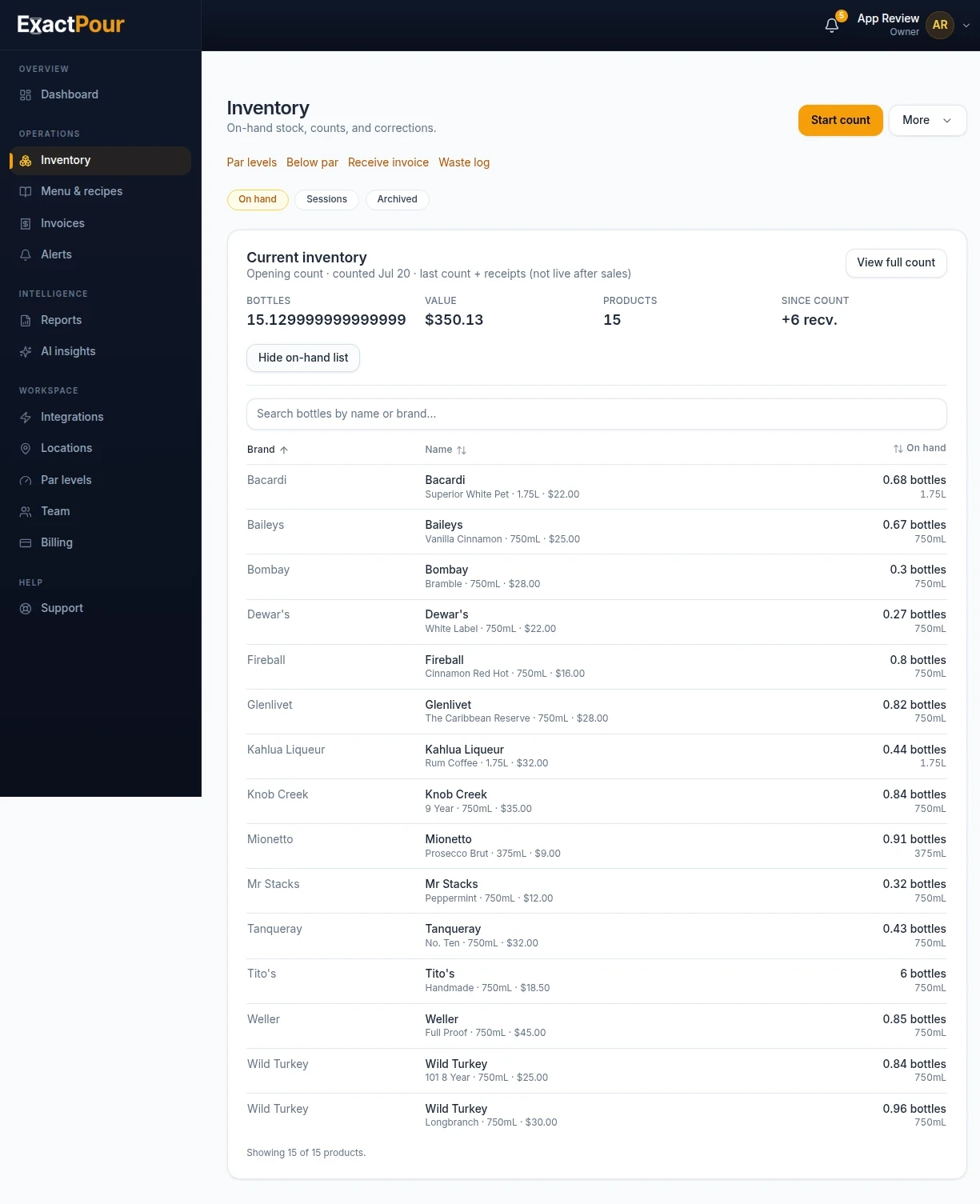
Wine SKU on the on-hand list
Mionetto Prosecco Brut 375mL at 0.91 bottles, $9.00. Each UPC stays its own SKU.
Compare
| Capability | ExactPour | Clipboard & cellar spreadsheet |
|---|---|---|
| Vintage-level identity | Distinct UPCs | Blurred rows |
| Open-bottle fill levels | Whole-bottle rounding | |
| POS reconciliation | Toast, Square, Clover, GoTab | Paste sales totals |
| Glass pour costing | Guessed yield | |
| Invoice cost updates | Stale list prices | |
| Wine + liquor in one loop | Separate files |
Track each label and vintage as its own SKU
Capture by-the-glass and tasting pours by fill level
Compute cost per pour for by-the-glass programs
Record true acquisition cost per bottle
Reconcile the wine program against POS sales
Wine inventory management software tracks every sellable bottle by label, vintage, and format, then compares what you physically counted against what your point of sale says you sold. The strongest systems replace clipboard rows that blur a 2019 and a 2021 into one fuzzy number with barcode identity, fill levels on open pours, and a variance list priced in dollars. That is the job: a count you can close, a valuation you can defend, and a Monday list of bottles that do not match tickets.
ExactPour applies the same barcode-plus-reconciliation engine used for liquor to wine programs. You scan a UPC, tap a fill on any open bottle, and the platform records that SKU's on-hand volume and value. Toast, Square, Clover, or GoTab sales become projected usage once glass and bottle items map to recipes. The gap is wine shrinkage you can coach from, not a year-end surprise.
This page is the wine inventory software pillar. Retail bottle shops should also read wine shops. By-the-glass rooms should read wine bars. If liquor dollars dominate the same building, pair this guide with liquor inventory management and the broader category view at bar inventory software.
Wine punishes sloppy inventory more than beer or well spirits. A serious list can carry hundreds of SKUs across vintages, producers, and formats, tie up cash in slow bottles, and lose real money to breakage, heavy glasses, unrecorded tastes, and bottles that walk. Clipboard counts fail for three reasons: labels look alike, vintage is a different product, and open bottles are not whole units.
A single mis-keyed line throws off both the count and the valuation. Treating two vintages as one SKU corrupts cost, availability, and the guest conversation when the 2015 is gone and the 2019 is what remains. Wine inventory management is not a nicety. It is the difference between a cellar that makes money and one that hides losses until the accountant asks.
ExactPour is built so the first walk of the room creates the products you actually carry. You do not need a perfect cellar library on day one. Scan what is on the wall, keep vintages distinct, and let the first reconciled week tell you which labels deserve a tighter cycle count.
Search lumps wine retail, wine bars, and restaurant cellars together. They share bottles. They do not share the same inventory job. A wine shop or bottle shop is sealed-SKU retail: shelf counts versus the register, allocation walls, and cash trapped in the long tail. That workflow lives on wine shops.
A wine bar lives on open bottles. Fill levels, Coravin, flights, and by-the-glass tickets that must hit a specific SKU. That workflow lives on wine bars. A restaurant list sits between them: sealed cellar stock plus a shorter BTG board. ExactPour covers all three with one catalog. This solutions page owns the shared wine inventory software method so those industry pages can stay specific.
Hybrid operators should not run three spreadsheets. Use sealed-unit counts on the retail floor or cage, fill levels on open service bottles, and one POS map. If the same group also runs a cocktail bar, keep wine SKUs distinct and let bar inventory software describe the liquor loop that sits beside the list.
Effective wine inventory software has to respect how wine actually varies. The same producer's bottling changes by vintage and by format, and a program may stock several at once. ExactPour tracks each as its own product with its own cost and count. A half-bottle does not round into a full bottle. A 375mL sparkling SKU stays beside a 750mL of the same label.
That granularity is what makes wine valuation meaningful. Because each SKU carries its real cost, value on hand reflects capital sitting in the cellar, not a rounded guess. You can see which bottles move and which are dead stock tying up cash. For a restaurant wine program, that turns the cellar from a black box into a managed asset.
Barcode scanning keeps even a large, diverse cellar fast to count and hard to mis-key. Staff scan the UPC instead of typing a producer name that three people spell three ways. When a vintage does not have a clean barcode, create the product once and keep the same identity on every later count.
The by-the-glass program is where most wine inventory falls apart, because it runs on partial bottles. A count that rounds to whole bottles cannot see the open Chardonnay that is two-thirds gone or the flight pours that never quite match the recipe. ExactPour records a fill level on every open bottle and computes real volume, so open wine is counted instead of ignored.
That partial-bottle precision is what lets you reconcile a glass program at all. Compare remaining ounces to what the POS says you poured. Over-pouring, unrecorded tastes, and the extra splash for a regular show up as variance on that SKU. Sommeliers and beverage managers can coach a pour the same way a bar manager coaches a well.
Preservation systems do not erase the need for a fill. A Coravin bottle still has remaining volume. An argon-preserved bottle still turns. ExactPour counts the ounces that remain so you can push a wine before it oxidizes instead of discovering a dead opener at the next monthly reconstruction. Deeper BTG guidance is on wine bars.
A count on its own only tells you what you have. The insight that protects wine margin comes from comparing that count to what should be there. ExactPour pulls sales from Toast, Square, Clover, or GoTab, maps bottle and glass items to the SKU they consume, and calculates projected inventory. Comparing projected to the physical count surfaces misrings, heavy pours, and bottles that left without a ticket.
Recipe mapping is what makes a glass ticket useful. A POS line that says house red is useless for inventory until it depletes the bottle you actually opened. Map the BTG board first. Sealed retail can reconcile as whole units without a pour spec. The four connectors live on POS integrations. ExactPour does not replace the POS. It closes the shelf-to-sales loop the POS leaves open.
Unmapped wine is a classic source of fake theft. If the 2019 Cabernet rings as a generic red, a clean count looks like shrink. ExactPour flags the gap so you can fix the map before you accuse the closer. That is the same discipline liquor inventory management applies to cocktails, applied to the list.
Wine margin lives in the gap between what a bottle costs and what it sells for, by the bottle and by the glass. That gap is only as trustworthy as your costs. ExactPour keeps wine costs current through supplier invoice OCR, so when a distributor's pricing shifts, pour cost and glass math move with it instead of waiting for a reprint of the list.
Recipe costing extends to by-the-glass pours. Cost per serving comes from live bottle cost and your pour spec, so you can price flights and glasses to a target rather than hoping last season's number still works. When a new vintage arrives higher, you see which glasses drifted below target before a weekend of volume locks in the loss.
Because wine sits beside spirits and beer in the same system, you see beverage cost of goods across the whole program. Use pour cost control when you want the pour-cost formulas in one place. Use this page when the SKU itself is a vintage, a format, or an allocation that a generic liquor row would smear.
Wine is the category where the same product name can represent a dozen differently priced items. A 2015 and a 2019 of the same label have different costs, different values, and different availability. Treating them as one line corrupts inventory value and the ability to sell them correctly. ExactPour tracks wine at the vintage and SKU level so a vertical stays organized.
Allocated and hard-to-get bottles are the inventory most worth tracking and the easiest to lose to a misring or an uncounted pour. You cannot always replace them at the original cost. Vintage-level management means you know what you hold, what it is worth today, and whether any has gone missing within days of a busy service, not at tax time.
Retail allocation walls need a weekly cycle count of that subset, not a once-a-year wall-to-wall. wine shops covers that retail habit. Restaurant cellars should treat the cage the same way: dual-control receiving, a named home location, and a spot count after every packed Saturday.
A wine program often spans a back cellar, a service station, and a display. Inventory that lives in only one of those lists is inventory you will eventually lose. ExactPour uses location-scoped catalogs so each area is counted precisely while the group view stays whole, without double-counting.
Classic wine losses are process misses: the bottle that walks out the back, the vintage that was pulled and never rung, the breakage that never got a waste code. Audit-grade corrections mean every adjustment leaves a trail. You can fix a miscount without losing accountability.
Transfers between cellar and floor need the same honesty as bar-to-bar liquor moves. Product that changes rooms without a record looks like shrink at one end and surplus at the other. Count both ends on the same night when the list is hot. Multi-venue groups should standardize the method, then read multi location bar inventory for roll-up discipline.
Monthly wine counts are usually archaeology. ExactPour is built for a weekly cadence where the count is short enough to finish and the variance review still remembers the week that caused it. Pick a consistent night. Assign ownership. Treat the reconciliation as non-negotiable even if it is fifteen minutes of reason codes.
Day one is setup: add the location, scan the wall, and keep vintages distinct. Day one or two is the POS connection and mapping of the BTG board plus the top bottle sellers. The first reconciled count is the milestone that matters. Close the session, read projected versus actual, and code the exceptions.
When a holiday or festival week hits, add a mid-week spot count on allocated and open BTG bottles rather than abandoning the system. ExactPour makes a short list practical because scanning twenty high-value SKUs is still faster than rebuilding a spreadsheet. The weekly full count remains the backbone.
Spreadsheets are familiar and they fail for the reasons every busy list already knows: slow entry, vintages collapsed into one row, no automatic POS link, and no trail of who counted which bay. ExactPour replaces the spreadsheet as the system of record while still letting finance export a file. The win is a count people finish and a reconciliation that does not depend on someone pasting sales totals.
Wine-specialist cellar apps can win on list presentation, tasting notes, or allocation marketplaces. Judge them on whether your closer will finish a count and whether glass tickets deplete the correct vintage. If the wine list is the entire business and liquor is incidental, stay honest and evaluate those specialists on cellar features. If beverage dollars include a serious liquor room, trial ExactPour and keep wine as SKUs with barcodes and fill levels.
Barcode-plus-fill is the operational method. Scales can still spot-check a high-value open bottle. ExactPour does not require proprietary hardware to start: phone camera, USB handheld, or browser. See vs binwise when a wine-list vendor is already in the inbox, and best bar inventory software when the shortlist is broader beverage software.
Wine inventory management software has to handle what makes wine unique or it will misstate the room from the first pour. The non-negotiable is vintage-level identity. Without it, the tool cannot cost the list or protect rare bottles. Then demand fill-level capture for openers, POS reconciliation by SKU, and invoice cost that lands in the catalog.
Run a bake-off, not a demo tour. Time a representative walk of the cellar or the retail wall. Map ten BTG items. Finish a second count after a busy weekend. Score minutes, unfinished sessions, unexplained dollars, and whether a new hire can complete a bay without a manager standing over them. Published ExactPour plans start free for a single location, with paid tiers from $59/month. New accounts get one 14-day Pro trial. Nothing is charged unless you add a payment method.
If ExactPour loses that test on your list, buy the winner. If it wins, you have a weekly operating system instead of a binder. Use sign up to start the trial, or book a walkthrough from the form on this page. Related buying context for mixed beverage rooms is on bar inventory software.
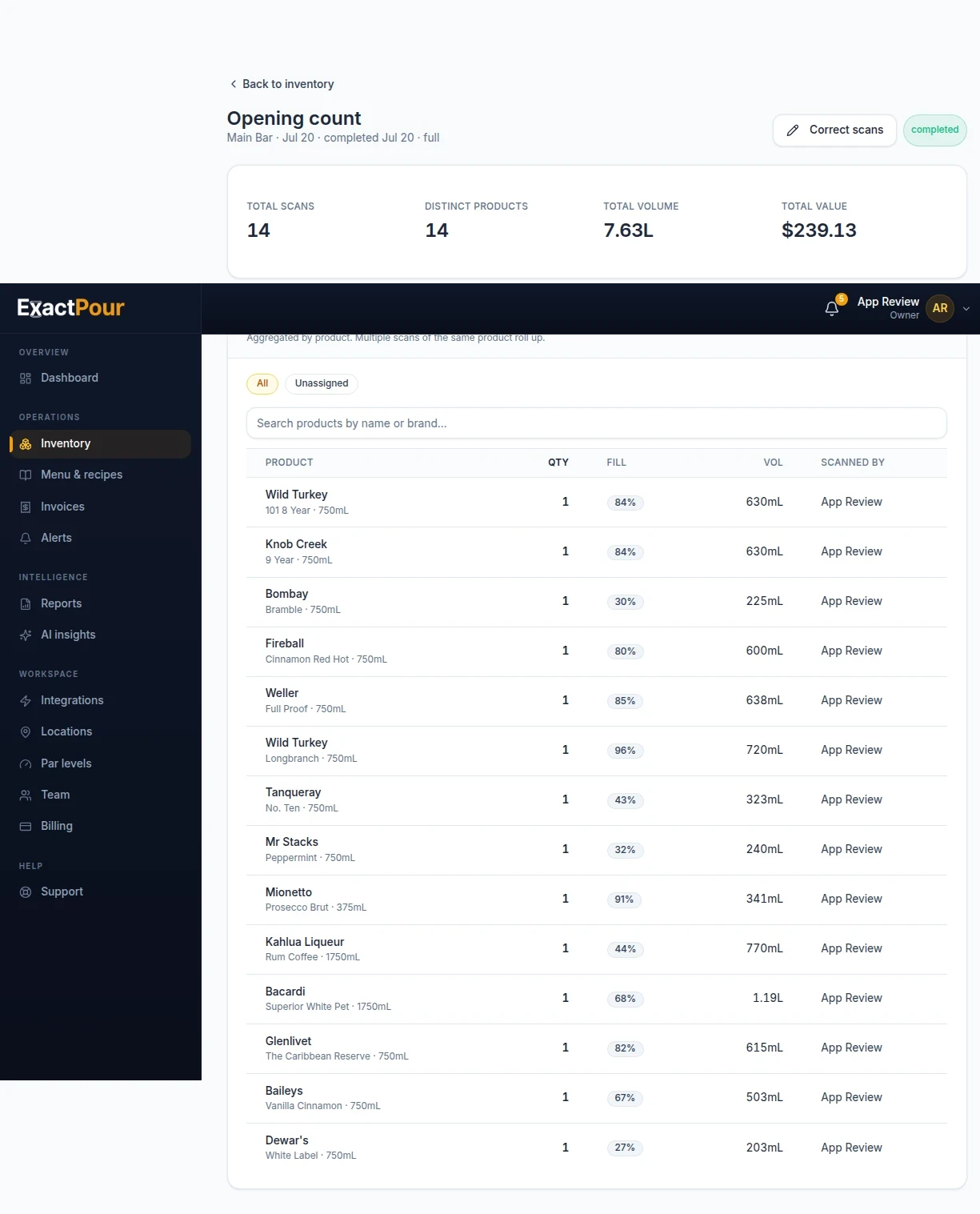
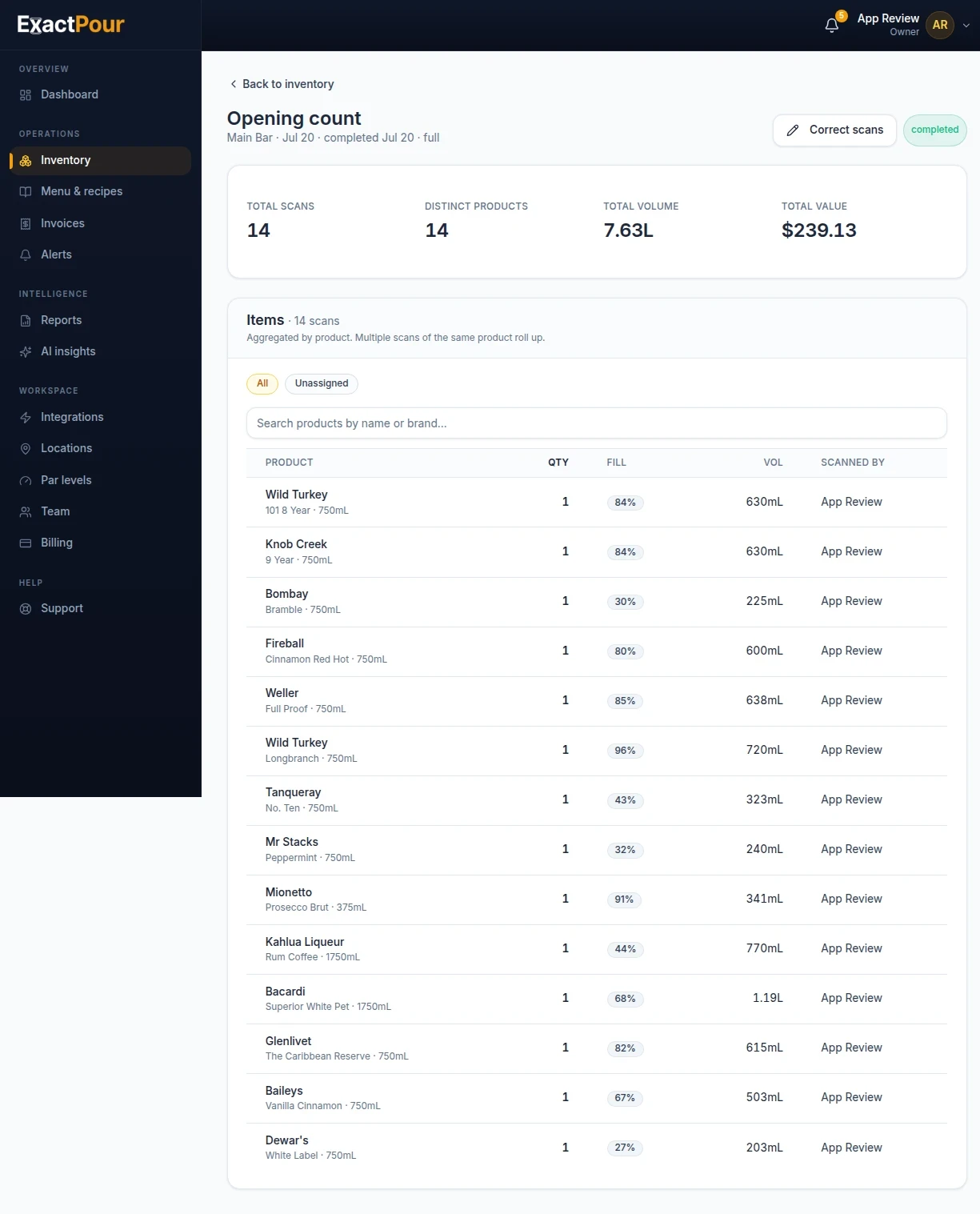
The screenshots on this page are sample data from a demo workspace, not a live wine bar. The sample count closed at 14 scans, 14 products, 7.63L, and $239.13. Mionetto Prosecco Brut 375mL sat at 0.91 bottles (341mL) beside open spirits. Each UPC stayed its own SKU.
That is the product behavior wine programs need: decimal bottles, fill percentages, and on-hand value on the same list as liquor. We do not show an empty pour-cost grid and call it wine analytics. Analytics starts after a finished count and a POS map. The reports index is where pour cost and variance live once those inputs exist.
Your cellar will have different dollars. The method does not change. Scan identity, capture fill on openers, sync the POS, and code the gap. That loop is how wine inventory management stops being an annual valuation project and becomes a weekly habit.
FAQ
No. Ideal customers are casual bars, pubs, and sports bars with a liquor well that also pour wine. Wine-only lists and allocation temples are not the target.
Yes. Each label and vintage is its own product so a count does not smear two years into one row.
The same way you count the well: scan identity, tap a fill level, close the session. Whole-bottle rounding hides by-the-glass loss.
Yes, along with Square, Clover, and GoTab. Map glass and bottle items to the vintage they deplete.
Retail sealed-SKU counting is wine shops. This solutions page stays on the shared method for rooms that also pour a well.
Free counting is $0. Paid plans are $59, $99, and $129 a month. See pricing.
Next step
Start your 14-day Pro trial. No credit card required.
Start tonight
Run ExactPour on your own bar for two weeks. See the leaks, the over-pours, and the dollars you can still save.
14 days free · No credit card · From $59/mo