
Cost the spec
Recipe ounces times live bottle cost, divided by menu price. That is recipe pour cost, not a quarterly reconstruction.
Solution
Know the exact cost of every pour and the margin on every menu item. ExactPour computes pour cost from live bottle pricing and recipes, then reconciles actual usage so target and reality finally match.
14 days free · No credit card · Plans from $59/month
Last updated
Pour cost is liquor cost divided by beverage sales. Control it by keeping bottle cost current, counting the well, and comparing recipe cost to actual usage. ExactPour computes both sides after a barcode count and a POS sync. A calculator alone models the ideal pour. The software is for the gap. Start from /pricing or /pour-cost-calculator.
Recipe ounces times live bottle cost, divided by menu price. That is recipe pour cost, not a quarterly reconstruction.
After a count, realized pour cost includes what actually left the bottle versus what tickets claimed.
Reprice, trim a pour, or swap a well when the dollars say so. ExactPour does not invent a target percentage for your room.
The problem
Menu prices set without a true cost per pour leave low-margin drinks lurking on the list.
A free-poured 2.5 oz where the recipe says 1.5 quietly turns a healthy pour cost into a loss.
Supplier costs change constantly, so a pour cost calculated once is wrong within a month.
The solution
Compute target pour cost, then prove it against what actually left the shelf.
Know the cost of every drink.
Cost per serving is computed from live bottle pricing and recipe ounces, so you see pour cost and margin per menu item and can price with confidence.
Map every drink to its ingredients.
Turn POS items into recipes with ounces per serving and auto-compute cost per serving from bottle price. Tracked items feed variance; untracked items surface as blind spots.
Underpriced drinks, flagged.
Pour-cost math flags underpriced drinks against your target band, suggests a new price, and shows the monthly margin impact at current volume. The numbers come from your recipes and sales; AI only writes the summary.
A dollar up? A quarter-ounce less? See the impact.
Ask what happens if you raise a drink a dollar or trim a pour by a quarter ounce. Scenario math returns the weekly, monthly, and annual impact with every assumption stated up front.
Surface the gaps. Explain them.
Items that drift beyond tolerance are flagged (>10% warning, >5% info). Close each out with a reason (breakage, theft, over-pour, measurement error) and notes.
Photo in, items and prices in.
Upload any PDF, JPG, or PNG invoice, every line item and price enters automatically. Files stay private to your account.
Integrates with the POS you already run
Sales sync nightly · No rip and replace




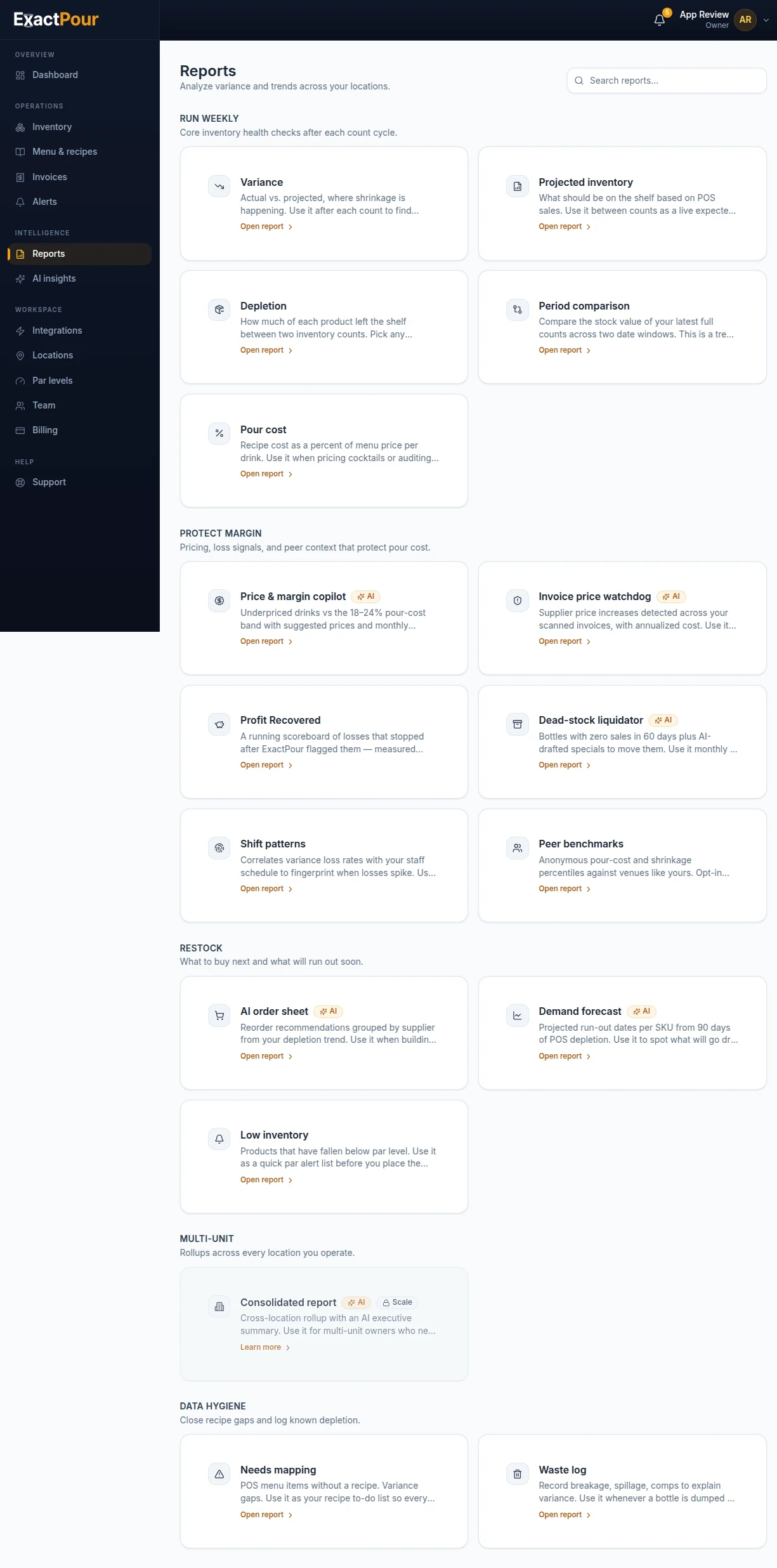
Reports index, including pour cost
Pour cost is a report you open after recipes and counts exist. This is the index, not an empty pour-cost grid.
Compare
| Capability | ExactPour | Manual pour cost math |
|---|---|---|
| Cost per serving | Auto from bottle price | Rebuilt by hand |
| Pour cost by product & category | One blended number | |
| Updates when invoice prices change | ||
| Ties to actual usage & variance | ||
| Flags drinks below target margin | ||
| Time to refresh | Instant | Hours per cycle |
See cost per serving on every drink
Price menu items against true, current cost
Get suggested prices for drinks above your target cost band
Test a price or pour change before you commit
Catch over-pouring where projected meets actual
Keep bottle costs current from supplier invoices
Pour cost is the percentage of a drink's selling price that goes to the liquor it contains. Sell a cocktail for ten dollars that costs you two dollars in spirits, and your pour cost is twenty percent. pour cost is the formula. It is the single most important metric in beverage management because it tells you, at a glance, whether your pricing, recipes, and purchasing are working together or quietly bleeding margin. Most bars target a pour cost in the high teens to low twenties, but very few actually know their real number, because pour cost is only as accurate as the inventory and recipes behind it.
That is where pour cost control breaks down for most operators. They calculate a projected pour cost from a recipe on paper, then never reconcile it against what actually happened behind the bar. Over-pouring, comps, spillage, and theft push the real number higher, but without a count-to-sales reconciliation, that gap stays invisible. ExactPour exists to close it: it computes pour cost from live bottle pricing and real recipes, then reconciles actual usage against POS sales so your target pour cost and your real pour cost finally sit side by side.
A pour cost calculator is a useful starting point, plug in a bottle price, a pour size, and a menu price, and it spits out a percentage. But a calculator only models the ideal world where every pour is exact, every bottle costs what it did last month, and nothing walks out the door. Real bars do not operate in that world. Base spirit prices change with every invoice, bartenders free-pour with a heavy hand on a busy night, and comps and spillage never make it into the calculator. The number it gives you is a target, not a truth.
Effective pour cost software has to bridge the gap between that target and reality. ExactPour keeps bottle costs current by reading your supplier invoices, so the cost side of every drink updates automatically instead of drifting stale. It then compares the pour cost your recipes predict against the pour cost your actual inventory and sales imply. When the two diverge, you know instantly whether the problem is pricing, portioning, or loss, and where. That closed loop is the difference between a drink cost calculator that produces a nice-looking spreadsheet and a system that actually controls liquor cost percentage over time.
The point of measuring pour cost is to act on it, and the clearest place to act is the menu. ExactPour shows pour cost by drink, by category, and by location, so you can see exactly which cocktails carry healthy margin and which are quietly unprofitable. When a base spirit's cost rises, the affected drinks reprice themselves in your cost view immediately, so you can adjust the price, swap the well brand, or tweak the recipe before a full point of margin disappears across thousands of tickets.
This turns menu engineering from intuition into math. A cocktail that runs a thirty-percent pour cost might justify a one-dollar price increase the market will happily bear, or a half-ounce recipe adjustment that no guest will notice. A well spirit that quietly drives up your blended cost might be worth substituting. Because ExactPour ties every recipe to real, current pricing and reconciled usage, these decisions rest on your actual numbers rather than a distributor's suggested price or a gut feeling, which is exactly what separates bars that manage pour cost from bars that merely track it.
Projected pour cost assumes perfect execution; actual pour cost tells you what really happened. ExactPour computes both and reconciles them by comparing your physical barcode count to the usage your POS sales imply. The difference exposes the hidden costs that inflate liquor cost percentage: heavy pours, unrung drinks, comps that never got logged, and outright theft. Each variance beyond tolerance is flagged and reconciled with a reason code, so you can separate honest operational loss from patterns worth addressing.
Over a few cycles, this reconciliation reveals where your margin actually goes. Maybe a specific well spirit always runs short because the jiggers came off the bar. Maybe one shift consistently posts a worse pour cost than the others. Maybe a popular cocktail's real cost is two points higher than its recipe suggests because of a generous garnish or a free-poured float. These are the leaks a calculator can never find, and they are precisely what a bar has to see to bring its real pour cost down to its target and keep it there.
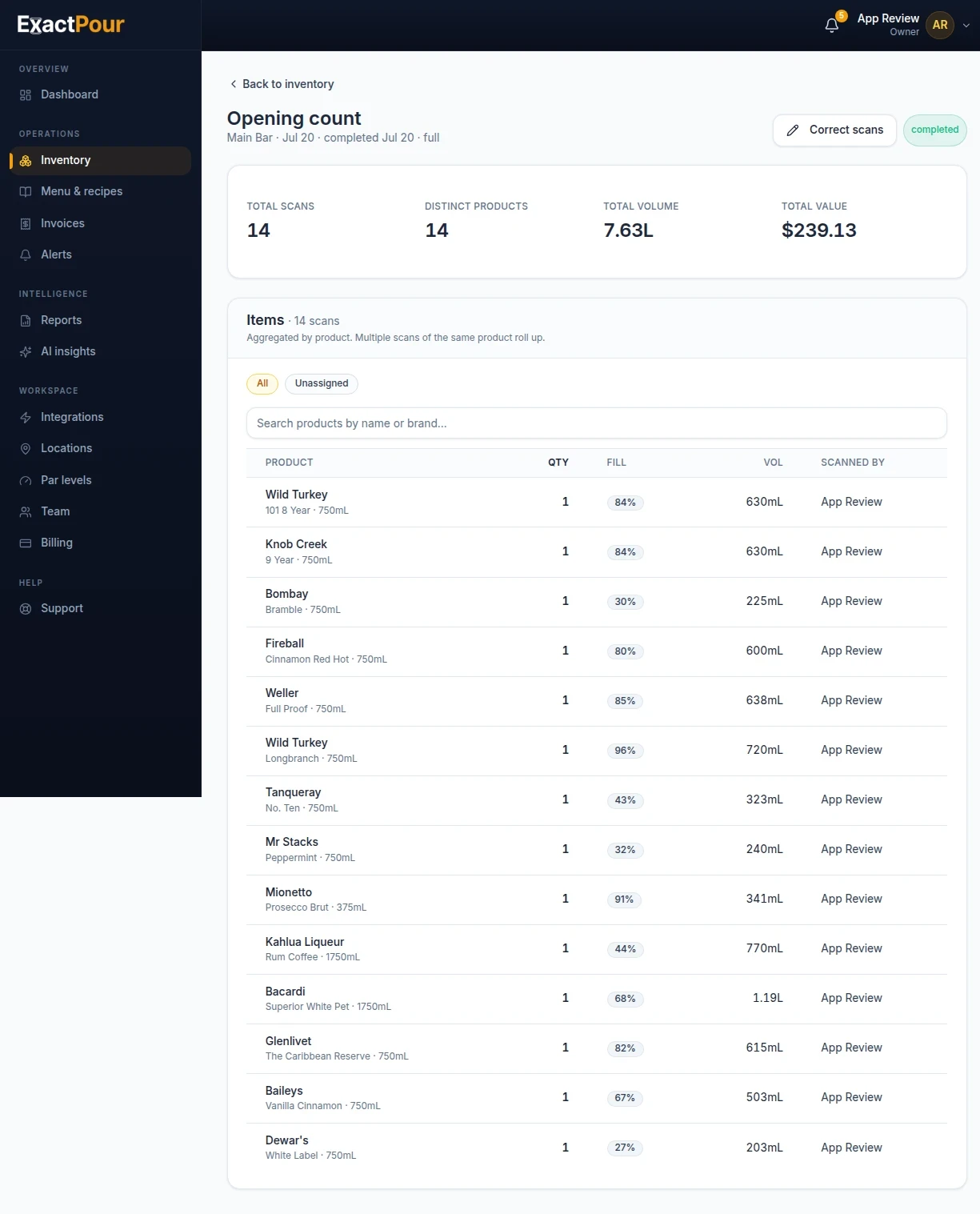
Pour cost control is not a one-time audit; it is a habit, and habits only stick when they are easy. The reason most bars review pour cost quarterly, if at all, is that the underlying count is painful. ExactPour removes that friction with fast barcode counting and automatic reconciliation, so a manager can check pour cost every week without dedicating a night to it. Frequent measurement is what keeps small leaks from compounding into a margin problem nobody can explain at the end of the quarter.
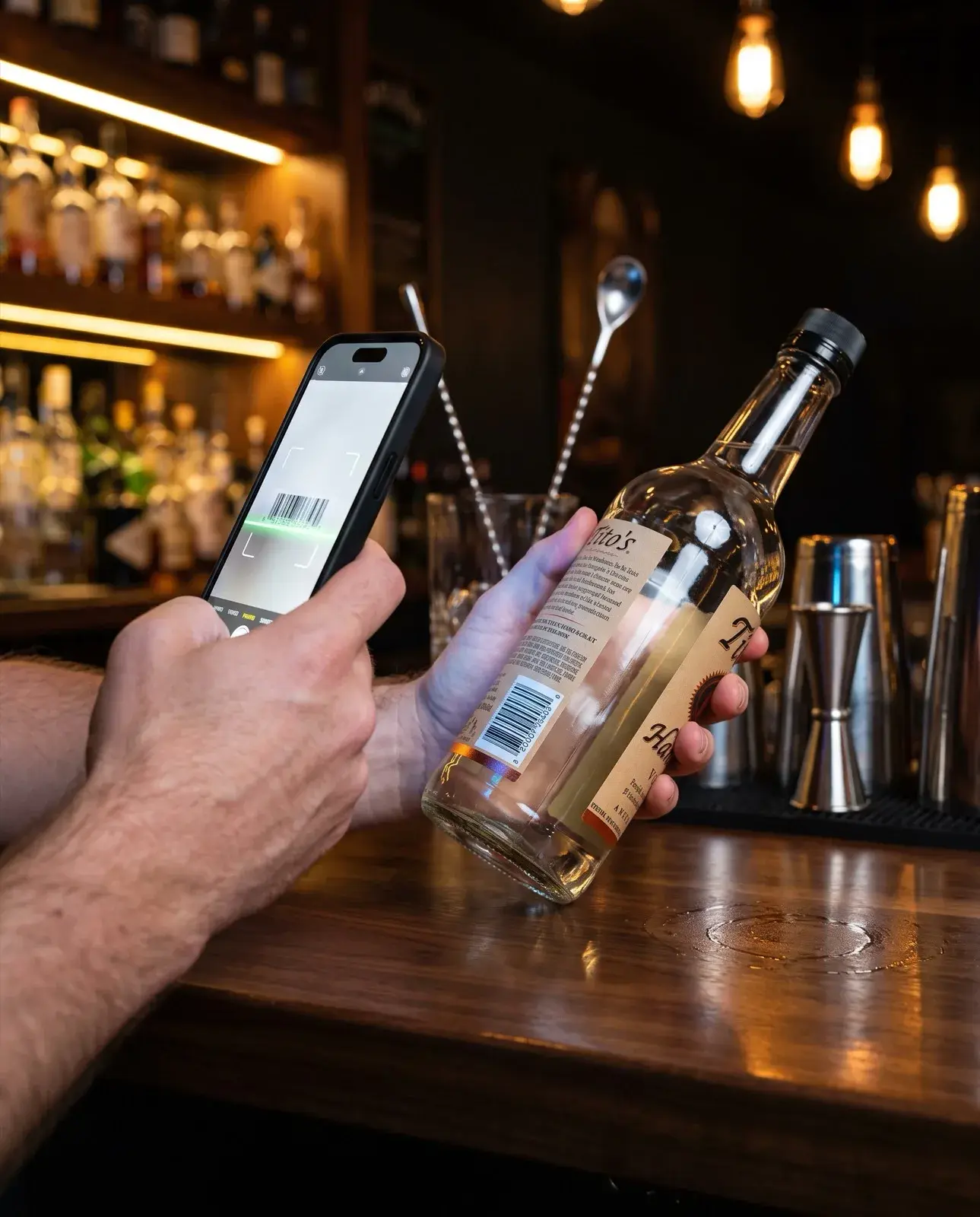
Getting started is quick: scan your shelves to build the product list, connect your POS, set your recipes and target pour cost, and run your first reconciliation, usually within the first day. From there, the AI layer watches pour cost trends and flags the products and shifts dragging your margin down, so you are alerted to problems rather than discovering them. What you recover depends on your own counts and sales. The weekly review is there so a price or recipe change shows up in the next count.
Pour cost is the percentage of a drink's selling price that goes to the liquor it contains, and the basic formula is simple: divide the cost of the product poured by the revenue it generated. A drink built on $2.00 of spirits and sold for $10.00 carries a twenty percent pour cost. Calculate it across your whole program over a period and you get your overall beverage pour cost, the headline number most operators watch. The math is not the hard part; getting honest inputs is.
That is where most pour cost calculations fall apart. The cost side depends on current product pricing and accurate recipes, and the usage side depends on a real physical count of what left the shelf, not what a recipe says should have. ExactPour keeps both honest: it holds current supplier costs from invoices, ties them to recipes, and reconciles against a barcode count of actual usage. Calculate pour cost on guessed inputs and you get a comforting number that means nothing; calculate it on reconciled data and you get a figure you can actually manage against.
There are two pour costs that matter, and the distance between them tells the real story. Ideal, or projected, pour cost is what your drinks should cost if every pour matched its recipe exactly. Actual pour cost is what they truly cost based on the product that left your shelf. In a perfectly run bar the two would match; in the real world, actual almost always runs higher, and that gap is the dollar value of over-pouring, spillage, comps, and theft.
Managing pour cost is really the work of shrinking that gap. ExactPour calculates both numbers from your recipes, sales, and counts, so you can see not just that your pour cost is high but why, and by how much, on each product. A well spirit whose actual cost runs five points above ideal points straight at a heavy free-pour or a shrinkage problem. Watching the ideal-to-actual gap over time turns pour cost from a lagging report card into an active control you can tighten week over week.
A single blended pour cost number hides more than it reveals. A bar can hit a healthy overall percentage while bleeding margin on cocktails, or look troubled overall because one high-volume category runs hot. The insight is in the breakdown. ExactPour reports pour cost by category, spirits, wine, beer, cocktails, by individual product, and by location, so you can see exactly where your margin is strong and where it is quietly leaking.
That granularity is what turns pour cost into decisions. Category-level data tells you whether your cocktail program or your wine list needs attention; product-level data flags the specific SKUs dragging you down; location-level data shows which bar in a group is out of line. For multi-unit operators especially, comparing pour cost across venues surfaces the outlier that needs coaching or investigation. Without the breakdown you are managing a rumor; with it, you are managing a business, one category, product, and location at a time.
The most common pour cost mistake is calculating it too rarely. A number reviewed once a quarter is a historical curiosity; by the time you see a problem, thousands of over-poured drinks have already gone out the door. The second mistake is stale cost inputs, using last year's bottle prices while your distributor has raised them three times, which makes every pour cost calculation optimistic and every menu price a little too low. Both errors let margin erode silently between reviews.
The subtler mistakes live in the recipes and the counting. Loose or undocumented specs mean your ideal pour cost is a fantasy, so you cannot tell over-pouring from bad math. Whole-bottle counting that ignores partial fills makes usage, and therefore actual pour cost, unreliable. ExactPour removes each of these traps by keeping costs current from invoices, enforcing consistent recipes, and capturing partial-bottle counts, so your pour cost reflects reality closely enough to act on. Avoiding these mistakes is often worth more than any single price increase.
FAQ
Divide liquor cost by beverage sales for the same period. ExactPour uses recipes and current bottle cost for the cost side, and a physical count plus POS sales for the usage side. See how to calculate pour cost.
A calculator assumes every pour matches the spec and every bottle still costs last month's price. Real rooms overpour, comp, and take new invoices. ExactPour compares the calculator's ideal to the count.
There is no single honest target for every concept. Measure your own ideal and actual numbers, then manage the gap. ExactPour will not assign a universal percentage.
Starter at $59 a month and up, plus the 14-day trial. See pricing.
Actual pour cost rises when usage exceeds the recipe. ExactPour shows that beside variance dollars so you can coach the product, not a blended guess.
Yes. Tickets from Toast become projected pours after you map recipes. The Toast-specific companion is toast liquor inventory.
Next step
Start your 14-day Pro trial. No credit card required.
Start tonight
Run ExactPour on your own bar for two weeks. See the leaks, the over-pours, and the dollars you can still save.
14 days free · No credit card · From $59/mo