
Count partials
Fill level times bottle size is the volume. Rounding to whole bottles manufactures fake variance.
Liquor inventory management
Track every bottle of liquor by barcode, capture partial fills, reconcile pours against POS sales, and let AI surface the variance that's draining your margin. Built for bars, restaurants, and hospitality groups.
14 days free · No credit card · Plans from $59/month
Last updated
Liquor inventory management is knowing how much alcohol you have, what it cost, what sold, and where the gap went. ExactPour does that for a working well: barcode counts, fill levels on open bottles, invoice costs, and POS reconciliation. It is built for small bars and pubs that pour spirits, not for a sealed retail stockroom.
Fill level times bottle size is the volume. Rounding to whole bottles manufactures fake variance.
Invoice lines update bottle cost so pour cost is not last quarter's price list.
Projected from POS minus actual from the count. Reason-code what you can. Shrinkage is the rest.
The problem
If you only count once a month, you find problems weeks after the trail went cold. Variance becomes a guess instead of a number you can act on.
Without comparing your count to POS sales, you have no way to separate honest measurement error from over-pouring, comps, and theft.
When invoices live on a different spreadsheet than your inventory, pour cost is fiction and menu pricing becomes a guess.
The solution
Barcode counting, fill tracking, POS reconciliation, invoice OCR, and AI variance analysis in one platform.
Scan once, count everything.
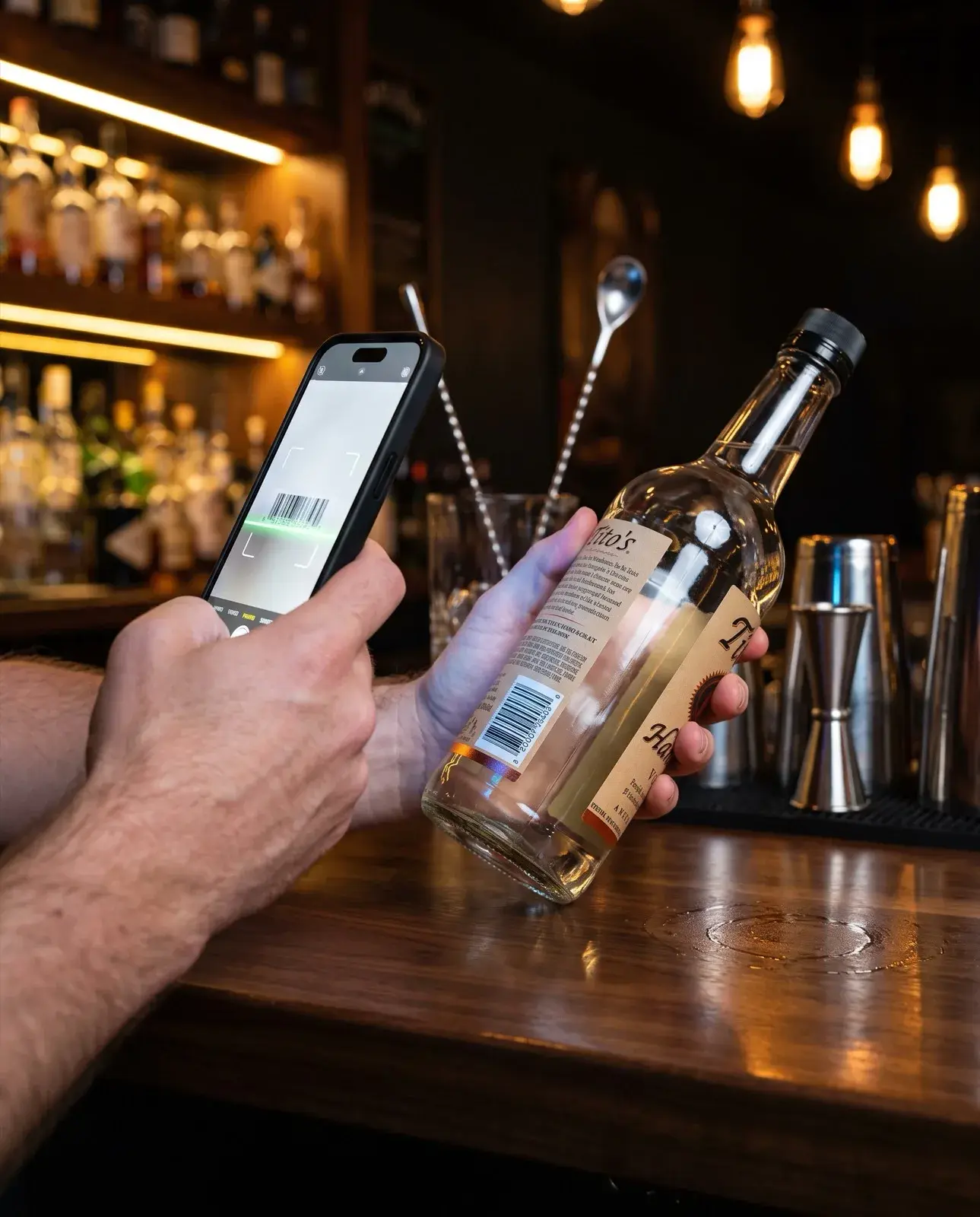
Scan any UPC with a phone or handheld, tap a fill level, and ExactPour aggregates scans per product and auto-computes volume in real time. Undo and inline edits keep counts honest.
Partial bottles, not just whole counts.
Every scan records a fill level from 0 to 1 and computes volume as size times fill, so you track real stock instead of rounding to the nearest bottle.
Toast, Square, Clover, and GoTab are live.
Connect Toast, Square, Clover, or GoTab to a location. Menus and sales import on a schedule or when you ask. POS credentials are stored encrypted.
The baseline behind every comparison.
For every product, ExactPour computes what should be on the shelf from starting bottles minus what the POS says you sold. This is the engine that powers poured-vs-sold comparisons.
Surface the gaps. Explain them.
Items that drift beyond tolerance are flagged (>10% warning, >5% info). Close each out with a reason (breakage, theft, over-pour, measurement error) and notes.
Photo in, items and prices in.
Upload any PDF, JPG, or PNG invoice, every line item and price enters automatically. Files stay private to your account.
Integrates with the POS you already run
Sales sync nightly · No rip and replace




Fill levels on counted liquor
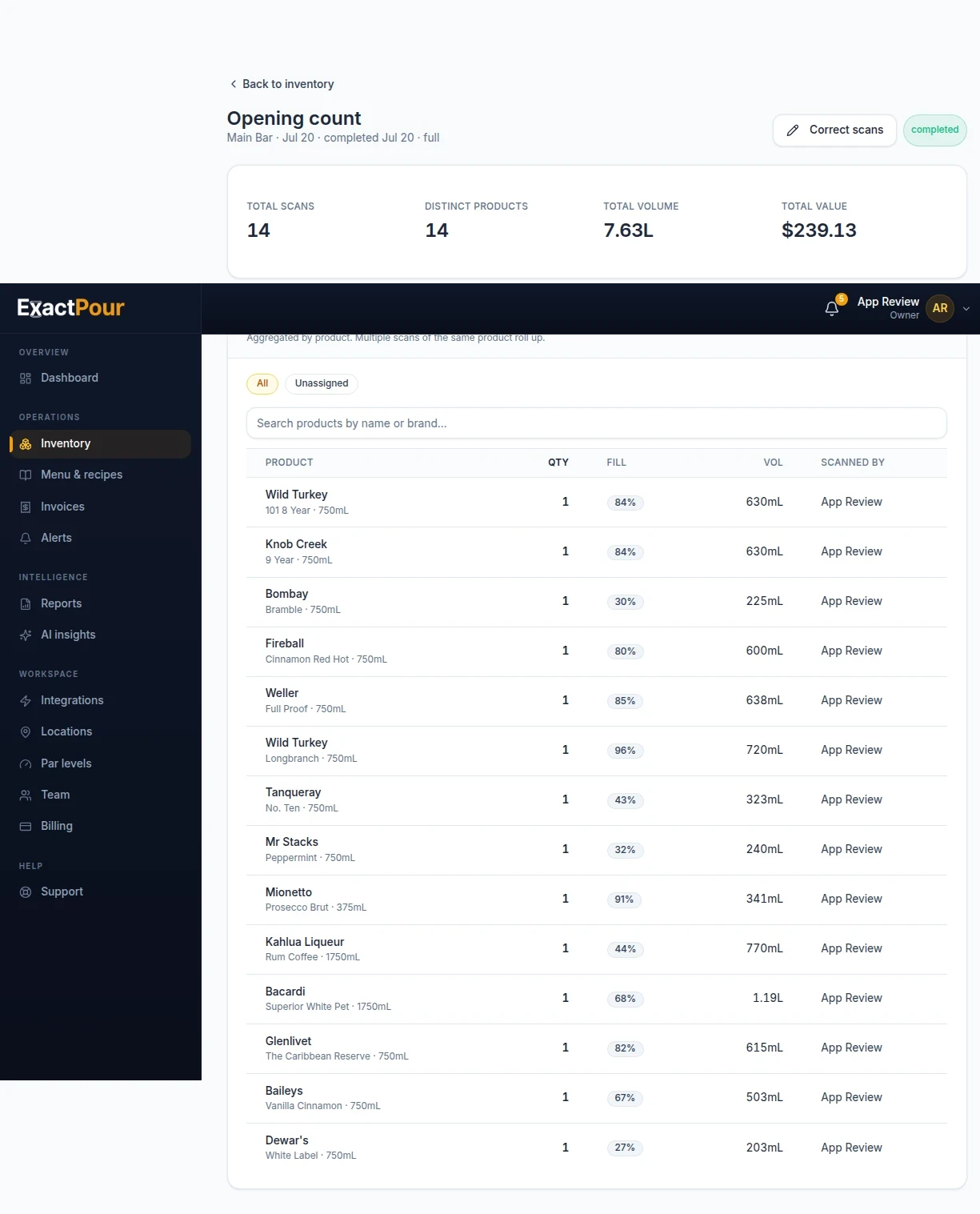
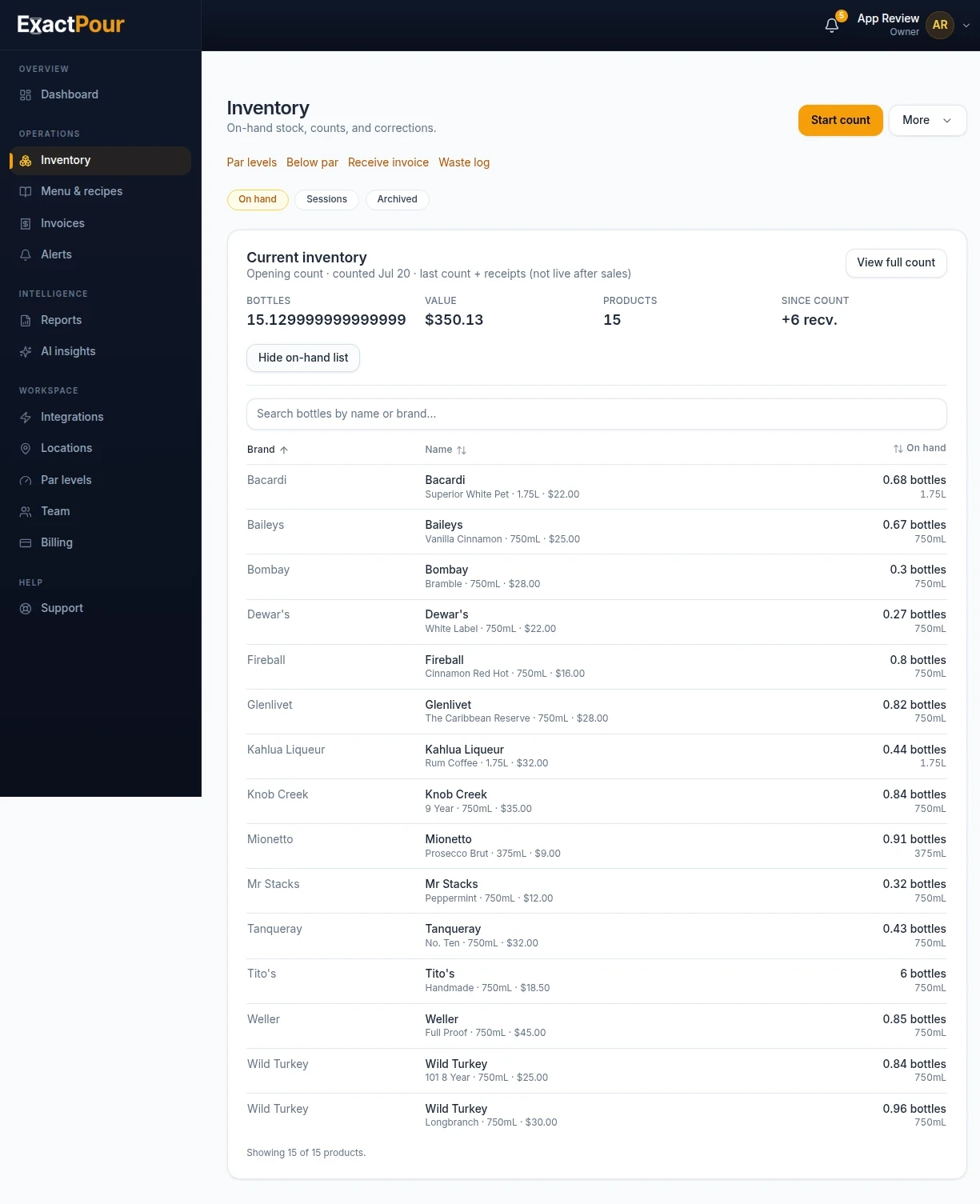
Knob Creek 84% (630mL), Bombay 30% (225mL), Fireball 80% (600mL) from the Jul 20 opening count.
Compare
| Capability | ExactPour | Spreadsheets & clipboards |
|---|---|---|
| Full liquor count | Minutes, by barcode | Hours, hand-tallied |
| Partial-bottle fill levels | Rounded guesses | |
| POS sales reconciliation | Automatic | |
| Variance flagged automatically | ||
| True pour cost per drink | Manual formulas | |
| Multi-location roll-up | Separate files | |
| Immutable audit trail |
Scan partial bottles and get real volume, not rounded guesses
Reconcile every shift against POS sales to expose variance
Keep costs current with supplier invoice OCR
See pour cost and margin per drink, per category, per location
Let AI surface anomalies and forecast demand automatically
Liquor inventory management is the discipline of knowing, at any moment, exactly how much alcohol you have on hand, what it cost you, what you sold it for, and where the gap between the two went. For most bars and restaurants, that discipline is aspirational. Counts happen monthly at best, costs live on a different spreadsheet than the count, and the gap, the variance between projected and actual usage, is never reconciled to a reason.
Liquor inventory management software like ExactPour collapses all of that into one system. You scan bottles by barcode, capture fill levels on partials, import supplier invoices so costs stay current, and reconcile every cycle against your POS. The result is a beverage program where every bottle is accounted for, every variance has an explanation, and every menu decision is backed by numbers you can defend.
ExactPour treats liquor inventory management as an operating loop, not a monthly project: count, reconcile, explain, order, and review. Operators can measure the loop's health by whether weekly counts finish, whether variance flags get reason codes, and whether pour cost moves when recipes or prices change. That practical definition is more useful than any abstract checklist of features.
Three metrics tell you almost everything about the health of your liquor program: pour cost (the percentage of revenue spent on the liquor in each drink), variance (the gap between what you should have poured and what you actually used), and shrinkage (the portion of variance you cannot explain). ExactPour computes all three from your recipes, POS sales, and physical counts so you manage your own band rather than chasing an uncited industry target.
ExactPour computes all three automatically. Recipes tie each drink to its ingredients and cost, POS sales drive the projected inventory, and your physical count closes the loop. When variance drifts beyond tolerance, the system flags it and you reconcile with a reason code, so over time your shrinkage number reflects the real, explainable losses instead of an unmanaged black box.
Use the formulas directly. Pour cost equals liquor cost divided by beverage sales for the period. Variance quantity equals actual usage minus projected usage; variance dollars apply your bottle costs to that gap. Shrinkage is what remains unexplained after reason codes. ExactPour exists to make those formulas computable every week instead of reconstructable every quarter.
Liquor inventory is hard precisely because bottles are open and partially poured. A bottle of vodka that is half full has half its value sitting on the shelf, but many inventory processes round to the nearest whole bottle and lose that information entirely. Over a full back bar, the rounding error alone can swing your inventory value by thousands of dollars and manufacture fake variance.
ExactPour records a fill level from 0 to 1 on every scan and computes volume as bottle size times fill. That means your count reflects real stock, not a rounding exercise, and your variance calculation has a fighting chance of being accurate. Fill tracking also makes marriage management possible, grouping interchangeable SKUs like well vodka or seltzer variety so any member barcode counts as one logical slot.
Consistency beats false precision. ExactPour standardizes fill choices so two bartenders estimating a half-full bottle are more likely to land in the same band than if each invented their own tenths on a clipboard. Over time, that consistency is what makes week-over-week liquor inventory management comparable, and comparability is what makes coaching possible.
Pour cost is only as accurate as the bottle prices behind it. If your catalog still shows last year's distributor pricing, every recipe cost and variance figure downstream is wrong. The problem is that supplier invoices are messy, unstructured PDFs, and keying them into your system by hand is exactly the kind of low-value work that never gets done.
ExactPour uses document understanding to extract lines from a PDF, JPG, or PNG invoice, with plain-text PDF extraction as a fallback, then fuzzy-matches each line to your catalog using barcode lookup and similarity matching. The result is that your costs stay current without manual data entry, and your pour cost and variance numbers reflect what you actually pay, not a stale catalog default.
Fresh costs change decisions. When ExactPour updates a spirit's unit cost from a new invoice, recipe costing and pour-cost views move with it. That is how liquor inventory management stays honest when distributors change prices mid-season, without waiting for someone to notice a margin problem after the fact.
Variance is the gap between what your POS says you sold and what your count says is missing. Items that drift beyond tolerance need an explanation, and that explanation is where the management actually happens. ExactPour flags products beyond tolerance and lets you reconcile each exception with a reason code, breakage, spillage, comp, over-pour, theft, or measurement error, turning a number into a story you can act on.
Over a few cycles, those reason codes reveal patterns. A specific well spirit that always runs short on a certain shift, a high-theft SKU that needs to move behind the bar, a station that consistently over-pours. That pattern recognition is what separates liquor inventory management from liquor inventory counting, and it is the foundation of every other metric in your beverage program.
ExactPour keeps the history so disputes are evidence-based. Managers can see which products were flagged, which reasons were used, and whether the same exception repeats. That audit trail is how liquor programs move from suspicion to process change without turning every variance review into a confrontation.
The right liquor inventory management software depends on your operation, but the platforms that actually move the needle share a few traits. They scan barcodes natively, capture partial fills, integrate with your POS to drive reconciliation, import invoices so costs stay current, and surface variance automatically instead of making you build reports. The best ones add an intelligence layer that forecasts demand and flags anomalies for you.
ExactPour was built to do all of the above for bars, nightclubs, restaurants, wineries, hotels, and hospitality groups. It starts free for a single location, scales to unlimited venues on Enterprise, and runs on the phone or browser your team already uses. If liquor inventory management has been a monthly fire drill at your operation, that ends the day you complete your first reconciled count and keep the cadence weekly.
When you compare options, insist on a live count demonstration, a real POS sync with Toast, Square, Clover, or GoTab, and a sample variance review with reason codes. Marketing feature lists are easy; ExactPour is designed to be judged on whether your team finishes the loop. The cluster guide at bar inventory software pairs with this page when you need the broader software category view. If the list is the business, use wine inventory management instead of forcing wine into a well-shaped row.
Inventory accuracy starts before the count. If deliveries are put away without updating on-hand quantities, ExactPour will correctly report a gap that is really a process miss. Strong liquor inventory management includes a receiving habit: check the invoice, confirm bottle counts, and make sure new product is reflected in the catalog and location where it will be stored. ExactPour's invoice tools help keep costs current; your team still owns putting product in the right place.
Storage discipline matters just as much. Wells, call shelves, and cage storage should be countable without moving half the room. ExactPour works best when barcodes face out and like products live together, because scanning speed collapses when bottles are buried. Marriage groups for interchangeable wells keep the logical count sane even when physical brands rotate.
Transfers between stations are a classic source of fake shrinkage. ExactPour can only reconcile what the POS and the counts know; product that moves from the main bar to a satellite without a record looks like a loss. Operators who log transfers, or at least count both ends on the same night, give ExactPour clean inputs. Liquor inventory management is as much choreography as software.
Monthly liquor counts are usually archaeology. ExactPour is built for a weekly cadence where the count is short enough to finish and the variance review still remembers the week that caused it. Pick a consistent night, assign ownership, and treat the reconciliation meeting as non-negotiable, even if it is fifteen minutes of reason codes rather than an hour of debate.
ExactPour supports that rhythm with barcode sessions, POS sync before the count, automatic flags, and history that shows whether last week's fixes stuck. Forecasting and AI briefs become useful only after a few clean cycles exist; the cadence creates the dataset. Operators can measure success by completion rate: did the count close, did sync run, did flagged items get reasons?
When volume spikes on holidays, festivals, or a packed home stand, keep the weekly full count. Between counts, ExactPour projects what should be on the shelf from POS sales and deliveries, so you can spot-check a suspicious bottle against that number.
Counting without ordering is only half the job. ExactPour connects on-hand quantities from a closed count to par levels you set, then builds suggested reorders that bring products back to target. That is how liquor inventory management becomes working-capital management: you buy what the room will sell, not what a hurried glance at the cage suggested on a Tuesday.
Pars should reflect real velocity. ExactPour's forecasting uses recent POS depletion to project run-out dates and confidence, so managers can raise pars on accelerating SKUs and lower them on dust collectors. Seasonal programs change, rooftop rose in summer, brown spirits in winter, and ExactPour's location-level pars let each room carry a different shape without breaking the shared process.
Purchasing conversations with distributors improve when ExactPour can show depletion and on-hand by product. You are no longer arguing from memory about whether the well tequila "feels low." Liquor inventory management earns its keep when the order guide is a consequence of the count, not a separate guessing exercise.
Groups that run several bars need liquor inventory management that rolls up without erasing local truth. ExactPour keeps counts, POS connections, and variance reviews per location while giving owners consolidated pour-cost and variance visibility. That structure lets an area manager see which room is the outlier without forcing every venue onto identical menus.
Standardize the method, not necessarily the product mix. ExactPour works when every location scans barcodes, captures fills, syncs its POS, and codes variance the same way. Menus can differ; the operating system should not. Shared reason-code discipline is especially important so "over-pour" means the same thing in every room.
If venues run different POS brands, ExactPour still fits: Toast in one room, Square or Clover in another, GoTab in a taproom, each location connects independently. The cluster page at bar inventory software covers the cross-cutting software evaluation; this liquor-focused guide stays on the bottle-level discipline those connectors feed.
FAQ
A small bar needs a count the closer will finish, fill levels on the rail, and a POS map for house pours. ExactPour starts free for counting and publishes paid plans from $59 a month. See liquor inventory software if you want the conversion page for pouring rooms.
Scan the barcode and record a fill level. ExactPour stores fill from 0 to 1 and computes volume as bottle size times fill. Rounding to whole bottles invents fake variance.
Yes. Connect Toast, map well drinks first, then reconcile the count. Unmapped house pours make a careful count look like theft. See toast liquor inventory.
ExactPour Free is $0 for counting. Starter is $59, Pro is $99, Scale is $129. POS reconciliation and invoice tools are on Starter and up. See pricing.
This pillar is for bars that pour spirits. Retail shelf counting is a different job on liquor stores.
Weekly is the cadence most casual rooms can keep. Monthly counts are reconstructions. Daily full-room counts burn the team. Spot-count high-value SKUs after a packed Saturday.
Next step
Start your 14-day Pro trial. No credit card required.
Start tonight
Run ExactPour on your own bar for two weeks. See the leaks, the over-pours, and the dollars you can still save.
14 days free · No credit card · From $59/mo