
Guides
How to count liquor inventory: a practical bar and retail workflow
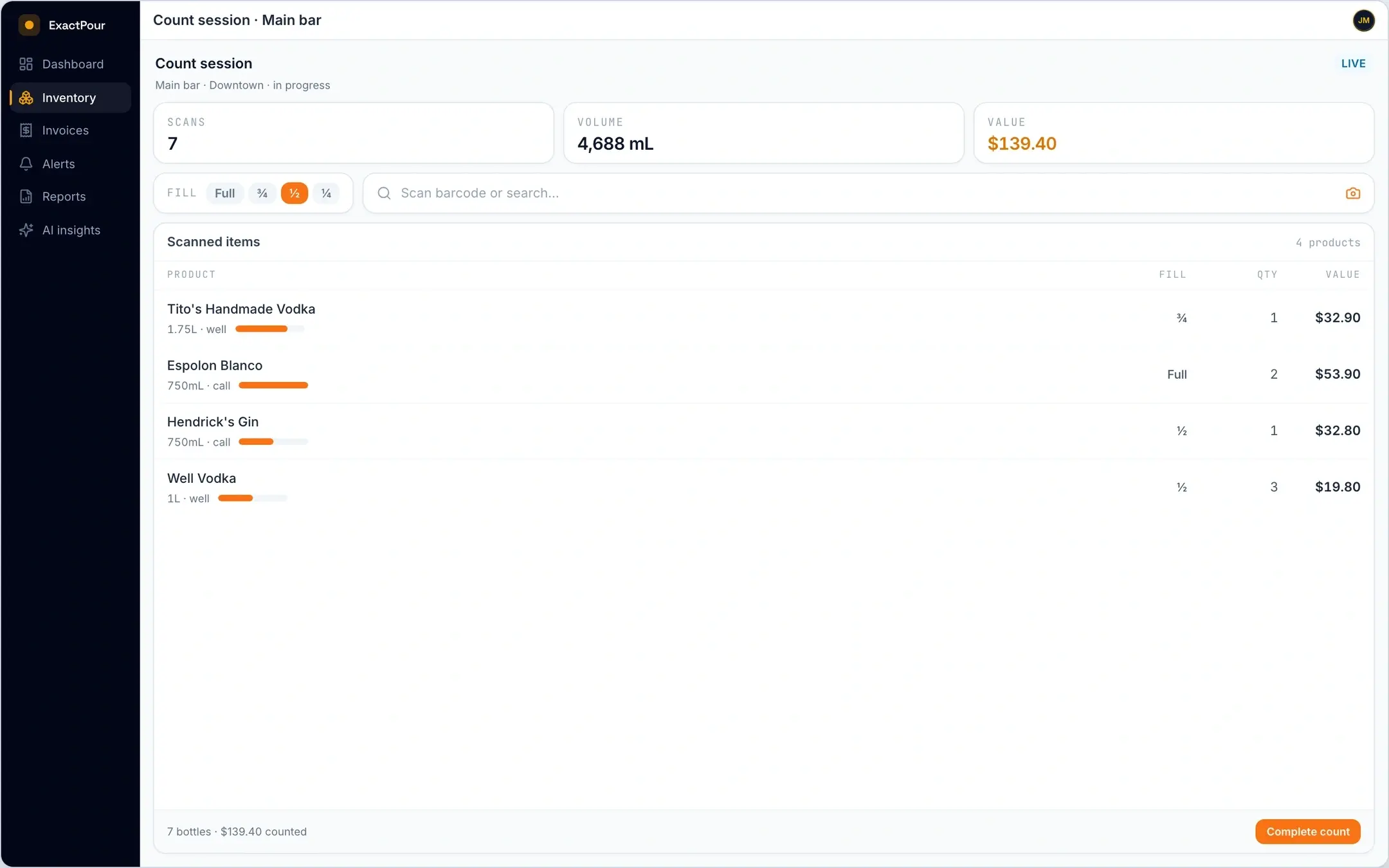
Counting liquor inventory only works when the route, units, and cutoffs are consistent. Here is a step-by-step workflow bars and package stores can finish and trust.
How to count liquor inventory is less about memorizing a formula and more about running a repeatable physical process. A count that finishes inconsistently, uses mixed units, or happens while deliveries are still being put away will invent variance even when nobody stole a bottle. This guide is a practical workflow for bars, restaurants, and liquor retailers who need a finished count they can reconcile.
Start by deciding what the count is for. A full-room inventory establishes on-hand truth for pour cost and variance. A cycle count on high-risk SKUs catches leaks faster without walking every shelf. Label the scope before anyone picks up a scanner. Comparing a spot check of openers to last month's full count as if they were the same dataset is how teams lose trust in the numbers.
Write a route map and keep it. Walk storage, then the main bar, then satellite stations and coolers in the same order every time. Missing the same speed rail or banquet closet every week creates a phantom shortage that looks like theft. Laminate the route or pin it in your inventory app so new staff do not improvise a different path each close.
Freeze activity at a cutoff. Pause receiving, transfers, and event pulls, or record them with timestamps the reconciliation can respect. Counting while a case is being broken down moves the physical truth under your feet. ExactPour and any serious liquor inventory system assume the count window and the sales window describe the same world; cutoffs are how you make that true.
Pick one unit system and do not switch mid-count. Ounces, milliliters, or bottle-equivalents can all work if recipes, receiving, and reports use the same convention. Mixing tenths of a bottle on the rail with case counts in the storeroom without converting them is a common source of fake variance. Document the convention next to the route map.
Count sealed product first by barcode or SKU, then open bottles with a consistent fill-level method. Visual tenths are fast when the team is trained; they are still estimates. The goal is shared bias, not laboratory precision on every opener. If a few top-shelf bottles create disproportionate noise, spot-check them with a stricter method later rather than slowing the entire room.
Capture empties and known waste separately. Pull dead bottles, log breakage and comps with reason codes, and do not leave mystery empties in the rail for the next person to invent a story about. Clean empties and documented waste make the remaining unexplained gap smaller and more honest.
Use two people when the room is large or high-value. One scans or calls SKUs; one confirms location and fill. Dual control slows casual sweethearting and catches mis-scans. For a small neighborhood bar a single trained counter may be enough; for a multi-station nightclub or package store with thousands of retail SKUs, pairs pay for themselves in fewer recounts.
Record who counted, when the session started and ended, and which locations were in scope. An audit trail is not bureaucracy for its own sake. When variance appears next week, you need to know whether the prior count was complete. Software helps here: ExactPour keeps session history so a finished liquor inventory count is evidence, not a screenshot of a spreadsheet.
After the physical count, reconcile against POS sales for the same period. Projected usage from recipes and sales should be compared to actual usage from beginning inventory plus receipts minus ending inventory. The gap is variance. Assign reason codes where you know the cause; escalate only the unexplained, high-dollar exceptions. For the math and investigation habits, see bar variance explained, inventory variance, actual usage, and the method notes in bar inventory counting basics.
Retail liquor stores and wine shops follow the same logic at catalog scale. Scan down the aisle by UPC, cycle-count high-theft categories more often, and reconcile to register sales so shrinkage is a SKU list rather than an annual guess. The industry page at liquor stores covers that retail shape; the product workflow still begins with a finished count.
Bars and restaurants should map top sellers to recipes before they obsess over a perfect variance percentage. Unmapped cocktails deplete stock that projected reports never see, which makes a careful count look wrong. Close the highest-volume blind spots first, then tighten pour specs. The liquor inventory management guide explains how counting feeds that loop.
Cadence matters as much as method. A weekly count you finish beats a monthly marathon you skip in peak season. Choose an interval your team can sustain for six consecutive cycles, then tighten only where unexplained dollars stay loud. Companion reading: how often should bars count inventory.
Common failure modes when learning how to count liquor inventory: changing fill conventions between shifts; counting during receiving; forgetting a satellite cooler; treating comps as if they never left the shelf; and arguing about theft before checking recipe maps and transfer logs. Fix process before you escalate people.
A clean first-week agenda: print or open the route; train fill levels on ten open bottles; count one full cycle; enter or confirm receiving for the same window; pull POS sales; review the top ten variance SKUs; assign reason codes; write one process fix. If that loop feels impossible by hand, you need better tooling, not a longer spreadsheet.
ExactPour is built to shorten the minutes inside that agenda: barcode identity, fill-level capture, shared count sessions, POS reconciliation, and a history of who closed what. The software does not replace judgment about theft versus over-pouring. It makes the count finishable and the unexplained gap visible enough to coach in the same week.
Multi-location groups should standardize the route language and unit system even when outlet cadences differ. A lobby bar and a flagship nightclub can count on different days; they should not invent different definitions of a tenth. Corporate rollups only work when each liquor inventory count means the same thing.
Train closers the way you train cash handling. Counting liquor is part of closing the house, not optional homework. A short refresher before the first three live counts prevents the method from drifting into tribal knowledge. Keep inventory cadence and bar inventory counting basics next to the SOP so new managers inherit the method, not a myth.
If ownership asks for a single tip on how to count liquor inventory, give them this: finish the same route, at a real cutoff, in one unit system, then reconcile to sales before you debate causes. Everything else, scanners, AI briefs, pour-cost dashboards, amplifies that discipline. Without it, the most expensive liquor inventory system is still just a faster way to be confidently wrong.
For operators evaluating tools after they fix the workflow, start from bar inventory software and liquor inventory management. Ask how partial bottles are recorded, how POS sales become projected usage, and how long a representative count takes in your room. The buying questions matter more than any claim about industry-average shrink.
Package the count for the next person: empties pulled, transfers closed, devices charged, route current, and the review owner named. Five minutes of handoff prevents the twenty-minute scavenger hunt that makes people hate inventory night. When the handoff is clean, how to count liquor inventory stops feeling like archaeology and starts feeling like closing the till.
Revisit the method whenever the room layout, menu, or staffing model changes. A new speed rail or banquet bar is a new miss risk. Retiming a full count after a remodel is cheaper than six weeks of mysterious variance. ExactPour can show missed sessions and product gaps; leadership still has to keep the physical route honest.
Finally, celebrate finished counts the way you celebrate sales goals. A streak of on-time, fully scoped liquor inventories signals that control is part of professionalism. Pair that praise with same-week exception review so you are not celebrating empty checkboxes. The point of learning how to count liquor inventory is not the ritual, it is a shelf number trustworthy enough to manage margin.
How to count liquor bottles for inventory is the same loop at bottle scale. Scan or identify each SKU. Count sealed units. Record the opener as a fill from 0 to 1. Do not skip an empty hole in the rail. Empty is information. Pubs that still say stocktaking are naming this ritual. Use bar stocktaking for the sign-off story and liquor inventory template if you need paper tonight.
Sports bars and pubs should count the well first, then the back bar. See sports bars and pubs. The software category page remains bar inventory software.
Questions this guide answers
- How do you count liquor bottles for inventory?
- Walk one route, count sealed bottles by barcode or SKU, then record each opener as a fill from 0 to 1. Use one unit system. Freeze receiving or timestamp it. Save the session before staff leave.
- Is this the same as bar stocktaking?
- Same ritual, different URL. /bar-stocktaking is the stocktake sign-off story. This guide is the step-by-step count. /liquor-inventory-template is the paper sheet.
- How often should we run this count?
- Weekly for the liquor well in most casual bars and pubs. See /blog/how-often-should-bars-count-inventory and /docs/inventory-cadence.
Put it into practice
See this on your bar
Run ExactPour for two weeks and turn this guide into real numbers in your own operation. Book a walkthrough if you want a live tour first.
Related
Guides
How to calculate pour cost from current inventory data
Guides
How to choose bar inventory software without the demo fog
Guides
How to price a cocktail menu with pour-cost math
Guides
How to benchmark your bar's pour cost without folklore
ExactPour
Liquor inventory management
Docs
Bar inventory counting basics