
Most demos look fine. The operators who choose well test counting, POS mapping, variance, and invoice workflow on their own catalog, not on a vendor sample bar.
Choosing bar inventory software is less about finding the flashiest dashboard and more about finding a system your team will finish counting with on a busy Tuesday. The wrong purchase becomes shelfware. The right one becomes the weekly habit that makes variance and pour cost trustworthy.
Start from the job to be done. Are you trying to finish counts faster, catch unexplained depletion sooner, keep bottle costs current, control pour cost, or roll up multiple outlets? Rank those jobs. A tool that is excellent at reporting but painful to count with will lose to a simpler workflow your staff actually completes.
Counting method is the first fork in the road. Barcode-driven counting, scale-based counting, visual fill levels, and hybrid approaches each trade speed, precision, and hardware burden. Be honest about storage layout, training maturity, and whether you will maintain extra devices. For a deeper comparison, see our barcode vs scale piece; for the category overview, start at bar inventory software.
Partial bottles are where many systems quietly fail. Sealed-case counting is easy. Openers are not. Ask how fill levels are captured, whether units stay consistent with recipes, and how the system prevents creative freelancing between shifts. If the demo only shows full bottles, ask to walk an open well.
POS integration determines whether projected inventory is real or aspirational. Confirm which platforms you use today, Toast, Square, Clover, GoTab, or others, and what 'integration' means in practice: sales import, item mapping, recipe linkage, and how breaks are handled when a menu item changes. A CSV export you babysit weekly is not the same as a maintained connection.
Recipe and catalog integrity should be visible. You want one product list, clear units, and editable mappings when the POS name does not match the bottle on the shelf. Ask who owns catalog cleanup during onboarding and how long a typical bar's top sellers take to map. Fuzzy matching helps; human confirmation still matters.
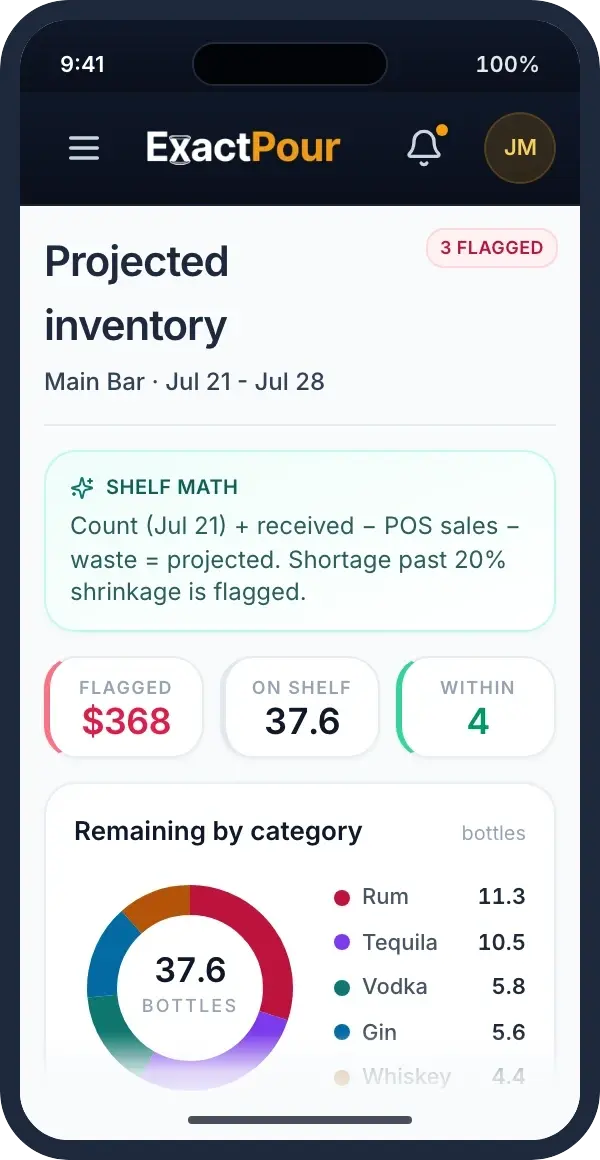
Variance and reconciliation workflows separate inventory notebooks from inventory control. Look for projected vs actual comparison, per-product tolerances or baselines, exception queues, and reason codes. A chart without a review loop is decoration. ExactPour's bar inventory software guide at bar inventory software spells out how those pieces fit together.
Pour cost and beverage cost features should draw from the same live inputs as counts and invoices, not from a disconnected cost spreadsheet. Ask how a supplier price change flows into drink cost, and whether you can see cost by drink, category, product, and location. Pretty pour-cost tiles with stale costs are worse than a plain number you trust.
Invoice capture is an underrated buying criterion. If bottle costs are updated only when someone remembers to type, every downstream metric drifts. OCR with human review can shrink that labor. Confirm how credits, specials, and unit mismatches are handled when the model guesses wrong.
AI features deserve a specific interrogation in 2026. Daily briefs, anomaly detection, forecasting, and conversational query can save manager time, if they are grounded in your data and show provenance. Ask what happens when the model is unsure. Distrust any pitch that implies the software will run the bar without people.
Multi-location needs show up immediately in permissions, transfers, and rollups. Can a beverage director see exceptions across outlets without giving every bartender company-wide access? Are transfers first-class? Can each location keep a cadence that fits its volume while reporting on a shared calendar?
Implementation reality beats feature matrix theater. Ask for a trial plan that uses your catalog, your storage photos or map, and your real invoices. Measure count time before and during the trial. Review two variance cycles. Have the person who actually counts, not only the owner, use the product before you sign.
Pricing should be evaluated as total cost of control: subscription, scanners or scales if required, onboarding fees, and the labor hours to keep the system honest. Cheaper software that doubles count time is not cheaper. Expensive software that sits unused is not an investment.
Security and tenancy questions belong in the same conversation as features. How is customer data isolated? Who at the vendor can access your environment? Where do invoice images live? For groups with compliance or franchise constraints, get answers in writing.
Red flags in demos include: refusal to use your items; vague POS answers; no discussion of partials; promised savings percentages without a measurement method; and pressure to annual-prepay before a single live count. You are allowed to leave those conversations.
A concise shortlist process: define must-have jobs; eliminate tools that fail counting or POS fit; run a two-week trial on one location; score on completion rate, count minutes, exception quality, and manager trust; then negotiate. Keep bar inventory software open as your category checklist while you compare.
ExactPour is built around barcode-driven counts, fill levels, POS-linked variance, pour cost, invoice OCR, and an AI layer that summarizes what needs attention. Whether or not you choose ExactPour, choose software the way you choose a bar tool: by how it performs in the hands of the people who close the night, not by how it looks in a slide deck.
Involve the skeptics early. The senior bartender who hates new systems will find the broken barcode and the awkward partial faster than the owner who loves dashboards. Their frustration during a trial is a gift. If you only demo with enthusiastic managers, you will buy something that collapses on the first Saturday the skeptic is alone on count.
Ask vendors for references in concepts like yours, volume, POS, and storage complexity, and ask those references what broke in month two. Month one is adrenaline. Month two is whether the catalog stayed clean and whether counts still finish when the GM is on vacation. Note what the reference still does manually; that residue is part of total cost.
Contract terms deserve a slow read: data export rights, renewal notice windows, hardware warranties, and what happens to invoice images if you leave. Inventory history is operational memory. You should be able to take counts, costs, and mappings with you in a documented format. If export is vague, treat that as a product gap.
Support quality shows up when a delivery arrives with a new pack size the day before inventory. Is there a human who understands bars, or only a generic ticket queue? During the trial, intentionally create a messy case, wrong unit, missing UPC, recipe edit, and watch how support and the product respond. That exercise predicts year-one pain better than a feature matrix.
End the buying process with a written decision memo: jobs ranked, tools scored, trial metrics, risks, and the reason you chose the winner. Future you will thank present you when a new salesperson claims everything changed. Keep bar inventory software and your memo side by side; category clarity plus local evidence is how operators choose software without the demo fog.
Score vendors on a one-page sheet during demos so comparisons stay parallel: counting, partials, POS, variance, invoices, AI provenance, multi-unit permissions, trial realism, support, export rights. Weight the rows by your ranked jobs. A weighted score will not make the decision automatic, but it will stop the loudest salesperson from rewriting your criteria mid-call.
Plan the first ninety days before you sign. Who cleans the catalog? Who trains closers? Which location goes first? What does success look like at day thirty versus day ninety? Software without an operating plan becomes a logo in a bookmarks folder. ExactPour trials work best when that plan is explicit; the same is true of any serious alternative you evaluate beside the checklist at bar inventory software.
When two finalists tie on features, pick the one your counters finish with less complaining and the one whose exception queue your managers actually close. Adoption is the multiplier on every ROI model. Unadopted precision is ornamental.
After you choose, schedule a thirty-day retro with the same score sheet you used in demos. Did counting minutes match the trial? Are exceptions closing? Are invoice costs current? If not, the issue is usually onboarding or process, not a need to rip out the tool on day thirty-one. Fix the operating plan first; only then reopen the vendor decision. That is how bar inventory software stops being a landing page and becomes a working control system.
Buying bar inventory software is ultimately a bet on operational honesty: that you want numbers good enough to coach from, not theater for a franchise audit. Choose the vendor that survives contact with your messiest cooler and your most skeptical closer. Feature lists are easy to inflate; finished counts and closed exceptions are not. Hold every demo, including ExactPour's, to that standard.
Bring a printed checklist into every demo and refuse to leave a row blank. Counting method, partial bottles, POS mapping, variance exceptions, invoice cost updates, permissions, export rights, and trial design should each get a concrete answer with a screenshot or live click, not a promise about the roadmap. Vendors that cannot show your messy case will not magically handle it after the contract. ExactPour should be held to the same blank-row rule as everyone else on your shortlist beside bar inventory software.
Put it into practice
See this on your bar
Run ExactPour for two weeks and turn this guide into real numbers in your own operation. Book a walkthrough if you want a live tour first.
Related
Guides
How to count liquor inventory: a practical bar and retail workflow
Guides
How to calculate pour cost from current inventory data
Guides
How to price a cocktail menu with pour-cost math
Guides
How to benchmark your bar's pour cost without folklore
Compare
Best bar inventory software (2026)
ExactPour
Bar inventory software