
Variance
Bar variance explained: the gap that's draining your margin
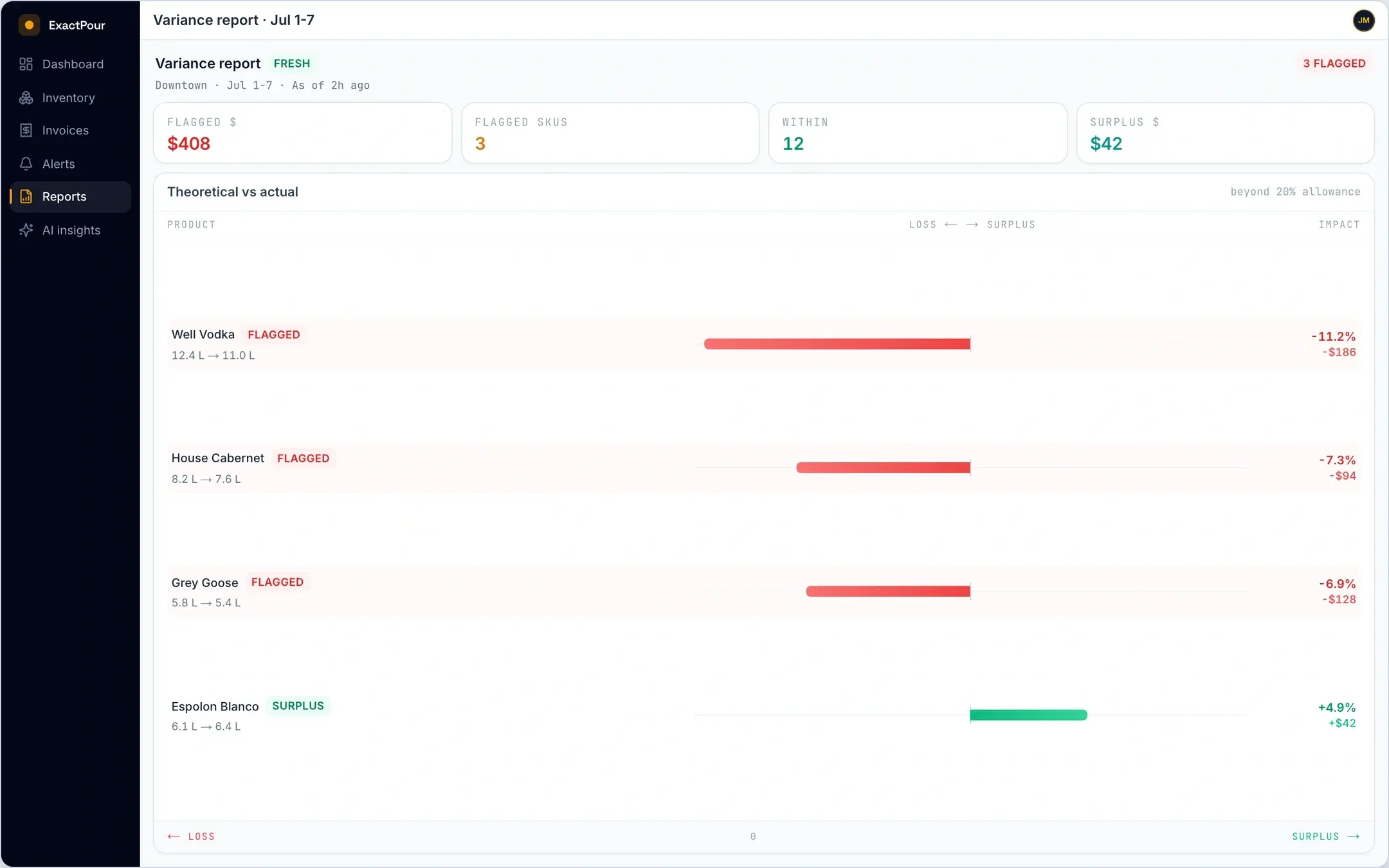
Variance is the gap between expected usage from POS sales and actual usage from physical counts. This guide explains how to calculate and investigate it.
Variance is the gap between what your POS says you sold (projected usage) and what your physical count says is missing (actual usage). inventory variance, projected usage, and actual usage are the three definitions. Tracking it gives a beverage team a concrete starting point for investigating unexplained depletion, without pretending that a single number proves theft, waste, or over-pouring on its own.
Possible causes include over-pouring, undocumented comps, theft, breakage, transfers that never hit the system, recipe mismatches, and measurement error on partial bottles. Reconciliation identifies the products and periods that need review. Assigning a cause still requires judgment, interviews, and supporting records.
How to calculate variance in the classic inventory identity: start with beginning inventory, add receiving (and transfers in), subtract projected usage derived from POS sales through recipes, and compare the result to ending physical inventory. Rearranged, actual usage equals beginning plus receipts minus ending. Variance equals actual usage minus projected usage (or the reverse, depending on your sign convention, pick one and keep it).
Express variance as both units (or ounces) and as a percentage of projected usage. Absolute ounces help you prioritize expensive SKUs. Percentage helps you compare a fast-moving well vodka to a slow premium whiskey without treating them as the same problem. Dollarize the gap when you need to talk to ownership; unit variance alone understates the cost of losing a top-shelf bottle.
What counts as acceptable variance depends on the category and on your own history. Well spirits and high-velocity products tend to show more noise because they move fast, pour often, and accumulate small estimation errors. Premium spirits and low-velocity products should usually run tighter. The useful discipline is a per-product baseline, not a single blunt tolerance pasted across the whole back bar.
Build baselines from several comparable count cycles before you panic over one bad week. A holiday rush, a large private event, or a new bartender cohort can move the number without meaning the process collapsed. Flag exceptions when a product drifts beyond its own recent distribution, for example, beyond a tolerance you set from prior cycles, then investigate, rather than chasing every one-off blip.
Investigation works best when the window is short. If you only count monthly, a missing half-case of tequila could have disappeared on any of thirty nights, with rotating staff and multiple receivers. Weekly or more frequent counts on high-risk SKUs shrink the suspect period. ExactPour's bar inventory software guide at bar inventory software frames how counting method and cadence support that tighter loop.
Reason codes turn a pile of exceptions into a learning system. Breakage, spillage, comp, over-pour, theft suspected, measurement error, transfer correction, and recipe error are common buckets. Require a short note on expensive or repeated flags. Over time you will see patterns: a specific well spirit short on one shift, a station that consistently over-pours, a high-theft SKU that needs to move behind the bar or onto a pour spout policy.
Recipe integrity is a silent variance driver. If the POS item maps to a 1.5 oz pour but the house standard is 2 oz free-pour, projected usage will forever understate reality. If a cocktail recipe omits a modifier that bartenders always add, the modifier will look like theft. Audit top sellers whenever variance clusters on those drinks.
Receiving errors create false variance just as easily as pouring errors. A case checked in at the wrong size, a credit memo never entered, or a transfer logged to the wrong outlet will show up as mysterious depletion or inflation. Close the loop between the invoice, the purchase order, and the inventory receipt before you escalate to coaching or security conversations.
Partial-bottle estimation deserves special attention. Visual tenths are fast and good enough for many programs; they are still estimates. A team that always rounds generous on openers and stingy on closers invents variance out of thin air. Train the method, use the same fill-level conventions, and consider scales or more precise tools for the highest-value openers if the noise is drowning the signal.
People dynamics matter. Variance conversations that only happen as accusations produce defensive counting and quiet workarounds. The healthier frame is: the system found a gap; we will find the process or behavior that created it. Celebrate clean cycles and clear documentation as much as you pursue unexplained loss.
Multi-unit operators should compare outlets carefully. Different layouts, different guest mixes, and different training maturity produce different baselines. Use variance to coach and to share what works, not to rank managers on a metric polluted by unequal concepts. Shared storage and commissary models need explicit transfer rules or the rollup will lie.
Tooling should automate the boring parts: compute projected usage from sales and recipes, compare to counts, surface products outside tolerance, and keep reason-code history. ExactPour is built around that loop, per-product baselines, automatic flags, reconciliation workflows, and AI briefs that summarize patterns for a manager who will not live in a spreadsheet every morning.
When you evaluate software, ask how projected usage is calculated, how partials are captured, whether POS mapping is visible and editable, and how exceptions are assigned and reviewed. The buying guide at bar inventory software is a useful checklist for those questions. A pretty variance chart without a trustworthy count and recipe layer is just a smoother way to be wrong.
A practical starting plan: pick one location, ensure recipes exist for the top revenue drinks, run consistent counts for several weeks, reconcile only the products outside tolerance, and write down what you learn. Expand scope once the first location's process is boring in the best sense, repeatable, documented, and trusted.
Variance will never hit perfect zero in a living bar. Guests spill, bottles break, estimates wobble, and humans are imperfect. The win is shrinking unexplained, repeated, high-dollar gaps until the remaining noise is small enough that you can manage the business instead of arguing with the spreadsheet.
Waste logs and comp policies are part of the variance system even when they live in a different app. If breakage is written on a napkin and comps are whispered to the POS as a different SKU, your projected usage will never match reality. Standardize how non-sale depletion enters the record before you escalate staffing conversations. The cleaner the side channels, the more meaningful the remaining gap becomes.
Camera footage, till reports, and schedule data can support an investigation, but they should not be the first tool you reach for on every flag. Start with process: Was the count complete? Was receiving correct? Did a recipe change? Did a private event pull from the back bar without a transfer? Only after those questions should you move to interpersonal or security framing. That order protects culture and still catches real loss.
Outlet transfers deserve a dedicated checklist in multi-bar buildings. A bottle that walks from the service bar to banquet storage without a ticket looks like theft in one place and a miracle delivery in another. Require the same discipline for internal moves that you require for supplier receiving. Software helps only if people use the transfer action when they move product.
Over time, publish a short variance digest to ownership: top dollar exceptions, resolved causes, open questions, and process changes made. That digest trains leadership to expect learning, not perfect zeros. It also creates institutional memory when managers change. ExactPour's briefs are one way to draft that digest; the habit of reviewing it is still a human operating cadence.
If you are still building the program, resist the urge to instrument everything on day one. Pick twenty high-velocity or high-value SKUs, get their recipes and counts clean, and reconcile those thoroughly. Expand the watched set as the process becomes boring. Depth on a focused list beats shallow red-yellow-green dashboards across a dirty catalog. The same principle is outlined in the buying context at bar inventory software.
Create a severity ladder so the team knows what needs same-day attention versus weekly review. Example tiers: high-dollar or high-theft-risk SKUs outside tolerance get same-day notes; medium flags get weekly reconciliation; tiny noisy gaps on low-value wells get watched for persistence across cycles. Without a ladder, every red cell feels equally urgent and nothing gets finished.
Share sanitized lessons across shifts: not to shame a person, but to show the pattern you fixed. A two-sentence note like 'well vodka short three cycles, pour spout installed and recipe confirmed at 1.25 oz' teaches faster than a private scolding. ExactPour can store reason history; culture decides whether that history becomes coaching or ammunition.
When you expand from one bar to a group, keep the first location's playbook as the template: same reason codes, same tolerance philosophy, same review meeting shape. Local baselines will differ; the operating system should not. That is how variance programs scale without turning into a different religion at each address. For tooling context, keep bar inventory software in the onboarding packet.
Close each investigation with a one-line outcome: cause confirmed, process fixed, still watching, or data quality. That tiny discipline keeps the exception queue from becoming a graveyard of unresolved red rows. Over a quarter, the distribution of those outcomes tells you whether you have a pouring problem, a receiving problem, or a measurement problem, which is the real payoff of variance work.
Questions this guide answers
- What is bar variance?
- Variance is actual usage minus recipe-based projected usage minus documented waste. It is the gap that still needs a name, not a theft verdict.
- Does variance prove theft?
- No. Overpours, comps, transfers, recipe errors, and a sloppy fill can look identical. Investigate the pattern before you assign a cause.
- Where does ExactPour show variance?
- After a count and a POS map, flagged products appear with dollars and a place to reason-code. See /solutions/liquor-variance-analysis.
Put it into practice
See this on your bar
Run ExactPour for two weeks and turn this guide into real numbers in your own operation. Book a walkthrough if you want a live tour first.