
Count on a cadence
Weekly sessions keep the trail warm. Monthly reconstructions cannot name a shift.
Solution
Theft, over-pouring, and unrecorded comps can quietly cost a bar thousands a month. ExactPour reconciles every pour against sales, flags anomalies statistically, and documents waste so shrinkage has nowhere to hide.
14 days free · No credit card · Plans from $59/month
Last updated
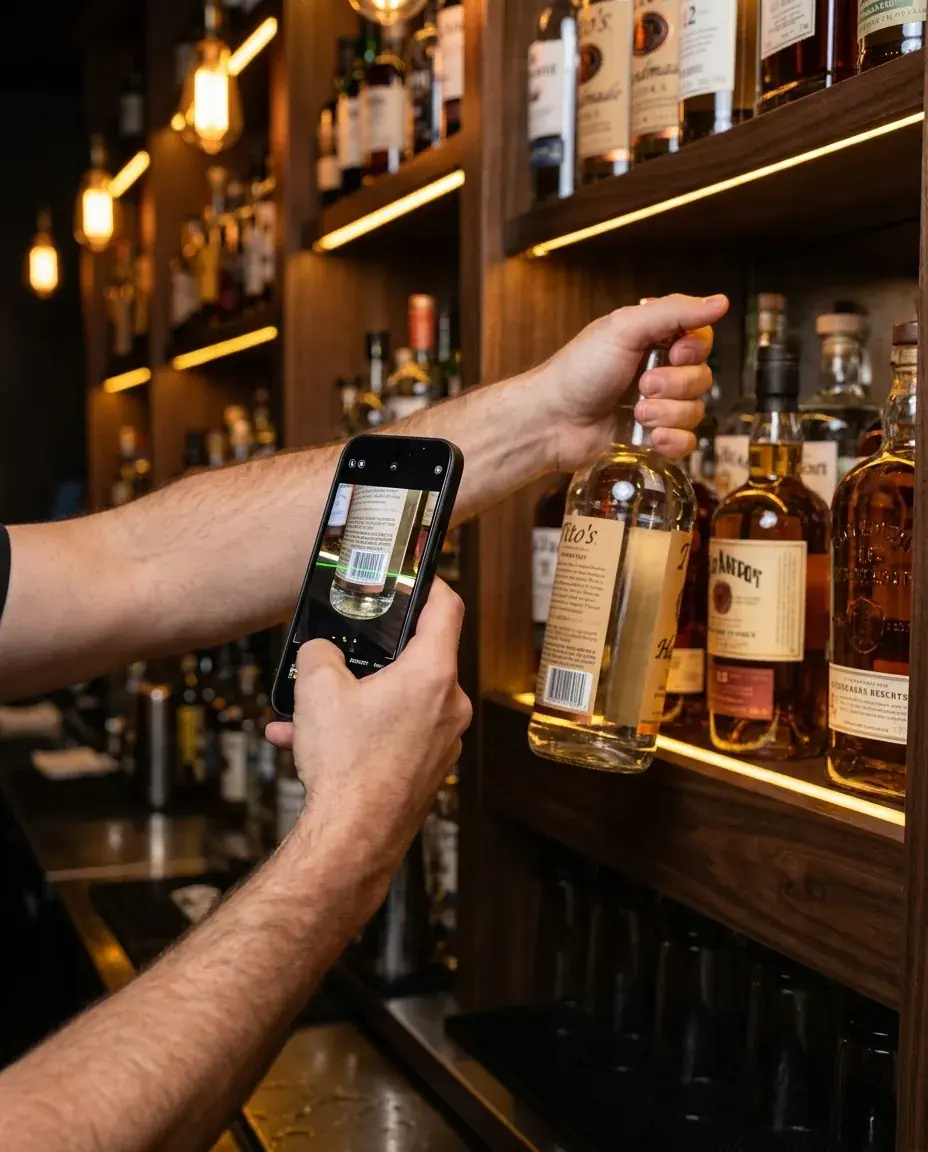
Shrinkage is the unexplained gap after you compare projected usage to a physical count and code honest loss. ExactPour does not claim a camera stops theft. It makes the weekly loop finishable: count the well, sync the POS, price the leftover in dollars, and store reason codes. Coach overpours first. Theft is what remains.
Weekly sessions keep the trail warm. Monthly reconstructions cannot name a shift.
What the POS sold should match what left the shelf after recipes.
Spills, comps, and breakage go in the waste log so they are not counted as theft.
The problem
An extra half-ounce per drink across a busy night is bottles of lost product no one records.
Without a statistical baseline, a bottle walking out looks identical to normal week-to-week noise.
Legitimate losses that aren't recorded inflate apparent shrinkage and hide the real problem.
The solution
Reconciliation, anomaly detection, waste documentation, and an immutable trail.
Surface the gaps. Explain them.
Items that drift beyond tolerance are flagged (>10% warning, >5% info). Close each out with a reason (breakage, theft, over-pour, measurement error) and notes.
Catch outliers the moment they appear.
Learns each product's normal range from 90 days of history and flags it when the latest numbers break pattern. Runs on demand and nightly.
A coaching prompt, not proof.
Log your staff schedule and see whether losses run higher on the stretches certain people worked. A coaching prompt, not proof.
Savings you can verify, not vibes.
When ExactPour flags a loss and your team fixes it, the scoreboard measures the before-and-after loss rate from your own counts and reports a verified dollar figure for what you recovered. No estimates, no AI guesswork.
Document every dropped bottle.
Log breakage, spillage, comps, spoilage, expiry, theft, and training with quantity, volume, cost, and notes. Used as evidence when reconciling variance.
Fix mistakes without losing the trail.
Edit or delete recent scans anytime. Every correction writes to an immutable audit log with before-and-after values, so nothing goes missing quietly.
Integrates with the POS you already run
Sales sync nightly · No rip and replace


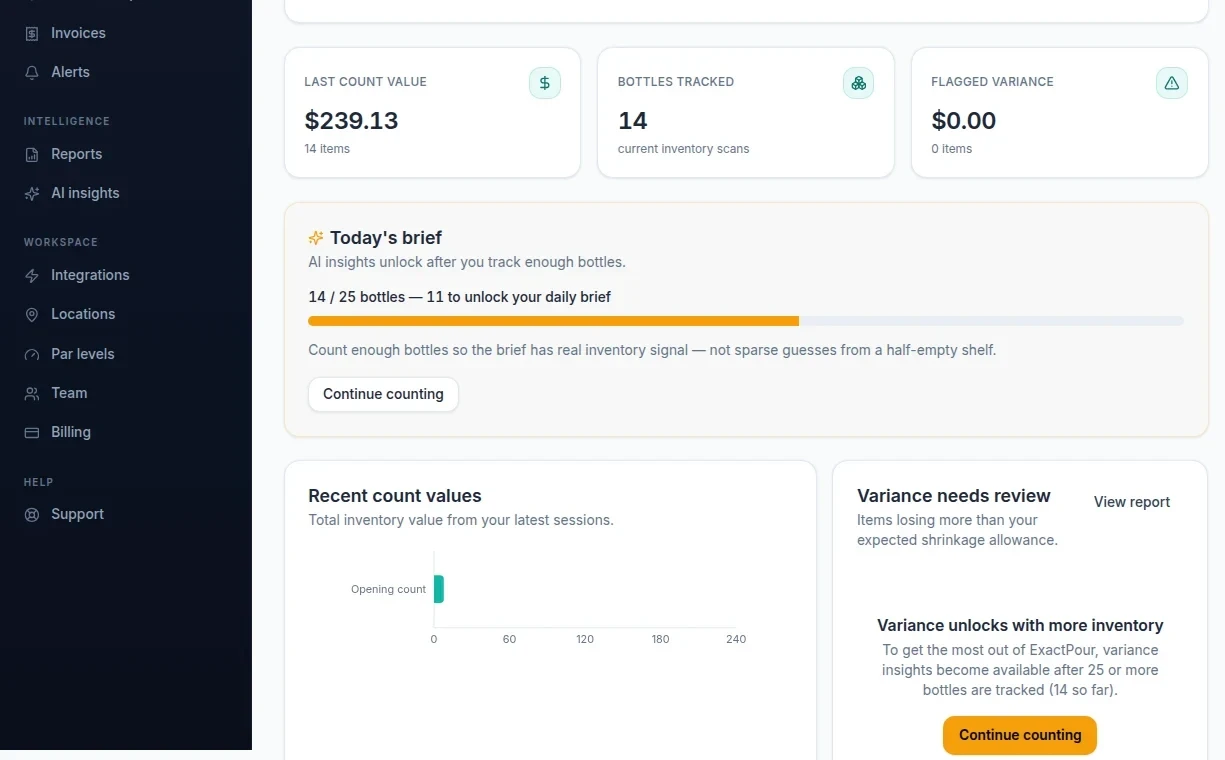
Flagged variance after a real count
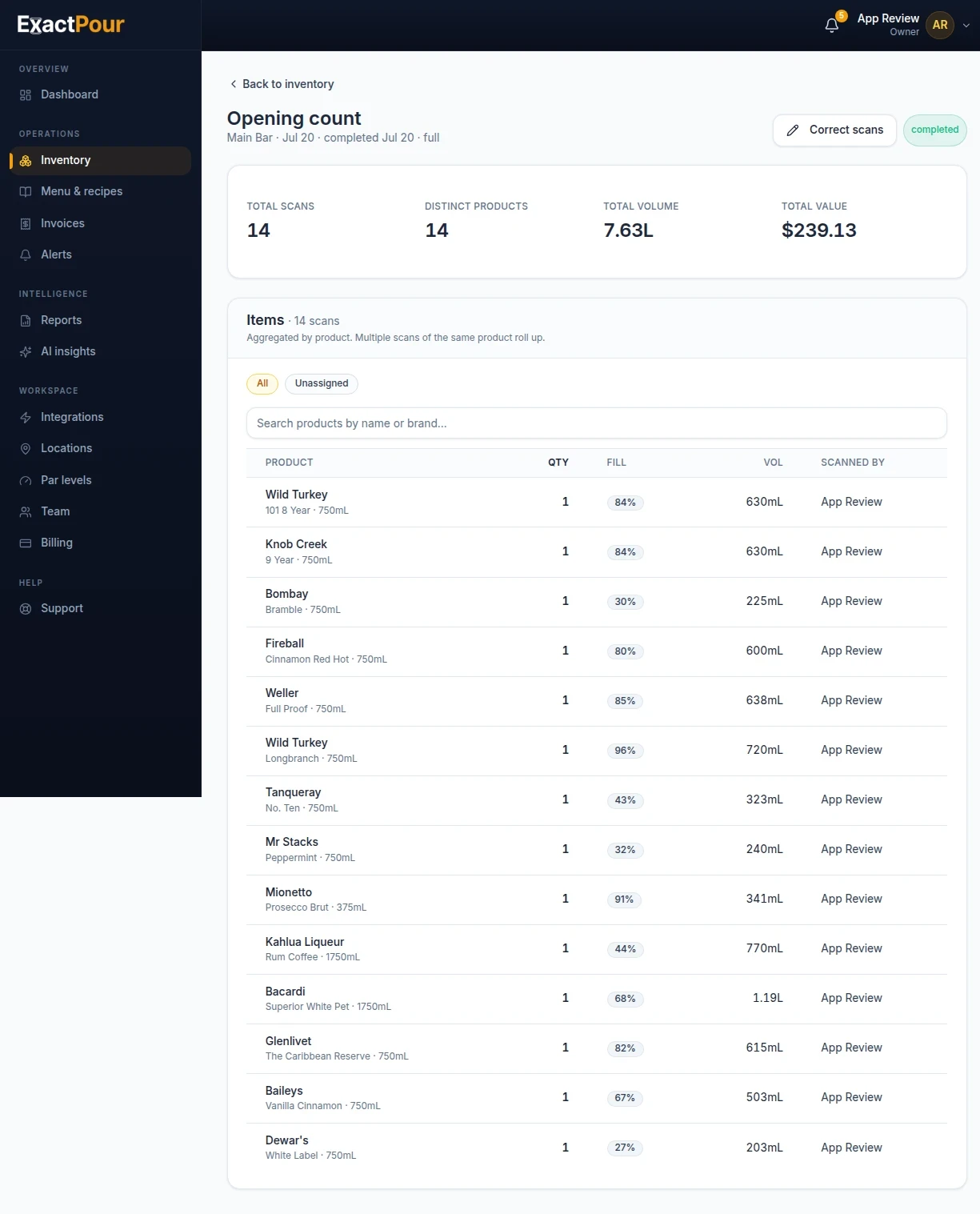
demo workspace: $0.00 flagged variance on 14 counted items. Your room will show its own dollars.
Compare
| Capability | ExactPour | Spreadsheets & clipboards |
|---|---|---|
| Full liquor count | Minutes, by barcode | Hours, hand-tallied |
| Partial-bottle accuracy | Rounded guesses | |
| POS sales reconciliation | Automatic | |
| Variance flagged automatically | ||
| True pour cost per drink | Manual formulas | |
| AI briefs, forecasts & anomaly alerts | ||
| Multi-location roll-up | Separate files | |
| Immutable audit trail |
Reconcile every pour against POS sales
Flag products whose variance spikes statistically
Log your staff schedule and see whether losses run higher on the stretches certain people worked. A coaching prompt, not proof.
See verified dollars recovered after each fix, from your own counts
Document comps and waste so they're not mistaken for theft
Keep an immutable audit trail of counts and edits
Bar shrinkage is the quiet difference between the liquor you paid for and the liquor that generated revenue, and it is one of the largest controllable costs in the business. shrinkage is the residual after sales and documented waste. It hides in four main places: over-pouring, where a heavy hand turns a one-and-a-half-ounce pour into two; comps and giveaways that never get rung; waste from spillage, breakage, and mistakes; and outright theft, whether that is drinks poured for cash that never hits the register or bottles walking out the back door. ExactPour does not invent an industry shrinkage rate for your room. It measures your gap after you count and reconcile.
The reason shrinkage persists is that it is nearly invisible without the right system. A bottle poured a little heavy looks identical to one poured correctly, and a drink given away leaves no trace in a spreadsheet. You cannot manage what you cannot measure, and you cannot measure shrinkage without reconciling physical counts against sales. ExactPour is built to make that reconciliation fast and routine, so the leaks that used to disappear into the noise of a busy night finally show up as numbers you can see, attribute, and act on.
The foundation of bar shrinkage prevention is the count-to-sales reconciliation. ExactPour computes projected inventory, your starting stock minus everything the POS says you poured, and compares it against your physical barcode count. Where actual falls short of projected, product left without a matching sale, and that gap is shrinkage. Because the comparison is per product and expressed in dollars, you immediately see which SKUs are leaking and how much they are costing you, rather than facing a vague overall shortfall you cannot pin down.
This reconciliation is what turns beverage loss prevention from suspicion into evidence. When a premium tequila shows a consistent shortfall that its sales cannot explain, you have a concrete, quantified problem to investigate rather than a hunch. And because ExactPour flags only the products that exceed your tolerance threshold, your attention goes straight to the leaks that matter. For most bars, simply making this reconciliation routine, weekly rather than quarterly, is enough to cut shrinkage measurably, because staff behave differently the moment they know pours are being measured against sales.
Some theft and over-pouring is too subtle or too intermittent for a human to catch. A bartender who over-pours only on certain shifts, or skims a few drinks a night, produces a pattern that blends into normal variance unless you are looking for it specifically. ExactPour's anomaly detection builds a statistical baseline for each product and flags any item whose variance spikes beyond its normal range, surfacing liquor theft signals that a person scanning reports would never notice. It effectively watches every product on every shift, all the time.
Because the analysis is continuous and attributes shortages to shifts and locations, it can point you toward the where and the when, not just the what. A well spirit that only runs short on one closing shift, a station that consistently loses more than its peers, a high-value bottle whose usage never matches its sales: these become visible patterns. That does not accuse anyone by itself, but it tells you exactly where to look and gives you the dollars to run a fair training conversation. For over-pouring control and theft detection alike, this early warning is the most powerful tool in the platform.
Not every shortfall is theft, and treating it that way poisons a team. Spillage, breakage, tastings, and comps are legitimate parts of running a bar, but if they go undocumented they look identical to stolen product. ExactPour includes a waste log that captures these categories as documented events, so honest operational loss is recorded and separated from unexplained shrinkage. That distinction protects good staff from suspicion and sharpens your focus on the variance that genuinely has no explanation.
Documented waste also improves the accuracy of everything downstream. When spillage and tastings are logged rather than lumped into mystery shrinkage, your variance numbers reflect real loss, your pour cost is more accurate, and your investigations target actual problems. Over time, the waste log itself becomes a source of insight, revealing, for example, that a particular bottle consistently loses more than spillage can explain or that tastings have quietly grown beyond policy. Bar theft prevention software that respects the difference between waste and theft is both fairer to staff and more effective at finding the real leaks.
Preventing shrinkage is not a single crackdown; it is a durable program built on frequent measurement, clear accountability, and a visible deterrent. The most effective thing a bar can do is count and reconcile often, because the knowledge that pours are measured against sales changes behavior more than any policy memo. ExactPour makes that frequency sustainable by pairing fast barcode counting with automatic reconciliation and anomaly detection, so the effort of prevention drops low enough that a busy operation actually keeps it up.
Getting started takes an afternoon: scan your shelves to build the product list, connect your POS, set tolerance thresholds, and run your first reconciliation. From there, the reason-coded variance history and AI anomaly alerts compound into a clear picture of where product leaks and whether your fixes are working. Bars that commit to this rhythm routinely recover several points of liquor cost that used to vanish into over-pouring, comps, and theft, turning shrinkage prevention from a source of frustration into one of the highest-return habits in the entire operation.
You cannot prevent what you cannot measure, and bar shrinkage starts as a number. The clearest way to express it is as a percentage: the value of product that went missing beyond what your sales explain, divided by the value of product that should have been used. If your sales and recipes say you should have poured $10,000 of liquor and your counts show $11,500 actually left the shelf, that $1,500 gap is a fifteen percent shrinkage rate, a figure that immediately tells you how serious the leak is.
Measuring it reliably requires the same reconciled data that powers variance analysis: accurate opening and closing counts with partial fills, real purchases, and projected usage from your point of sale. ExactPour computes this automatically each cycle and trends it over time, so you can see whether shrinkage is improving or worsening and which products drive it. A single measurement is a snapshot; a tracked shrinkage percentage is a vital sign, and watching it move is how you know whether your prevention efforts are actually working.
When operators imagine shrinkage, they picture theft, but the largest single source of loss in most bars is far more mundane: over-pouring. A free-pour that runs a quarter-ounce heavy on every drink does not feel like stealing, yet across thousands of pours it quietly gives away a substantial share of your liquor cost. Because it is habitual and well-intentioned, over-pouring is also invisible without measurement, no one reports it, and it never shows up until the count comes in short.
It is also the most fixable source of loss, which is what makes catching it so valuable. ExactPour exposes over-pouring by reconciling actual usage against projected, so a product that consistently runs heavy stands out as flagged variance tied to specific patterns. From there the fix is coaching, not punishment: retrain the pour, consider jiggers or controlled pourers on the worst offenders, and re-measure. Bars that tackle over-pouring first typically recover several points of margin quickly, because they are correcting a large, systematic leak rather than chasing the occasional bad actor.
One of the most powerful effects of a shrinkage-prevention program is one it produces before catching anyone: deterrence. When staff know that inventory is counted on a predictable cadence and that variance is reviewed every cycle, the calculus around over-pouring, casual comps, and outright theft changes. Behavior that thrives in the dark, when nobody is measuring and nothing is reconciled, quietly recedes once everyone understands the numbers are watched and traceable.
ExactPour strengthens that deterrent by making measurement visible and consistent. Scheduled counts, per-location history, and a clear record of who counted what and when signal that the program is real, not occasional theater. The goal is not to police the team but to align incentives: honest staff appreciate working in a controlled environment where they will not be blamed for someone else's loss, and would-be leakage has nowhere to hide. Over a quarter, that steady discipline tightens variance as much as any single investigation, because it prevents loss rather than merely detecting it.
The fastest way to kill a shrinkage-prevention program is to turn it into a witch hunt. If every flagged variance becomes an accusation, staff get defensive, morale drops, and the honest majority resents a system aimed at the dishonest few. The better approach treats shrinkage data as coaching material. ExactPour's reason-coded reconciliation lets managers document what actually happened, breakage, spillage, over-pour, a legitimate comp, or a genuine unexplained loss, so most variance is explained and only the truly suspicious remainder gets escalated.
That framing changes the conversation from blame to improvement. A bartender whose pours run heavy gets retrained, not written up; a shift with recurring loss gets a closer look at process before anyone assumes theft. Because the data is accurate and the history is clear, the rare case that is theft is also easy to address decisively, with evidence rather than suspicion. A shrinkage-prevention program built on coaching lasts, because staff trust it and managers can rely on it, and a program that lasts is the only kind that actually protects margin over the long run.
FAQ
Count weekly, map well drinks, price the gap, retrain heavy pours, and log comps and spills. Investigate only the leftover. ExactPour stores that loop. The playbook is how to reduce liquor shrinkage.
No. Overpours, comps, transfers, recipe errors, and a sloppy fill can look identical in the arithmetic.
There is no honest universal number. Measure your own unexplained gap after reason codes, then watch the direction week to week.
Not by itself. Both show up as variance. Reason codes and patterns by product or shift narrow the cause.
Yes. Scans, edits, and corrections are logged so a fix cannot quietly erase the history.
Variance and poured-versus-sold are on Starter at $59 a month and up. See pricing.
Next step
Start your 14-day Pro trial. No credit card required.
Start tonight
Run ExactPour on your own bar for two weeks. See the leaks, the over-pours, and the dollars you can still save.
14 days free · No credit card · From $59/mo