
Map the drink list
Tie POS items to recipes so a sold cocktail depletes the right ounces, not a category lump.
For restaurants
Restaurant beverage inventory software for dining rooms where the bar is the highest-margin, and leakiest, category. ExactPour counts liquor, wine, and beer by barcode, ties every drink to a recipe, and reconciles pours against your POS so cost of goods stops surprising you.
14 days free · No credit card · Plans from $59/month
Last updated
Restaurant beverage inventory software tracks liquor, wine, and beer, maps each drink to a recipe, and reconciles usage against POS sales to control beverage cost of goods. ExactPour lets restaurants count by barcode with partial fill levels, auto-computes cost per serving, and surfaces the menu items and shifts where margin is leaking.
Tie POS items to recipes so a sold cocktail depletes the right ounces, not a category lump.
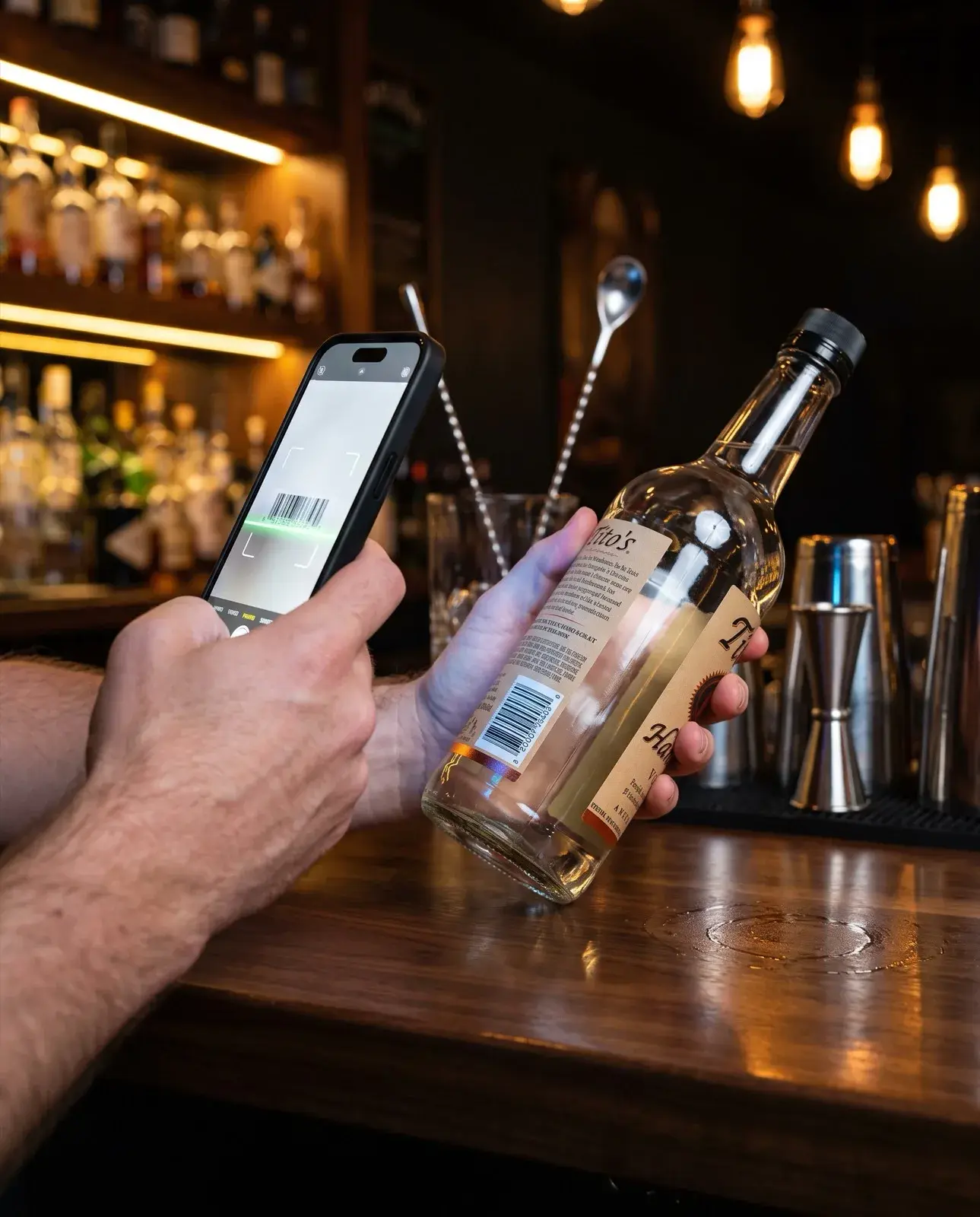
Scan the bar and by-the-glass bottles. Fill levels keep openers honest between service periods.
Compare shelf math to tickets. Document comps and spills so FOH variance is not blamed on the line.
The problem
Every comped glass of wine or heavy-handed cocktail that isn't recipe-mapped depletes stock your cost reports can't see.
Without count-to-sales reconciliation, a two-point rise in liquor cost blends into food cost and goes unnoticed for months.
Your POS knows what sold but not what's left on the shelf, so nobody can close the loop on beverage margin.
The solution
Recipe-level costing plus POS reconciliation for the whole beverage program.
Scan once, count everything.
Scan any UPC with a phone or handheld, tap a fill level, and ExactPour aggregates scans per product and auto-computes volume in real time. Undo and inline edits keep counts honest.
Map every drink to its ingredients.
Turn POS items into recipes with ounces per serving and auto-compute cost per serving from bottle price. Tracked items feed variance; untracked items surface as blind spots.
Toast, Square, Clover, and GoTab are live.
Connect Toast, Square, Clover, or GoTab to a location. Menus and sales import on a schedule or when you ask. POS credentials are stored encrypted.
The baseline behind every comparison.
For every product, ExactPour computes what should be on the shelf from starting bottles minus what the POS says you sold. This is the engine that powers poured-vs-sold comparisons.
Know the cost of every drink.
Cost per serving is computed from live bottle pricing and recipe ounces, so you see pour cost and margin per menu item and can price with confidence.
Find your blind spots.
Lists menu items without recipes. Every unmapped sale depletes stock that the poured-vs-sold math cannot see. One click to build each recipe.
Integrates with the POS you already run
Sales sync nightly · No rip and replace




Restaurant beverage count
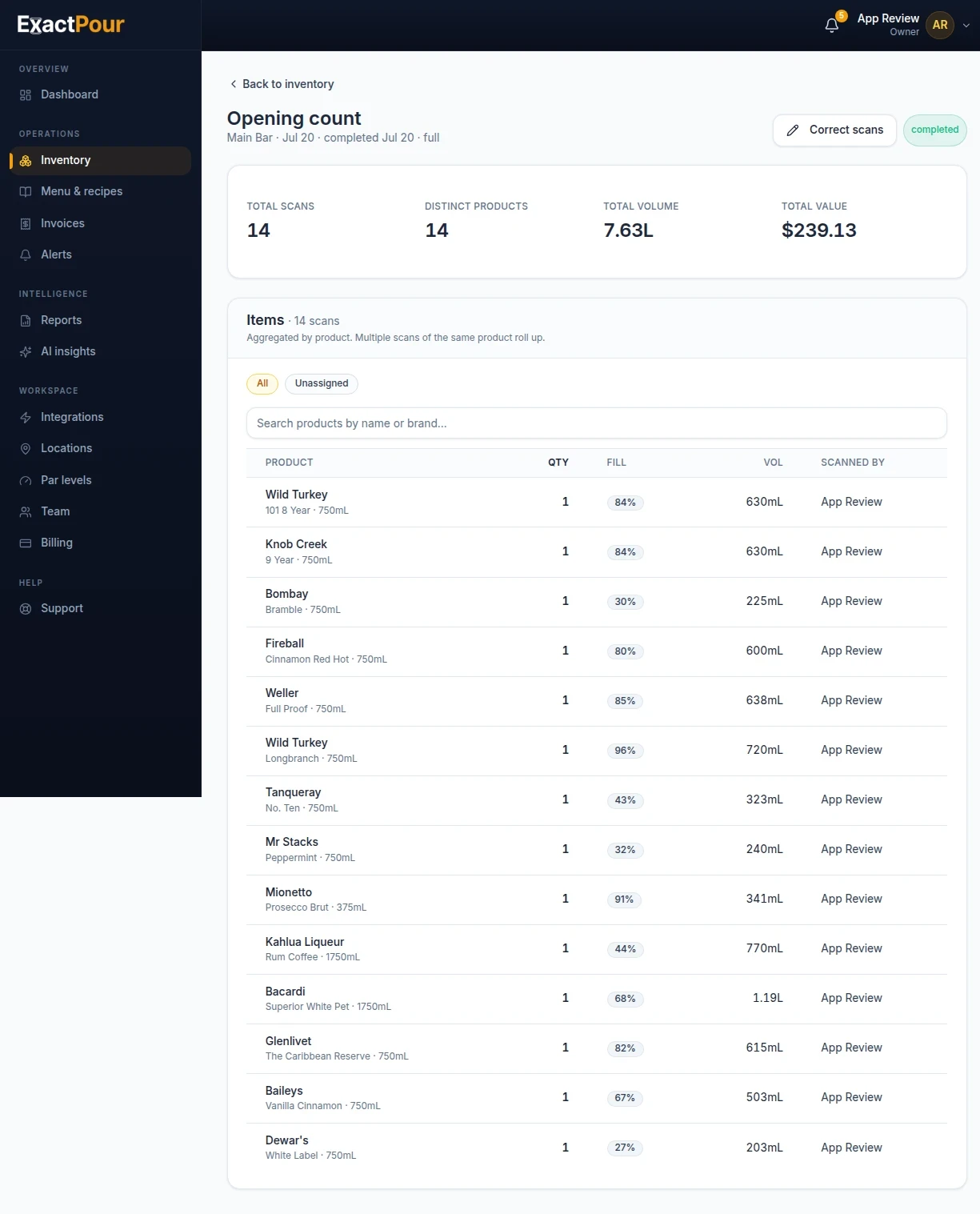
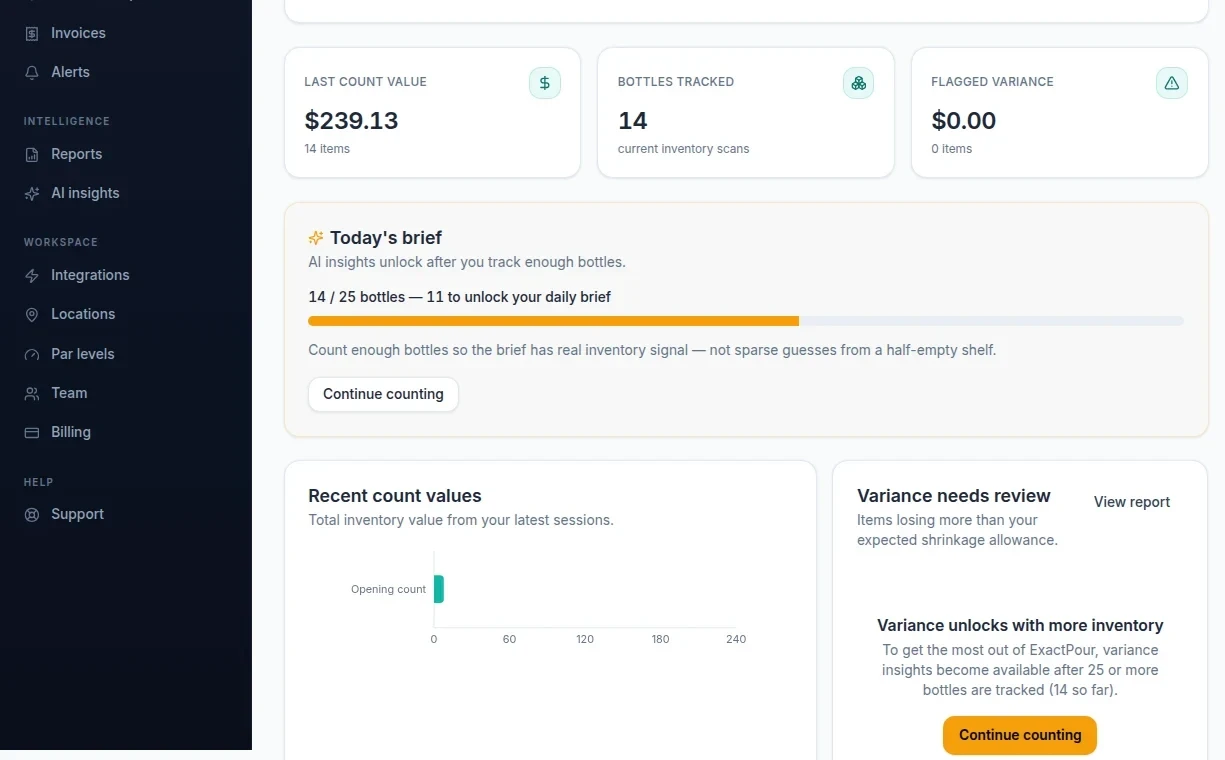
Opening count, Main Bar, Jul 20: 14 scans, 14 products, 7.63L, $239.13. The same session a dining-room bar closes.
Compare
| Capability | ExactPour | Spreadsheets & clipboards |
|---|---|---|
| Full liquor count | Minutes, by barcode | Hours, hand-tallied |
| Partial-bottle accuracy | Rounded guesses | |
| POS sales reconciliation | Automatic | |
| Variance flagged automatically | ||
| True pour cost per drink | Manual formulas | |
| AI briefs, forecasts & anomaly alerts | ||
| Multi-location roll-up | Separate files | |
| Immutable audit trail |
Track liquor, wine, and beer in one system
Map every drink to a recipe with cost per serving
Reconcile beverage usage against POS sales automatically
Surface untracked menu items that hide depletion
Bring beverage cost of goods under control month over month
In most full-service restaurants, the beverage program is the single most profitable category by percentage, and the one most likely to leak. Food cost gets obsessive attention because ingredients are portioned and plated, but liquor, wine, and beer flow through free pours, generous tastings, comped rounds, and end-of-night guesses. The result is a category that should run a pour cost in the high teens or low twenties but quietly drifts higher because nobody can see where the product actually goes.
Restaurant beverage inventory software closes that gap. ExactPour counts liquor, wine, and beer by barcode, ties every drink to a recipe, and reconciles what you poured against what your point of sale sold, so beverage cost stops being a monthly surprise and becomes a number you manage on purpose. For a restaurant running tight margins everywhere else, recovering even two points of beverage cost is often the most valuable operational improvement available, and it comes entirely from finally being able to see the category clearly.
Restaurants rarely have a single beverage problem. The bar runs on spirits and pour cost, the dining room lives and dies by a wine list with dozens of by-the-glass and bottle SKUs, and the beer program cycles through cans and bottles with their own spoilage risk. Managing those on three different spreadsheets guarantees none of them is accurate. ExactPour handles all three in one platform, with the right counting method for each: fill-level capture for open spirits and wine, and unit counts for packaged beer.
Because everything lives together, your beverage director sees the whole program at once, total beverage cost, category breakdowns, and the specific SKUs dragging margin down. By-the-glass wine, historically one of the hardest things to control because of over-pouring and oxidation waste, becomes visible and manageable. That unified view is what lets a restaurant treat beverage as the profit engine it should be rather than a black box that gets reconciled once a month and hoped for the rest.
You cannot price a menu you cannot cost, and you cannot cost a drink whose recipe lives only in a bartender's memory. ExactPour maps each cocktail, wine pour, and beer to the exact product and volume it consumes, so every item on the menu carries a real, current cost that updates as invoice prices change. When a distributor raises the price of a base spirit, the affected drinks reprice themselves in your cost view immediately.
That connection is what makes menu engineering possible. You can see which drinks are quietly unprofitable, which have room for a price increase the market will bear, and how a recipe change, a half-ounce here, a different well brand there, moves your blended pour cost across thousands of tickets. Instead of guessing at margins, your management team makes menu and pricing decisions backed by the same reconciled data that runs the count.
The core loop that protects restaurant beverage margin is simple in theory and hard in practice: compare what you should have used to what you actually used. ExactPour automates it. It calculates projected usage from POS sales and recipes, compares it to your physical count, and flags any product that drifts beyond tolerance so your team investigates the real problems instead of scanning a spreadsheet for outliers.
Each flagged variance gets reconciled with a reason code, breakage, over-pour, spill, or comp, building a history that separates honest operational loss from patterns worth addressing. A server who consistently over-pours, a wine that shows more waste than the by-the-glass program should produce, a spirit that goes short only on certain shifts: these become visible and coachable. Catching them weekly rather than monthly is what keeps small leaks from compounding into a beverage cost problem nobody can explain.
Accurate inventory does more than protect margin; it fixes ordering. With real usage data and par levels per product, ExactPour tells you exactly what to reorder before you run dry, and just as importantly, keeps you from over-buying wine and spirits that tie up cash on the shelf. Demand forecasting anticipates busy weeks, holidays, and events, so your beverage director orders to actual demand rather than habit.
Rolling it out is quick. Scan your existing stock to build the product list, connect your point of sale, import or set your recipes and pars, and run your first reconciliation, typically within the first day. Because the counting app is fast and mobile, your team adopts it without friction, and the payoff, tighter pour cost, cleaner ordering, and a beverage program you can actually see, starts showing up in the very next inventory cycle.
Food-cost discipline is second nature in most kitchens, yet the beverage program, which usually carries a far better margin, often runs on a monthly guess. Restaurant beverage inventory software closes that gap by making a full liquor, wine, and beer count fast enough to fit into a normal weekly close. When counting stops being a dreaded all-night chore, managers actually do it, and frequency is the single biggest driver of accuracy. A restaurant that reconciles beverage weekly catches a slipping pour cost in days, not after a quarter of quietly lost margin.
That rhythm also changes the conversation with ownership and staff. Instead of debating whether the bar is losing product, you have a reconciled number, a variance trend, and a reason-coded history that shows exactly where beverage cost of goods is going. Servers and bartenders understand that pours are measured, waste is logged, and comps are tracked, which tightens behavior without heavy-handed policing. For multi-unit restaurant groups, the same data rolls up across locations, so a beverage director can compare pour cost between rooms and export the outliers worth a visit. The result is a beverage program managed with the same rigor as the kitchen, and a margin the P&L can finally rely on.
In most restaurants, food cost gets all the attention while beverage, the higher-margin category, runs on a fraction of the oversight. That imbalance is expensive, because a point of variance on liquor and wine is worth far more than a point on produce. ExactPour lets you give the bar the same rigor you give the kitchen: fast counts, recipe-level costing, and reconciliation against POS sales, all in one place. When beverage cost of goods becomes as visible as food cost, your general manager finally sees the complete margin picture instead of managing half of it blind.
Bringing beverage into your operating numbers also sharpens the weekly manager meeting. Instead of debating anecdotes about a slow month, the team reviews real pour cost, variance by category, and the specific products driving loss, then assigns fixes with owners and deadlines. Because the data is trustworthy and current, those conversations lead to action rather than excuses. For a full-service restaurant where beverage can be a third or more of revenue, treating it as a first-class cost center, not an afterthought, is one of the highest-leverage changes an operator can make.
Every restaurant loses some product to legitimate causes: a comped round for a regular, a spilled tray, a cocktail sent back, a bottle that broke in the well. The problem is not the loss itself; it is that most of it is never recorded, so it looks identical to theft when the count comes up short. ExactPour lets staff log waste against reason codes at the moment it happens, building an honest ledger of where product goes. That documentation separates the loss you accept from the loss you need to investigate, so managers stop chasing ghosts and start fixing real leaks.
Over time, the waste log becomes a management tool in its own right. If comps spike on a particular shift, or one cocktail generates a suspicious amount of breakage, the pattern shows up in the data and prompts a conversation grounded in evidence. You can set expectations for acceptable comp levels, coach the servers who exceed them, and demonstrate to ownership exactly why beverage cost moved in a given period. That is how documented, reconciled beverage inventory turns fuzzy shrinkage into a controllable line you can actually manage.
The habits you build in a single restaurant either help or haunt you when you open a second. Inventory done on a manager's personal spreadsheet does not survive expansion, because each new location invents its own version and comparison becomes impossible. ExactPour standardizes counting, costing, and reconciliation from the first location, so the process you refine in one dining room copies cleanly to the next. When every restaurant measures the same way, you can benchmark them side by side, spot the outlier before it becomes a problem, and roll performance up to ownership without stitching together mismatched files.
Standardization also protects you as your team grows. New beverage managers inherit a proven workflow instead of reinventing one, corporate can set par levels and recipes centrally, and role-based access keeps each location focused on its own numbers while leadership sees the whole group. That consistency is what lets a promising two-unit concept become a disciplined multi-unit operator without losing control of its highest-margin category. Restaurant beverage inventory management, done right from the start, is as much about the next location as it is about this one.
FAQ
Yes. ExactPour tracks liquor, wine, and beer, including partial bottles, and maps each to recipes so the entire beverage program reconciles against sales.
By tying each menu item to its ingredients and ounces, ExactPour computes projected usage and cost per serving, exposing high-cost drinks and unmapped items that quietly deplete stock.
Yes. Yes. Line staff can count. Managers and owners see cost and variance.
ExactPour integrates with Toast, Square, Clover, and GoTab to import menus and sales, which drives recipe costing and variance without manual data entry.
Next step
Start your 14-day Pro trial. No credit card required.
Start tonight
Run ExactPour on your own bar for two weeks. See the leaks, the over-pours, and the dollars you can still save.
14 days free · No credit card · From $59/mo