
Comparisons
Toast inventory vs ExactPour: complementary tools, different jobs
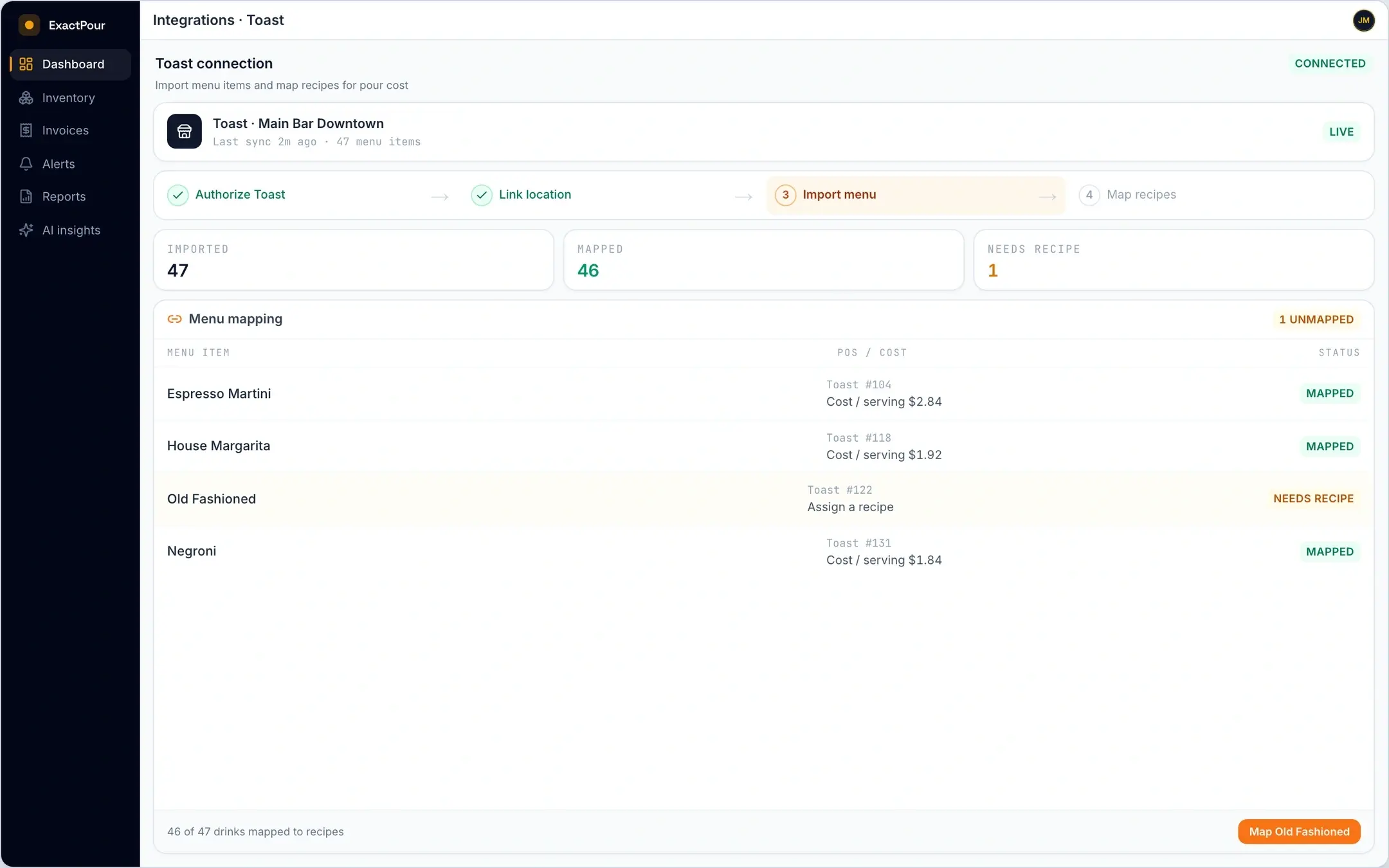
Toast is a full restaurant platform. ExactPour specializes in beverage inventory intelligence. Here is an honest map of where each is strong, and how they work together.
Comparing Toast inventory features to ExactPour works best when you stop treating them as clones. Toast is a broad restaurant platform: POS, payments, labor, menus, and inventory capabilities that serve the whole house. ExactPour is a specialized system for beverage inventory control, counting, projected vs actual, pour cost, invoice intelligence, and manager-facing analysis. Many operators use them together.
Toast's strength begins at the point of sale. If your front-of-house already runs on Toast, sales data, menus, and item configuration live in a system your staff already touch every ticket. That gravitational pull is real. Inventory features that sit next to the POS can be 'good enough' for programs that need basic tracking without another login.
ExactPour's strength begins on the beverage shelf. The product assumptions are bar-shaped: barcode-driven liquor counts, fill levels for partial bottles, variance against recipe-driven projected usage, pour-cost views, and AI briefs aimed at unexplained depletion. That specialization is the point, not a claim that Toast is 'bad software.'
Think in jobs. Job one: ring sales and run service, Toast (or your POS) owns this. Job two: finish a trustworthy liquor count quickly and repeatedly, specialized counting workflows often win. Job three: explain the gap between sales and depletion, that is where ExactPour focuses. Job four: company-wide restaurant inventory across food and retail, a full-platform inventory module may be the better spine.
Integration is the cooperative path. ExactPour is built to connect with Toast sales so projected usage reflects what was actually sold, while counting and beverage-specific reconciliation happen in ExactPour. The goal is complementarity: Toast remains the system of record for service; ExactPour becomes the system of record for beverage inventory truth.
Where Toast inventory may be enough: simpler beverage programs, teams that want one vendor for as much as possible, and operations where food inventory complexity dominates and liquor is a smaller concern. If your managers already live in Toast and your variance pain is mild, adding another system may be unnecessary overhead.
Where a specialized tool tends to earn its keep: heavy back bars, frequent open bottles, multi-outlet beverage leadership, active pour-cost management, and teams that need exception workflows and reason codes tailored to liquor variance. If count night is still a dreaded ritual and unexplained depletion shows up too late, specialization is worth a trial.
Avoid trash-talk criteria. Toast did not 'fail' because it is not a liquor-only product. ExactPour is not a Toast replacement for POS, payments, or full-restaurant inventory. Evaluating either product against the other's primary job produces a pointless scorecard.
Onboarding expectations differ. Platform inventory often inherits menu and item structures you already maintain for service. Specialized beverage software asks you to care about bottle catalog quality, fill conventions, and reconciliation habits. Budget time for that work either way, unclean catalogs punish every system equally.
Reporting philosophy differs too. Platform reports optimize for operators who live in one ecosystem. ExactPour reports optimize for beverage controllers and managers who need variance, pour cost, and invoice-driven cost changes in one beverage-centric loop. Pick based on who owns the weekly conversation about liquor margin.
Pricing comparisons should include the jobs you still have to do manually. A platform feature that is 'included' but unused has zero value. A specialized subscription that cuts count time and surfaces exceptions can offset its cost in labor and tighter control, calculate that with your baselines, as in our ROI framework post, not with generic savings claims.
A fair evaluation week: keep Toast as POS; run ExactPour counts on one location; map top sellers; reconcile variance for a short period; process a real liquor invoice; ask the bar manager which system they want open on count day. Read bar inventory software for the category checklist that applies regardless of vendor.
Multi-location Toast groups should also ask about permissions and beverage rollups. Sometimes the POS platform is perfect for enterprise restaurant ops while beverage directors still want a purpose-built variance cockpit. That is an architecture choice, not disloyalty to your POS vendor.
Data ownership and exports matter if you ever change tools. Know how to get sales history, item lists, and inventory counts out of any system you adopt. Complementarity works best when you are not trapped.
ExactPour's position is intentionally narrow: be excellent at beverage inventory intelligence beside the POS you already trust. If Toast is your POS, that is a feature of the partnership, not a competition to the death. If your beverage program needs deeper counting and variance than general inventory features provide, ExactPour is built for that lane.
Choose clarity over rivalry. Use Toast for what it is great at. Use a specialized bar inventory layer when liquor control needs its own workflow. And use a written buying guide, start at bar inventory software, so the decision survives the next sales demo that tries to collapse two different jobs into one slogan.
Menu engineering and item availability features in a full POS platform can interact with inventory in ways specialized liquor tools do not try to own. If 86-ing a food item mid-service is the daily pain, platform inventory may be the center of gravity. If 86-ing is rare but liquor variance is loud, specialize where the dollars leak.
Staff identity and permissions often already exist in Toast. Adding ExactPour means another login and role model unless you invest in clear SOPs for who counts, who reviews, and who maps recipes. That overhead is real. It is justified when the beverage controller needs a workspace that is not diluted by the entire restaurant's inventory surface area.
Reporting exports should be planned so finance is not surprised. Some groups want beverage variance in ExactPour and consolidated COGS in the platform or accounting stack. Define which system is canonical for which metric. Dual systems fail when two dashboards disagree and nobody declared a source of truth.
Roadmaps evolve on both sides. Toast will keep improving inventory-adjacent capabilities; ExactPour will keep deepening beverage-specific workflows. Re-evaluate annually against jobs, not brand loyalty. The complementary story remains valid as long as POS sales flow cleanly and counts remain something your bar team finishes willingly.
If you take one thing from this comparison, take the framing: platform versus specialist is an architecture decision. ExactPour is not asking you to rip out Toast. It is asking whether liquor control deserves a purpose-built loop beside it. For the checklist that keeps that decision honest, counting method, variance, pour cost, invoices, trial design, use bar inventory software and run the trial on a live bar, not a slide.
Train differently for each system. Toast training often lives in the broader restaurant onboarding path. ExactPour training should sit with beverage leads and counting pairs, with a short refresher before the first three live counts. Mixing the curricula confuses people about which login does which job.
When something looks wrong in variance, establish a triage order: confirm the ExactPour count and recipe map first, then confirm the Toast sales item and period, then look for operational causes. Starting in the wrong system burns an hour and erodes trust in both. Write that triage on a one-page runbook.
The complementary model is not forever by dogma, it is forever by fit. If a future Toast inventory release covers your beverage jobs with equal counting speed and variance discipline, re-evaluate. Until your bar team says the specialized loop is unnecessary, ExactPour's job is to remain the sharper tool for liquor control beside the POS you already run, guided by the criteria at bar inventory software.
For groups still deciding, a clean default is: keep Toast as the service and sales system of record; trial ExactPour on one beverage-forward outlet for counting, variance, pour cost, and invoice cost updates; compare manager trust and count completion after several cycles; then expand only if the specialized loop clearly earns its login. That sequence respects Toast, respects your team, and keeps the purchase tied to evidence instead of rivalry.
Honesty is the competitive advantage in this comparison. Toast does not need to be diminished for ExactPour to be useful, and ExactPour does not need to pretend it replaces a full restaurant platform. Operators win when tools match jobs. If your job is sharper liquor control beside a Toast POS, start from bar inventory software, run the trial, and let finished counts and closed exceptions cast the deciding votes.
Share this framing with both your Toast champion and your beverage lead before anyone digs into feature matrices: we are assigning jobs, not picking a winner in a cage match. When both people agree on which system owns sales versus which system owns liquor variance, implementation politics calm down. ExactPour is built for the second job. Toast remains excellent at the first. bar inventory software is the neutral checklist that keeps the conversation about evidence.
End the evaluation with a joint recommendation memo signed by ops and beverage: POS of record, inventory system of record for liquor, integration owner, success metrics at sixty days, and the conditions that would trigger a re-evaluation. That memo prevents the next vendor meeting from reopening a settled architecture. Complementary tools stay complementary when the organization writes the boundary down.
Questions this guide answers
- Does Toast inventory replace a liquor well count?
- No. Toast holds tickets and menus. Open well bottles still need a physical count. ExactPour is the companion. See /solutions/toast-liquor-inventory.
- What if we run Clover instead of Toast?
- Same companion job. Read /solutions/clover-liquor-inventory. The four-brand hub is /pos-integrations.
- Should we switch POS to get better inventory?
- Usually no. Keep the register the staff already know. Add a count that reconciles poured versus sold.
Put it into practice
See this on your bar
Run ExactPour for two weeks and turn this guide into real numbers in your own operation. Book a walkthrough if you want a live tour first.