
Operations
Bar inventory software ROI: a framework you can actually calculate
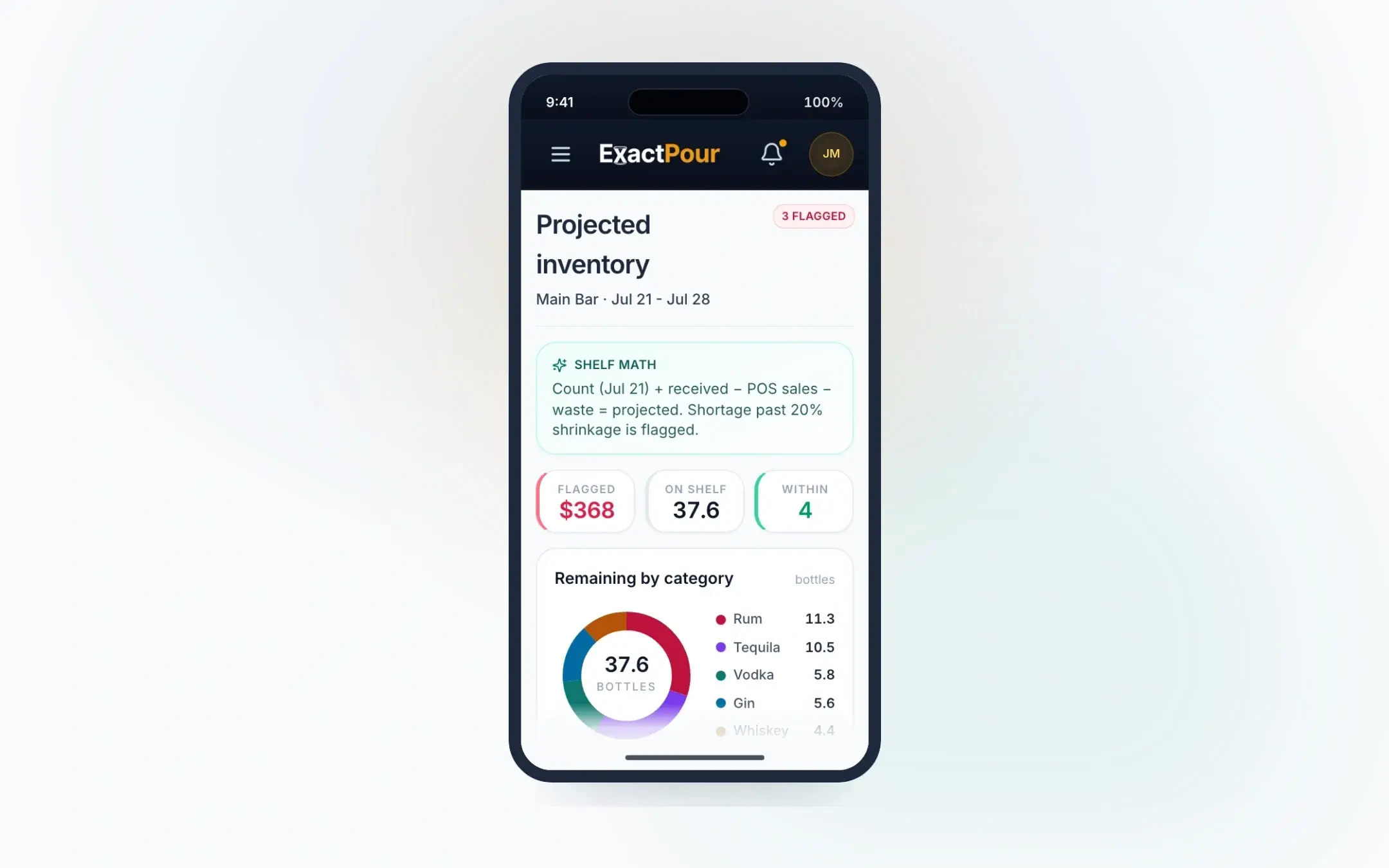
ROI for inventory software is measurable if you separate labor time, unexplained depletion, and cost accuracy, and label estimates as estimates.
Vendors love ROI slides. Operators need arithmetic they can defend. This framework shows how to estimate the return on bar inventory software using your own baselines. Illustrative examples are labeled as examples. They are not promises, and they are not industry-wide statistics.
ROI in this context is not a vibe. A simple form is: (annual benefit − annual cost) / annual cost. Benefit usually comes from three buckets: shorter count labor, tighter unexplained depletion you can attribute to better process, and fewer bad decisions from stale costs or blind ordering. Miss a bucket and your story will be incomplete; invent a bucket and your story will be fiction.
Annual software cost should include subscription, required hardware, payment processing if any, and onboarding if you capitalize or expense it in year one. Include internal hours for implementation at a realistic loaded wage. Ignoring internal time is how projects look cheap until the beverage director lives in mapping hell for a month.
Labor benefit starts with a time study. Measure minutes for a full count today (preparation, walking the route, recording, cleanup, and spreadsheet re-entry). Estimate minutes with the new system after a short learning period, not after the polished demo. Annual labor hours equal (person-minutes per count ÷ 60) × counts per year. Multiply the difference versus baseline by a loaded hourly rate for an illustrative dollar benefit.
Illustrative example A, count labor only. Two people spend three hours on a weekly count today; after training, a barcode workflow finishes in about one and a quarter hours. Person-minutes of difference per count: two hundred ten. Hours of difference per count: three and a half. Across fifty-two counts, that is one hundred eighty-two hours. At a twenty-two dollar loaded rate, illustrative annual labor benefit is about four thousand dollars. If software and hardware cost three thousand dollars per year, labor alone can justify the tool in this example, before any variance improvement.
Unexplained depletion is harder and more important. You need a baseline: dollar variance (or a carefully defined subset) over several like periods before the change. After process and software stabilize, compare like periods. Benefit is not 'everything that was ever missing'; it is the portion of unexplained loss that shrinks because you detect sooner, coach sooner, or fix receiving and recipe errors.
Illustrative example B, variance dollars. A location's unexplained liquor variance ran near twelve hundred dollars per month over a clean six-month baseline. After six months on a tighter count-and-reconcile loop, like months ran near eight hundred dollars unexplained. The illustrative improvement is four hundred dollars per month, or forty-eight hundred dollars per year. Do not claim the software 'caused' all of it unless you can point to specific process changes; treat part of the gap as process maturity.
Cost accuracy benefits show up when invoice prices finally flow into recipes. If a spirit jumps several dollars a bottle and you do not notice for many weeks, every drink that uses it was mispriced in your head even if the POS price never moved. The ROI here is avoided margin leakage on future sales after you adjust price, recipe, or brand, estimated from volume × cost delta × weeks of lag you eliminate.
Illustrative example C, stale cost lag. A high-volume vodka rises by twelve cents of true cost per drink. Noticing in two days instead of a month avoids roughly a month of unrecognized cost pressure on that SKU in the illustrative window, small alone, meaningful across many SKUs and a year of invoice changes.
Ordering and cash tied up in slow movers are optional fourth and fifth buckets. Forecasting can curb panic over-ordering, but only credit the software if you compare waste, stockouts, and standing inventory dollars before and after with similar sales. Otherwise you are attributing seasonality to the tool.
What not to do: cite unverified claims that inventory software always shrinks cost by a fixed percent. Your bar is not a press-release statistic. Also avoid double counting, if labor benefit and variance benefit share the same manager hours, do not multiply fairy dust. And do not annualize a single lucky week.
Sensitivity analysis keeps you honest. Build a base case, a conservative case (half the variance improvement, milder time change), and an aggressive case. If the conservative case is still positive, you have a purchase case you can defend. If only the aggressive case works, you are buying hope.
Qualitative returns still matter, but keep them outside the ROI ratio: clearer ownership conversations, smoother onboarding for new managers, cleaner audits, and lower dread around count night. Those may be decisive for culture even when the spreadsheet is merely break-even.
Tie the measurement plan to the buying guide at bar inventory software. Before go-live, freeze baseline count minutes, unexplained variance dollars, and invoice-to-cost lag. Review the same metrics at thirty, sixty, and ninety days. ExactPour is designed to make those inputs visible, counts, variance, pour cost, and invoice updates, so the ROI conversation uses your numbers.
A one-page ROI brief for ownership can look like this: annual cost; labor hours method and result; variance baseline vs post; cost-lag example; conservative ROI; risks (adoption, mapping quality); and the kill criteria if the trial fails. Clarity beats a glamorous percentage.
Software ROI is a management practice, not a vendor deliverable. The tool can compress counting and surface exceptions; only your team can coach pours, dispute deliveries, and keep recipes true. Calculate the economics with that partnership in mind, and label every projection as what it is: an estimate grounded in your baselines, not a universal savings rate.
Attribution windows should match how quickly your process can change. If onboarding takes six weeks to clean recipes, do not judge variance ROI on week two. Declare a stabilization period, then measure. Many failed ROI stories are really failed patience stories, or failed onboarding stories mislabeled as software failures.
Separate one-time cleanup value from ongoing control value. The first month often finds ghost SKUs, bad recipes, and receiving habits that would have been fixed by any serious project. Credit that cleanup once. Ongoing ROI is the repeatable weekly loop: shorter counts, earlier flags, fresher costs. Conflating the two overstates the subscription's permanent magic.
Ownership presentations land better with ranges than fake precision. Say labor benefit is roughly thirty-five hundred to five thousand dollars in the illustrative model, variance improvement two thousand to six thousand dollars depending on adoption, software cost as quoted, conservative ROI still positive. Ranges invite questions. A single dramatic percentage invites disbelief, especially if it sounds like a recycled industry statistic.
Track leading indicators during the trial even before dollar ROI is clear: percent of counts completed on schedule, minutes per count, percent of exceptions closed within seven days, and invoice lines confirmed within forty-eight hours. If leading indicators move and dollars do not yet, you may need more cycles. If leading indicators stall, dollars will not follow.
ExactPour can surface the inputs to this framework, but it cannot declare your ROI for you. Use the formulas, label examples as examples, and revisit the math when volume or staffing changes. Pair the numbers with the selection criteria at bar inventory software so finance and operations argue from the same definition of success.
Include a kill-switch metric in the trial agreement with yourself: if count completion falls below an agreed threshold, or if managers stop reconciling exceptions, pause expansion and fix process before you buy more locations. ROI models assume usage. Usage is not assured by a signed order form.
Revisit ROI after major menu changes, outlet openings, or POS migrations. Those events reset baselines. A model built on last year's quiet lounge will mislead a this-year festival calendar. ExactPour can help you rebuild the inputs quickly; you still have to rebuild the story for finance.
Publish the illustrative examples you used, with the word illustrative attached, so future debates do not mutate them into folklore. The discipline of labeling estimates is part of claims-safe operations, and it matches how we write publicly about bar inventory software and related guides.
Finally, put the ROI model next to the count calendar. Software that looks brilliant in a spreadsheet but collides with a staffing reality that cannot finish weekly counts will not deliver the variance line you modeled. Labor feasibility is a constraint, not a soft preference. Choose cadence and tooling together, measure both, and update the illustrative model when either changes.
If finance asks for a single headline number before a trial, give them the conservative case and the measurement plan instead. A pre-trial assurance is marketing. A post-trial model built from your count minutes and your unexplained dollars is management. ExactPour can help you gather those inputs; the integrity of the story still depends on labeling every projection as an estimate grounded in your baselines, not as an industry statistic nobody measured.
Treat the first quarter as instrumentation, not as a referendum on your intelligence as an operator. You are learning how quickly your team adopts a new count method and how clean your recipes really were. Illustrating ROI too early invites either false celebration or false disappointment. Measure, label estimates, and let the conservative case earn the renewal, that is the claims-safe way to talk about inventory software economics.
Put it into practice
See this on your bar
Run ExactPour for two weeks and turn this guide into real numbers in your own operation. Book a walkthrough if you want a live tour first.