
Quiet forty-cent bumps compound. Here is how to catch liquor price increases on the invoice, size the annual impact, and respond the same week.
Supplier price creep rarely arrives as a meeting. It arrives as a line item forty cents higher than last month on a bottle you order every week. Variance reports will not catch it, nothing went missing. The only defense is comparing every delivered unit price to your own purchase history.
Start by defining the number you are comparing: delivered cost per unit. That is the invoice line total divided by the bottles actually received, after case discounts and line-item credits, before sales tax. Case price, bottle price, and split-case fees get mixed together on real invoices, and a comparison that mixes them will flag phantom increases. Pick the per-bottle delivered figure as your standard and compute it the same way on every invoice, for every supplier.
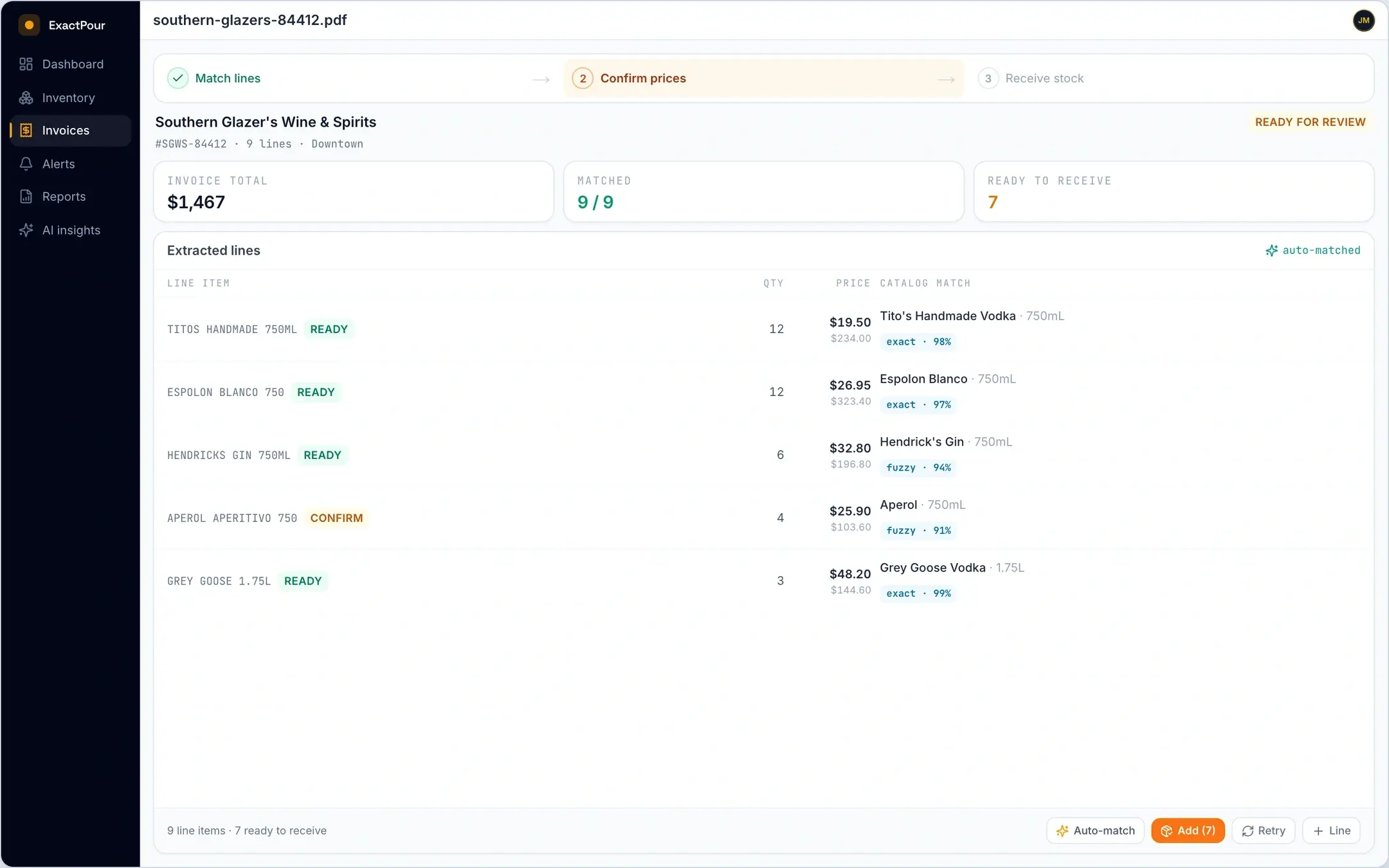
Make receiving the capture point. Whoever checks in the delivery uploads or photographs the invoice before it disappears into a folder. OCR and catalog matching turn that into structured lines; the price watchdog compares each to prior deliveries for the same SKU and supplier.
Check the physical delivery against the invoice before anyone signs. Shorted bottles, substituted sizes, and broken cases that get signed for anyway become two problems at once: you paid for product you do not have, and the next count shows a shortage nobody can explain. Note discrepancies on the driver copy, request the credit memo the same day, and log it against the original invoice so the delivered-price history stays honest.
A usable price history needs surprisingly few fields: supplier, product, pack size, number of units, delivered cost per unit, and the delivery date. Add the deal or post-off code when one applied, so a return to full price after a promotion does not read as a new increase. Whether you keep this in software or a spreadsheet, the discipline is identical, every delivery gets recorded, in the same units, from the invoice rather than from memory.
Watch for pack-size changes that disguise an increase. A brand that moves from a 1 L bottle to a 750 ml bottle at a similar invoice price has raised its real price without changing the headline number. Compare cost per milliliter when the size changes: a $30.00 liter works out to $0.030 per ml, while a $27.00 750 ml bottle works out to $0.036 per ml. The second bottle looks cheaper on the invoice and costs more in every drink you pour.
Annualize every flagged change. A small per-bottle bump times your order rate is the number that changes behavior. Sort the week's flags by annualized impact and ignore the noise at the bottom until the top of the list is handled.
To make annualizing concrete with clearly hypothetical numbers: suppose a well tequila moves from $18.00 to $19.50 per liter bottle. At a 44 ml pour, liquor cost per margarita goes from roughly $0.79 to $0.86. Seven cents sounds ignorable until you multiply it across every margarita, ranch water, and tequila soda on the menu for a year, and then add the other two or three flagged SKUs riding on the same delivery.
You have three honest responses. Negotiate with a twelve-month delivered-price history in hand. Substitute if a comparable brand did not move. Reprice affected drinks in small steps when the cost increase is real and market-wide. ExactPour connects the third path: flagged bottle costs flow into pour-cost math and pricing suggestions.
Prepare for the negotiation like you would prepare for a rent review. Bring the twelve-month delivered-price history for the SKUs in question, your monthly order volume, and a written quote from a competing distributor where your state allows one. Ask about quantity brackets, brand-family discounts, and the deal calendar. Reps have limited discretion, but a documented history moves the conversation from feelings to arithmetic, and it signals that quiet creep will be noticed next time too.
Substitution deserves a real test, not a swap on delivery day. Shortlist candidates in the same category and proof range, blind-taste them with the bar team in the highest-volume drink the SKU touches, and trial the winner for a few weeks while you watch sales mix and guest comments. Well pours are usually safe to substitute; call brands are riskier, because the guest ordered the label. Document the decision and the date so the next manager knows it was deliberate.
When repricing is the answer, work from the recipe map. List every drink that uses the flagged SKU, compute the new cost per drink, and rank by weekly margin impact. Correct the two or three drinks that matter, round to menu-friendly increments, and update the POS and the printed menu on the same day so pour-cost and variance reports keep telling the truth. The full pricing loop is covered in how to price a cocktail menu.
Not every increase deserves a fight. Seasonal citrus swings reverse. Allocation bottles carry premiums you accept. Across-the-board distributor adjustments hit every account. Tracking exists so you can tell those apart from quiet, compounding, account-specific creep.
Deals cut both ways. Buying deep on a post-off looks smart on the invoice and can be genuinely worth it on your highest-velocity well brands. But cases on a shelf are cash you cannot spend and product someone has to count, secure, and store. Weigh whether the discount beats the carrying cost and the theft exposure of a crowded storeroom, and do not let a deal push you into stocking a brand your menu does not actually pour.
Week-one habit: upload every invoice for fourteen days, review the top three annualized flags each Monday, and log the action (negotiate / substitute / reprice / accept). Companion page: bar invoice management.
ExactPour's invoice OCR and price watchdog automate the comparison; you keep the decision. The goal is not a spreadsheet hobby, it is answering cost increases the week they land instead of discovering them at menu-reprint time.
For how pricing and invoices fit the rest of beverage control, see bar inventory software and how to price a cocktail menu.
Worked example: a well vodka that moves 8 bottles a week jumps $0.40. That is about $166 a year on that SKU alone, before you count the cocktails built on it. Three similar movers in one delivery week is a real budget line, not noise.
Know your market's rules before you threaten to switch. In license states you can often shop the same brand across distributors; in control states and franchise states, brand-to-distributor relationships are fixed, and your leverage shifts toward substitution and repricing instead of negotiation. A quick conversation with neighboring operators about who they buy from, and at what bracket, is worth more than an afternoon of online research.
Assign an owner for receiving. If anyone on the floor can sign a delivery and the invoice vanishes, price creep becomes the default. Photograph the invoice in ExactPour before the driver leaves. Dispute windows are short.
Substitution has a guest cost. Switching a call brand to save a dollar can lose the regular who ordered it. Use pour-cost math to see whether a fifty-cent menu move is cheaper than a brand fight. Document the choice so next month's manager does not reverse it blindly.
Common failure modes: comparing case price to bottle price and flagging a phantom jump; missing a pack-size change and calling the brand flat; treating a post-off expiration as a fresh increase; letting invoices pile up for month-end entry so flags arrive weeks after the dispute window closed; and negotiating from memory instead of from a delivered-price history. None of these require a bad supplier, only a loose receiving habit.
Tariffs and distributor-wide adjustments hit everyone. Account-specific creep does not. NRA 2026 coverage noted operators seeing tariff-driven food and beverage cost pressure. Tracking exists so you can tell a market move from a quiet invoice bump. Related: bar invoice management.
Cadence recap: capture every invoice at the door, review flags weekly, negotiate or substitute quarterly, and reprice in small steps as real increases land. Price creep is not dramatic, which is exactly why it works. A receiving habit that takes a few moments per delivery keeps the response in the same week as the increase, and keeps menu economics a decision you make, not one that happens to you.
Put it into practice
See this on your bar
Run ExactPour for two weeks and turn this guide into real numbers in your own operation. Book a walkthrough if you want a live tour first.
Related
Operations
How often should a bar count inventory?
Operations
Bar inventory software ROI: a framework you can actually calculate
Solutions
Invoice management
Solutions
Pour cost control
Guides
How to calculate pour cost from current inventory data
Guides
How to count liquor inventory: a practical bar and retail workflow