
AI in bar management has moved past the hype cycle into tools that actually move margin. Here is what is real in 2026 and what is still vapor.
AI in bar management has moved past the hype cycle. In 2026, the useful applications are not chatbots that summarize your menu, they are tools that turn raw counts, invoices, and sales into actions a manager can take before the next shift. Here is what is actually working, what still needs a human, and how to evaluate vendors without drowning in buzzwords.
Start with a sober definition. AI in this context usually means machine learning or large language models applied to messy operational data: unstructured invoices, time series of depletion, text summaries of exceptions, and natural-language questions over a warehouse of sales and inventory facts. It is not magic autonomy. It is acceleration of analysis that used to take a spreadsheet afternoon.
Invoice OCR is one of the clearest wins. Supplier invoices are unstructured documents that take time to key in. Document-understanding models can extract line items for review and fuzzy-match them to a catalog, reducing manual entry while keeping a human confirmation step. The confirmation step matters: a misread unit size or credit memo can corrupt bottle cost and every pour-cost number downstream.
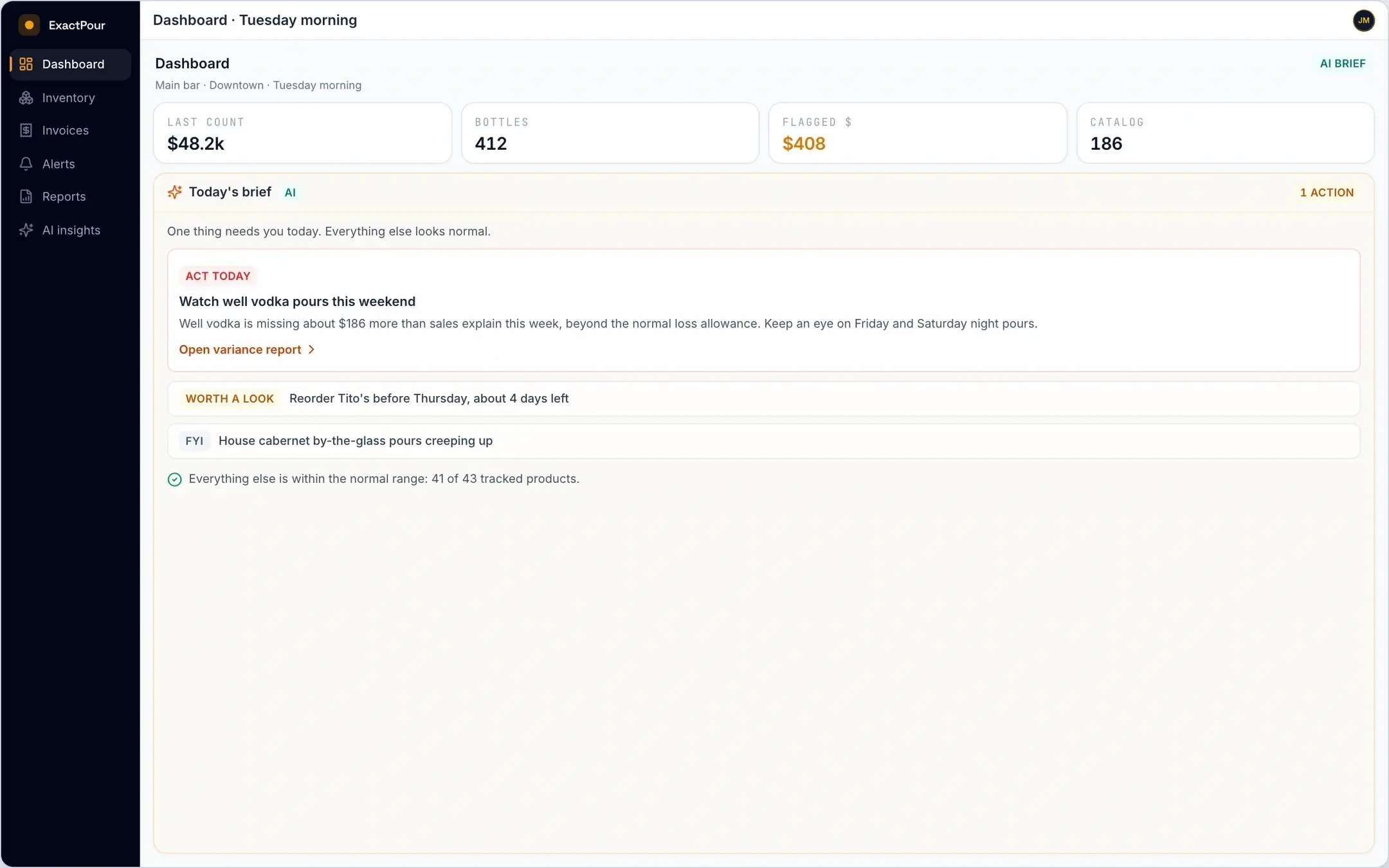
Daily briefs are the management-facing cousin of dashboards. An AI layer can read recent variance, sales, and counts and summarize prioritized issues in plain language: which products need attention, which locations drifted, which invoices changed cost. Treat the brief as a review queue, not as a assurance that every recommendation is correct. A good brief shortens time-to-notice; a manager still owns the decision.
Statistical anomaly detection earns its keep when volume is high. A single high-variance night might be noise. A product whose variance exceeds a threshold relative to its own baseline, for example, beyond two standard deviations across recent history, deserves a look. Computing that per product across weeks of history is repetitive analysis machines handle well and tired humans handle poorly at 2 a.m. after close.
Demand forecasting turns ordering from pure gut into a documented estimate. Models built on recent POS depletion per product can project per-day usage, a horizon total, an estimated run-out date, and a confidence band. The forecast will be wrong sometimes, new menus, weather, and events break patterns, but a wrong forecast you can see beats an invisible over-order that ties up cash in slow movers.
Conversational assistants are newly practical when they are grounded in your real numbers. Which product lost the most money last period? Which shift shows the highest variance? What changed in vodka cost after the last invoice? The assistant does the query work so you do not have to build a custom report for every question. Guardrails matter: the model should retrieve from your data, not invent industry statistics.
What is still vapor: fully autonomous 'set and forget' AI that runs a bar without a human. Even advanced agent-style workflows are best understood as a 24/7 analyst that surfaces insights and routes alerts, not a replacement for the manager who coaches pouring, disputes a delivery, or decides whether to cut a SKU. Anyone selling a bar that manages itself is selling a future that is not operational reality in 2026.
Data quality remains the limiting reagent. AI cannot fix a catalog where the same vodka exists under three names, recipes that do not match the menu, or counts that skip the walk-in. Before you buy an intelligence layer, fix the basics described in ExactPour's bar inventory software guide at bar inventory software: one product list, consistent units, a count cadence you keep, and POS mappings you trust.
Privacy and tenancy are not optional footnotes. Beverage inventory and sales data are competitive and operationally sensitive. Ask how tenant isolation is enforced, who can see cross-location rollups, whether prompts and documents are used to train external models, and how long invoice images are retained. Serious operators should prefer systems that treat isolation as a default, not a premium checkbox.
Evaluation criteria that hold up in demos: can the AI show its sources (which count, which invoice line, which sales window)? Can a human correct a bad extraction and have the correction stick? Does anomaly detection use your baselines or a generic threshold? Does the assistant refuse questions it cannot answer from your data? Fancy prose without provenance is a liability.
A realistic rollout sequence looks like this. Stabilize counting and POS reconciliation first. Turn on invoice OCR with mandatory review. Enable anomaly flags on a small set of high-value SKUs. Add daily briefs once the flags are trustworthy. Introduce forecasting for ordering after several clean cycles. Conversational query comes last, when the underlying facts are solid enough that answers help instead of confuse.
Team change management matters as much as model quality. If AI briefs feel like surveillance, staff will game counts. If they feel like shared operational clarity, here is what looked odd, help us explain it, adoption improves. Train managers to ask 'what process failed?' before 'who is guilty?'
ExactPour includes the workflows described above: invoice OCR with human confirmation, variance and anomaly surfaces, forecasting inputs tied to depletion, and plain-language briefs grounded in your tenant data. The product goal is not to replace bar leadership. It is to compress the time between a leak appearing in the data and a human deciding what to do about it.
When you compare vendors, ignore vague claims about artificial intelligence transforming hospitality. Ask for a walkthrough on your own invoice PDF, your own top twenty SKUs, and a sample variance week. Read bar inventory software for the non-AI foundations that make any intelligence layer useful. The best AI feature in the world is still only as good as the count and the recipe behind it.
In 2026, the operators who win with AI are the ones who treat it as infrastructure for attention: less time typing invoices, less time hunting for the outlier SKU, more time coaching service and fixing process. That is less glamorous than autonomous bars, and far more valuable on a Tuesday morning before the first ticket fires.
Prompt hygiene is an operational skill now. Managers should ask specific questions with time bounds and location filters: last seven days, main bar only, products over a dollar threshold. Vague prompts produce vague answers that feel insightful and change nothing. Train the same specificity you would demand from a human analyst writing a weekly note.
Model updates will keep coming; your evaluation checklist should stay stable. Provenance, correction paths, tenant isolation, and measurable time saved on a real weekly workflow matter more than which foundation model a vendor names in a press release. If a new feature cannot show where a number came from, keep it off the critical path until it can.
Human-in-the-loop design is not a temporary compromise. Invoice confirmation, reason-code assignment, and coaching conversations are where judgment lives. The best AI features shorten the queue into those moments. Features that skip them tend to create confident mistakes at scale, especially on cost and variance, where a wrong unit quietly multiplies across every drink.
Benchmarking across locations with AI summaries can help beverage directors spot outliers, but only with careful normalization. Different concepts, price points, and event calendars produce different baselines. An assistant that ranks outlets by variance percentage without context can start unhelpful political fights. Prefer questions like which outlets improved after a process change, not which manager is worst this week.
ExactPour's bet is that AI earns trust when it is boringly grounded: your invoices, your counts, your sales, your exceptions. Pair that with the non-AI foundations in bar inventory software and you get a stack where intelligence amplifies a clean process instead of decorating a messy one. That is the 2026 standard worth holding vendors to, including us.
Document which AI outputs are allowed to trigger automatic pages or Slack alerts versus which stay in a morning digest. Alert fatigue will kill a good anomaly model faster than a bad model dies. Start with digests; promote only the highest-confidence, highest-dollar patterns to real-time interrupts after you have watched them for several weeks.
Keep a lightweight error log for AI mistakes you catch: wrong invoice unit, bad product match, brief that blamed the wrong outlet. Review it monthly with the vendor or your internal owner. Models and prompts improve when failures are specific. Vague disappointment ('AI is useless') does not.
Remember that guests and staff experience the bar, not the model. If AI-driven coaching makes service worse, tighter pours that feel stingy, or managers buried in alerts, recalibrate. The ROI of intelligence is measured in healthier margin and saner mornings, not in the number of tokens your software burned overnight. Ground that recalibration in the same operational basics described at bar inventory software.
A practical quarterly AI review for a beverage team: which briefs were acted on, which were ignored, which invoice corrections were most common, and whether anomaly flags correlated with real process fixes. Keep the review on one page. If you cannot fill that page with specifics, the AI layer is entertainment, not infrastructure, and you should either improve grounding or turn features off until the count and recipe foundation is ready.
Put it into practice
See this on your bar
Run ExactPour for two weeks and turn this guide into real numbers in your own operation. Book a walkthrough if you want a live tour first.
Related
Product
ExactPour features
ExactPour
Bar analytics & pour cost
Guides
How to count liquor inventory: a practical bar and retail workflow
Guides
How to calculate pour cost from current inventory data
Variance
Bar variance explained: the gap that's draining your margin
Operations
How often should a bar count inventory?